Bill Gates' Foundation pledges $1 billion to expand AI in health, education, agriculture
Bill Gates' philanthropic arm, the Gates Foundation, announced a commitment of at least $1 billion over the next two years to broaden access to artificial‑intelligence tools in three critical sectors: health, education, and agriculture. The funding will target real‑world pilots, such as AI‑assisted diagnostics in Kenyan clinics, a guided‑learning platform in Sierra Leone, and a low‑cost digital…
Key points
- The Gates Foundation will invest at least $1 billion over two years in AI tools for health, education, and agriculture.
- Projects include AI diagnostic assistants in Kenya, a learning platform in Sierra Leone, and a digital farming advisory reaching 740,000 Indian farmers.
- Gates warns that over 90% of LLM training data is English, leaving seven billion non‑English speakers underserved.
Gates warns that the current AI landscape is heavily skewed toward English, with more than 90% of training data in that language, leaving the majority of the world—about seven billion people—underserved. By investing in non‑English data sources and multilingual model development, the foundation hopes to prevent AI from deepening existing economic and knowledge gaps, positioning the technology as a global equalizer rather than a privilege for the affluent.
The initiative is part of a broader, decades‑long plan for the Gates Foundation to spend roughly $200 billion before its 2045 wind‑down, representing nearly the entirety of Bill Gates' remaining fortune. The effort underscores a shift from highlighting AI risks to actively shaping its equitable deployment through targeted funding and policy influence.
After warning AI is too dangerous, Bill Gates bets a billion on its upside
The Decoder · 15 September 2026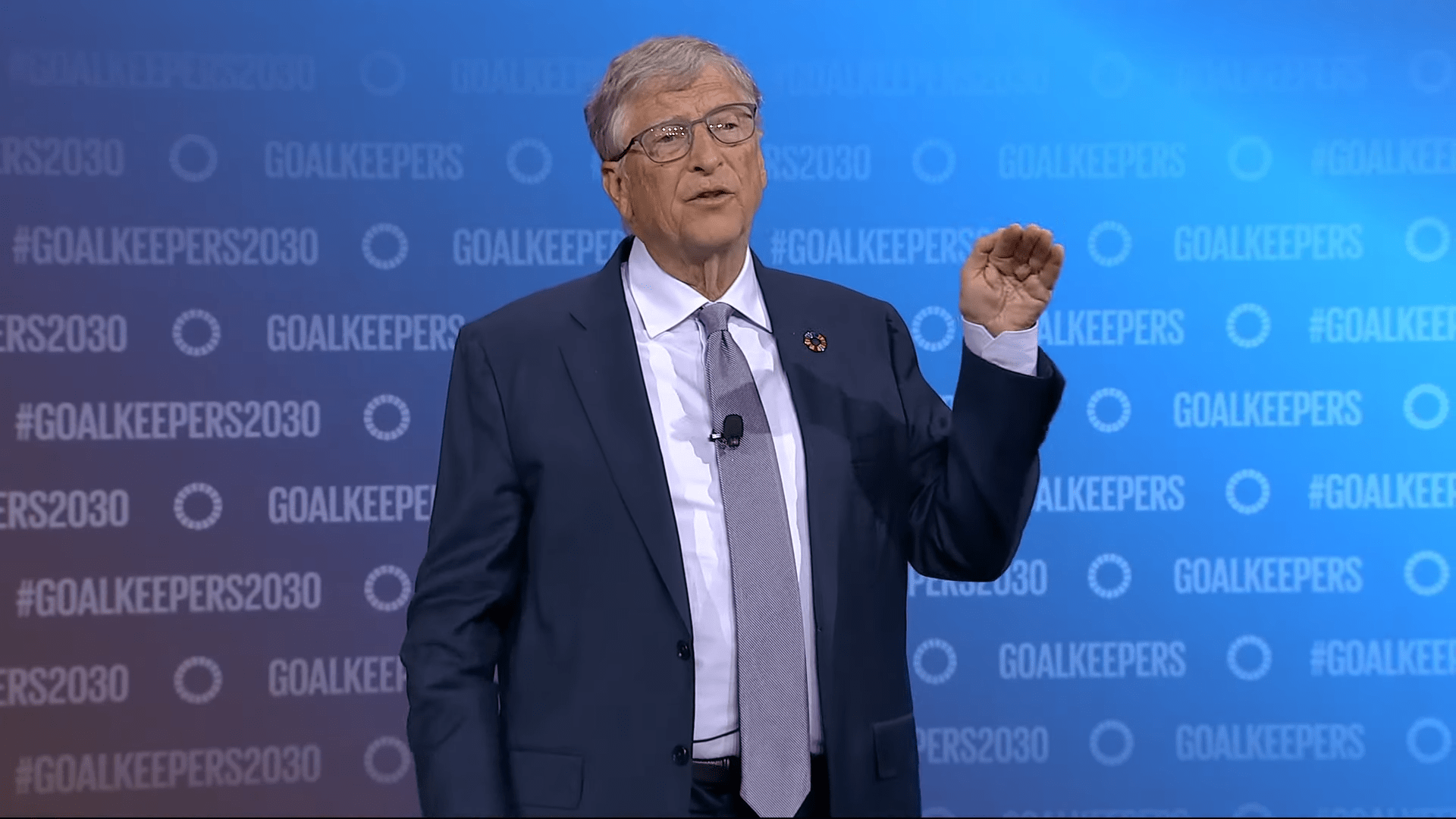
After warning AI is too dangerous, Bill Gates bets a billion on its upside
Key Points
- The Gates Foundation is investing at least a billion dollars over two years to make AI tools more widely available in health, education, and agriculture.
- Bill Gates warns of a growing gap between rich and poor, since common language models are built on more than 90 percent English data and neglect poorer regions.
- The money will go toward opening up non-English data sources and funding real-world projects, including diagnostic aids in Kenya, learning systems in Sierra Leone, and digital farming advice in India.
The Gates Foundation plans to spend at least a billion dollars over the next two years to widen access to AI in health, education, and agriculture. Bill Gates warns that without it, the technology will only deepen the gap between rich and poor.
The Gates Foundation plans to spend at least a billion dollars over the next two years on better access to artificial intelligence. Co-founder Bill Gates says he's worried that AI could widen the global gap between rich and poor, depending on how it spreads.
"AI could be a great equalizer - or widen the gap," Gates writes in the foundation's 2026 Goalkeepers report. "This is not a long-range prediction. It's a present-tense choice." He points to the possibility that AI, "if shaped well, could expand who has access to solutions, opportunities, and knowledge that has too often been out of reach."
The next year and a half will decide which way things go, Gates argues. "I believe that the decisions made in the next 12 to 18 months - about how AI is built, funded, and deployed - will determine whether this technology primarily benefits the people who already have the most or reaches those who have the least."
The money will go toward tools for workers in education, health care, and farming, Gates says. Part of it is set aside to fold non-English sources into large datasets, so developers can work in other languages too.
Why language is the biggest gap in today's models
Gates makes language the core of his argument: More than 90 percent of the data used to train early large language models came from English sources. That leaves the very people who could gain the most from AI barely represented in what these systems know. For about a billion mostly English-speaking users, AI gets better every month. For the other seven billion, nothing moves.
In English, the error rate for leading speech recognition systems sits below 6 percent. In Yoruba, a West African language, the same system fails more than 60 percent of the time. A bad translation can mean the difference between life and death in a medical emergency, he argues.
The market won't fix this on its own, Gates argues. It's "an extraordinary engine of innovation, but a terrible guarantor of equal opportunity." Leave development to the market, and the most capable tools get built first for the people who can pay.
Pilot projects meant to prove the case
The report cites several projects already running that are meant to back this approach. At clinics in Kenya's Penda Health network, an AI assistant helps medical staff with diagnosis and drug dosing, and diagnostic accuracy has risen by 16 percentage points. In Sierra Leone, students using the Gemini Guided Learning tool made learning gains of up to 1.7 years in an eight-week pilot. India's MahaVISTAAR AI advisory service for farmers already reaches more than 740,000 people and costs the government less than 18 cents per person.
The billion dollars is part of a much larger plan. The Gates Foundation aims to spend around 200 billion dollars before it shuts down in 2045, which Bloomberg says amounts to 99 percent of Gates' remaining fortune.
Not long ago, Gates struck a far darker tone in an essay of nearly 6,000 words, accusing the tech industry of knowingly downplaying the technology's risks because too much money is on the line. He named lasting job losses, the misuse of AI to build bioweapons, and the psychological toll of always-available AI companions as real dangers. The Goalkeepers report now shows the other side of that argument, with Gates presenting the same technology as an enormous promise, as long as its benefits are won through policy rather than left to chance.
This text was published by The Decoder and written by Maximilian Schreiner. It is reproduced here with attribution so you can read it in full; the rights remain with the publisher. Read it at the source ↗
The headline, key points and digest above were generated by Digest AI's editorial model from the linked sources. Automated summaries can contain errors: the sources are the record. Spotted a mistake? Tell us.
More in Policy & Regulation
All →- Anthropic: Claude used by state and criminal groups for cyberattacks and surveillance · 20 src
- Anthropic CEO urges government oversight as company eyes IPO · 20 src
- Critics label Big AI's proposed development slowdown a market lockout strategy · 2 src
- Google, OpenAI, Anthropic Discuss Industry AI Safety Standards Body · 13 src
- UK settlement rule overhaul threatens AI talent retention · 1 src
Comments
via GitHub Discussions