InOrbit launches OpenRobOps, first ISO 21423 reference implementation for robot fleets
InOrbit Inc., a Mountain View‑based leader in enterprise robot orchestration, announced OpenRobOps (ORO), an open‑source fleet‑management platform that implements the upcoming ISO 21423 standard for industrial mobile robots. The software provides a production‑grade foundation—high‑throughput telemetry, real‑time spatial tracking, configuration‑as‑code, automated incident remediation, and native…
Key points
- OpenRobOps is the first open‑source reference implementation of ISO 21423 for industrial mobile robot fleets.
- The platform offers telemetry ingest, real‑time mapping, configuration‑as‑code, and automated incident remediation in a hybrid edge‑to‑cloud architecture.
- Released under Apache 2.0, OpenRobOps is free for researchers, startups, and enterprises, aiming to standardise fleet management.
The release follows a public demo at Automate 2026 where multiple vendors showcased multi‑fleet coordination using InOrbit’s Space Intelligence platform. Executives liken OpenRobOps to the impact ROS had on robotics software, emphasizing its role in standardising operations and reducing duplicated effort. Distributed under the Apache 2.0 license, the project is freely available for academic, startup, and enterprise use, and supports edge‑to‑cloud, on‑premise, and air‑gapped deployments.
OpenRobOps also marks InOrbit’s contribution to the ISO working group, with its founder Florian Pestoni serving as the U.S. ANSI representative. By delivering the first reference implementation of ISO 21423, the company aims to accelerate adoption of interoperable robot fleets across manufacturing, logistics, and other sectors.
InOrbit.AI releases OpenRobOps ISO 21423 reference implementation
The Robot Report · 15 September 2026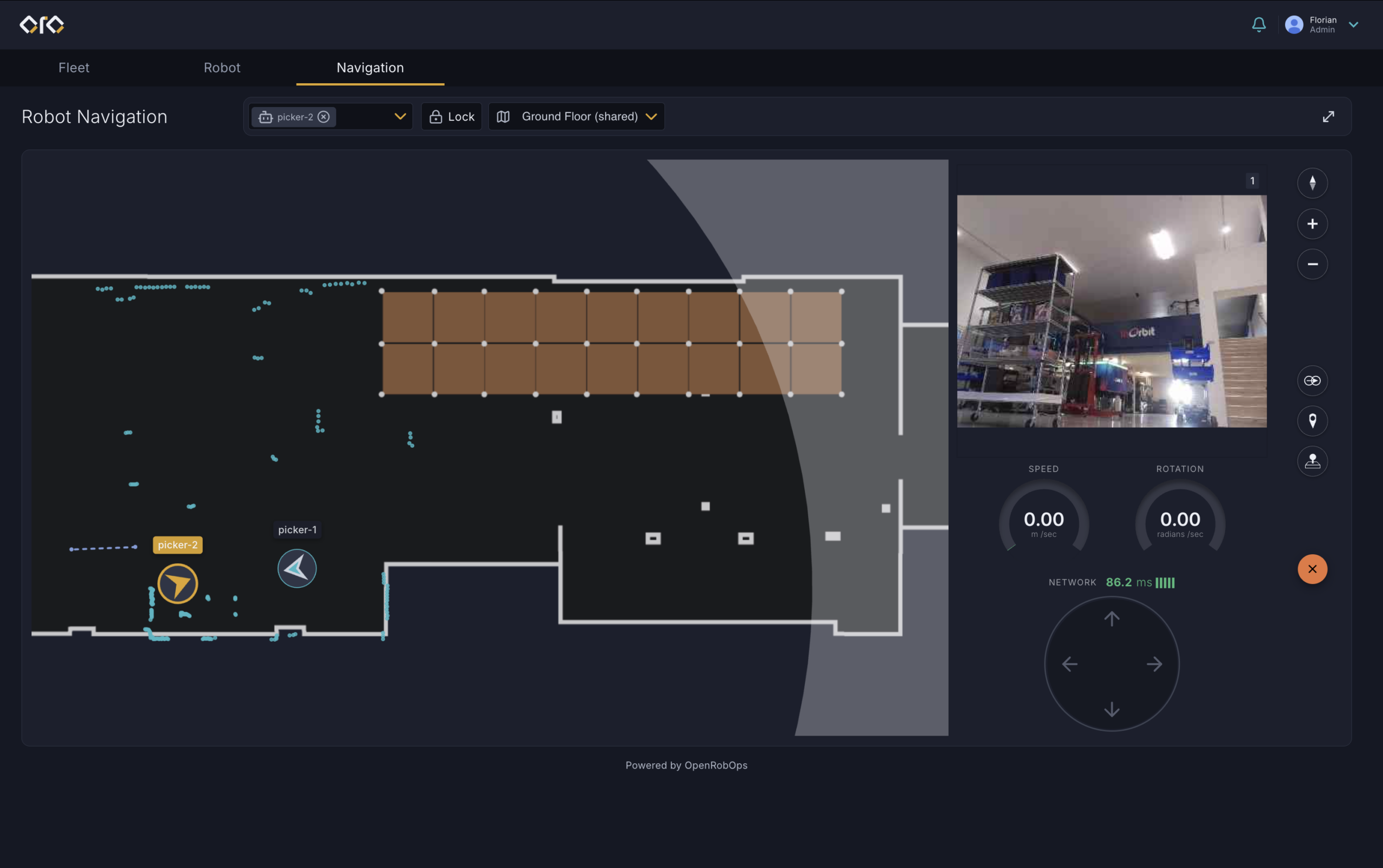
Orchestrating fleets of mobile robots could be getting easier. InOrbit Inc. has been working to make the core operations layer of its software more accessible to developers. The company today released OpenRobOps, which it described as “an open-source robot operations and fleet management software designed to support scaled deployments.”
“OpenRobOps gives robotics developers a production-grade, open-source foundation to escape the build trap, delivering the industry’s first ISO 21423 reference implementation and bridging the interoperability gap,” asserted Florian Pestoni, founder and CEO of InOrbit.AI.
Founded in 2017, InOrbit said it is a leader in enterprise robot orchestration software and spatial intelligence. The Mountain View, Calif.-based company claimed that it pioneered federated orchestration, enabling organizations running heterogeneous fleets to bridge the gap between business intent and physical execution.
Editor’s note: RobOpsCon will follow RoboBusiness 2026.
InOrbit offers OpenRobOps as fleet operations foundation
As fleets of autonomous mobile robots (AMRs) grow, customers increasingly expect equipment manufacturers (OEMs) to provide full-featured fleet managers with common functionality. According to Pestoni, many OEMs fall into the “build trap,” spending years developing and maintaining custom back ends, databases, and user interfaces instead of focusing on their core innovations.
After initially announcing OpenRobOps or ORO in February, InOrbit said the offering is a “standards-compliant foundation for fleet operations, as a contribution to the global robotics community.” It provides a production-grade open foundation, allowing developers to shift their focus from recreating basic fleet management functionality to building and deploying useful robots, said the company.
“By providing a production-grade operations foundation out of the box, OpenRobOps allows teams to bypass years of back-end development,” said InOrbit. It listed key features, including:
- High-throughput telemetry ingest provides a bandwidth-efficient pipeline designed for unreliable networks, ensuring minimal overhead for vitals and hardware diagnostics
- Real-time spatial tracking to enable interactive mapping, live camera visualization, and teleoperation with an exclusive robot-locking mechanism for safe manual intervention
- Configuration as code (CaC) allows teams to manage telemetry sources, metrics, and alert rules within Git CI/CD workflows
- Automated incident remediation performs continuous evaluation that detects anomalies, executes autonomous recovery, or escalates issues to human operators
- Edge-to-cloud hybrid architecture offering flexible deployment options to run fully on-premises, air-gapped at theedge, or securely bridged to enterprise clouds
- Native Open-RMF interoperability includes built-in adapters connecting physical and simulated fleets into Open-RMF multi-fleet traffic systems
The Robot Report. “This release levels the playing field, allowing more companies to offer complete offerings based on a proven technology.”
ORO supports upcoming ISO interoperability standard
InOrbit added that OpenRobOps includes a reference implementation of an upcoming interoperability standard from the International Organization for Standardization (ISO). The ISO 21423 specification establishes the communication and data exchange standard for industrial mobile robots (IMRs) and fleet managers (IMRFMs).
By providing native ISO 21423 support, OpenRobOps helps OEMs to build systems that comply with the new standard.
“Working with leading enterprises in manufacturing, logistics and other industries, I have seen firsthand that federated orchestration is essential to scaling automation,” said Pestoni, who serves as a member of the ISO working group and representative for ANSI, the U.S. national body.
“I’m proud of the collaborative work that led to this landmark international interoperability standard,” he added. “With OpenRobOps, we are helping take this from theory to market practice.”
Cousins compares ORO to ROS
At Automate 2026, 10 different companies participated in demonstration of multi-vendor orchestration based on InOrbit Space Intelligence, InOrbit.AI’s flagship product. This was the first public demonstration of ISO 21423.
OpenRobOps brings the technology powering those demonstrations to the open-source robotics community. InOrbit compared the contribution to the introduction of the Robot Operating System (ROS), which acted as a catalyst for robotics development, saving researchers and engineers countless hours of rewriting low-level code from scratch and bringing together a strong developer community.
“When we created ROS, our mission was to give roboticists an open ecosystem so they could stop re-inventing basic device drivers,” said Steve Cousins, executive director of the Stanford Robotics Center, member of the InOrbit.AI board of directors, and former CEO of Willow Garage.
“OpenRobOps creates the same shift for robot operations and fleet management, while also enabling standards-based interoperability,” he said.
OpenRobOps is distributed under the Apache 2.0 license, allowing academic researchers, robotics startups, and commercial enterprises to adapt, embed, and deploy the software without licensing fees. InOrbit invited interested parties to visit ORO’s website to learn more, access the software, and review deployment documentation.
This text was published by The Robot Report and written by The Robot Report Staff. It is reproduced here with attribution so you can read it in full; the rights remain with the publisher. Read it at the source ↗
The headline, key points and digest above were generated by Digest AI's editorial model from the linked sources. Automated summaries can contain errors: the sources are the record. Spotted a mistake? Tell us.
More in Robotics & Physical AI
All →- Writer Tests $4,000 Unitree Robot Dog in Washington, D.C., Finds Limited Practical Use · 1 src
- Monumental builds bricklaying robot fleet to tackle construction labor shortage · 2 src
- Tesla Cybercab faces regulatory scrutiny after early Austin ride quirks · 1 src
- Vision AI becomes critical safety layer for mixed human-robot construction sites · 1 src
- Humanoid Robots Face Hardware Limits · 1 src
Comments
via GitHub Discussions