Nvidia’s Earth-2: Simulating Weather for Cities and Climate Resilience
Nvidia, founded by Jensen Huang, is developing Earth-2, a platform that combines AI with GPU computing to simulate weather conditions at high resolution. This digital twin of the planet can generate global forecasts, downscale atmospheric information, and model hazardous weather events like floods and storms. Earth-2 has already produced simulations covering hundreds of years of hypothetical…
Key points
- Nvidia's Earth-2 combines AI, physics, and planetary-scale data for high-resolution weather simulations.
- Earth-2 Medium Range produces forecasts for over 70 variables over 15 days.
- Nowcasting uses satellite and radar information to model clouds and rainfall over six hours.
Jensen Huang's Nvidia is building a digital twin of Earth; AI could help cities simulate floods, storms and future climate risks
bing.com · 14 September 2026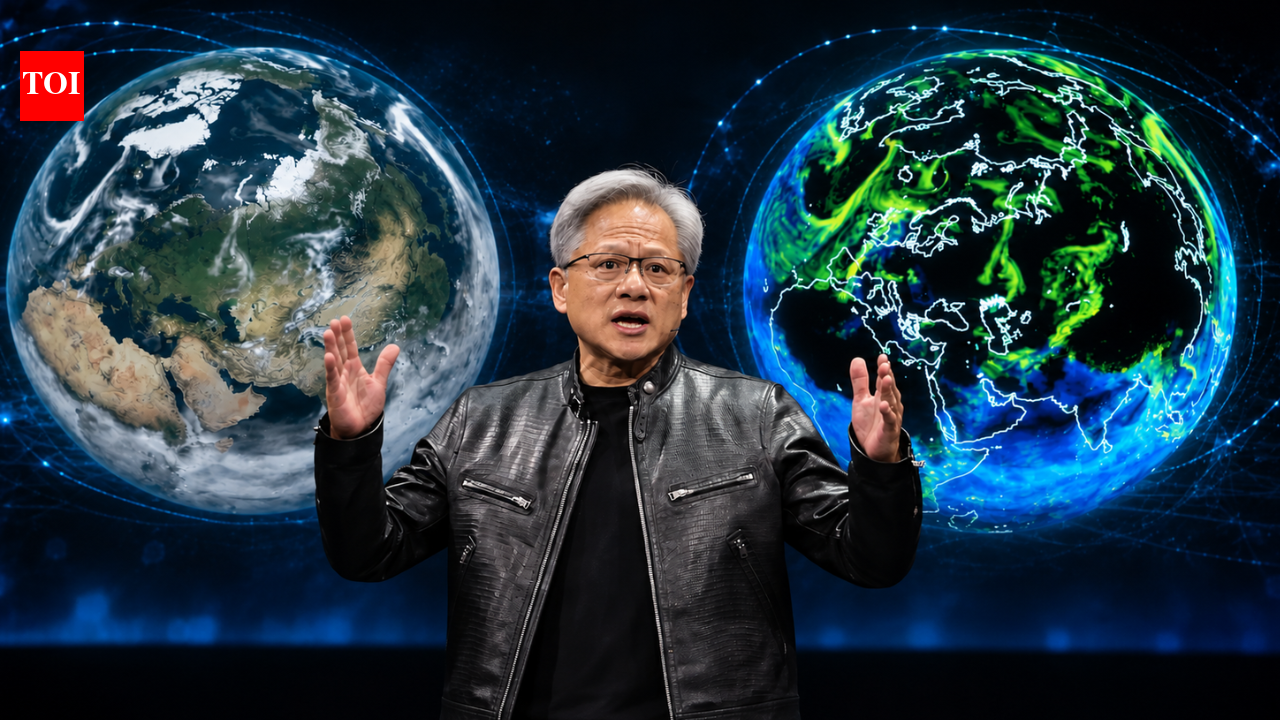
Nvidia, founded and led by Jensen Huang, is developing Earth-2, an AI-powered platform designed to simulate and visualise weather and climate conditions at increasingly high resolution. The project combines artificial intelligence, GPU computing, physical simulations and geospatial visualisation to create a digital twin of the planet. Its models can generate global forecasts, downscale atmospheric information to much finer scales and simulate the development of hazardous weather. The technology is moving beyond conventional forecasting into applications such as flood-risk assessment, storm modelling and climate resilience planning. Nvidia's work with weather agencies, climate researchers and risk-modelling companies has already produced simulations covering hundreds of years of hypothetical atmospheric conditions, showing how AI-generated scenarios could help cities and infrastructure planners examine extreme events that are poorly represented in historical records.Nvidia’s Earth-2 combines AI, physics and planetary-scale dataEarth-2 began as Nvidia's effort to use its accelerated computing technology to make high-resolution climate simulation more accessible. The company formally announced its Earth-2 climate digital-twin cloud platform in 2024, describing it as a system for simulating and visualising weather and climate from the global atmosphere down to local phenomena such as cloud cover, typhoons and turbulence. Its present architecture brings together AI models, GPU-accelerated physical simulations, observational data and visualisation tools rather than relying on a single forecasting model. Nvidia's Earth-2 research programme covers several parts of the Earth-system modelling process, including atmospheric-state estimation, generative data assimilation, high-resolution weather simulation and hybrid physics-AI modelling. The platform also incorporates simulations from established systems including ICON, WRF and PALM and can combine them with geospatial data for city-scale visualisation.The system is now organised around a growing family of AI models. Earth-2 Medium Range, based on the Atlas architecture, is designed to produce forecasts for more than 70 weather variables for up to 15 days. Earth-2 Nowcasting uses satellite and radar information to model the development of clouds and rainfall over periods of up to six hours. Earth-2 Global Data Assimilation generates initial atmospheric conditions from observations, while FourCastNet 3 provides AI-based global forecasting. CorrDiff performs high-resolution downscaling, converting coarser atmospheric information into much finer weather fields. Nvidia describes these components as an open software stack intended to cover the forecasting pipeline from processing observations through to local and global prediction and visualisation.AI can turn coarse global forecasts into local weather informationOne of Earth-2's most important functions is downscaling. Global weather models divide the atmosphere into relatively large grid cells, while decisions made by cities, utilities and emergency agencies often require information at much smaller scales. Nvidia's CorrDiff model uses generative AI to create higher-resolution weather information from lower-resolution inputs. The current Earth-2 platform says CorrDiff can perform this process up to 500 times faster, with Nvidia reporting a 10,000-fold improvement in energy efficiency for its current comparison. The earlier version announced in 2024 was reported as producing 12.5-times higher-resolution outputs than the numerical model used in the comparison, while operating 1,000 times faster and 3,000 times more energy efficiently.StormCast takes this approach into the storm-scale environment. Developed as a generative diffusion model, it was designed to emulate NOAA's 3-kilometre High-Resolution Rapid Refresh model and predict 99 atmospheric state variables at kilometre-scale resolution using hourly steps. Nvidia researchers reported that StormCast reproduced important features of convective weather, including evolving storm clusters, moist updrafts and cold-pool structures, while achieving competitive one- to six-hour forecast skill for composite radar reflectivity. The research describes the approach as a potential route towards kilometre-scale regional weather prediction and high-resolution climate-hazard downscaling.This global-to-local capability is central to the urban application of Earth-2. Nvidia has demonstrated a workflow in which high-resolution atmospheric simulations are combined with 3D geospatial information, allowing weather data to be viewed in an urban environment. The company says its planetary digital-twin platform can incorporate city-scale simulation data and visualise it alongside detailed geographic information, creating a route from global atmospheric conditions to local assessments of weather and climate hazards.Elbe flood simulations show how cities could test extreme scenariosThe clearest example of Earth-2 being connected to an actual climate-risk application comes from JBA Risk Management's work on the Elbe River basin in Europe. JBA used Earth-2 to build a large ensemble of hypothetical winter-weather scenarios and then passed the AI-generated atmospheric data through a hydrological modelling system to examine the resulting river and flood behaviour. The project produced a 1,008-member ensemble representing 300 years of atmospheric data, generated in about 110 GPU hours on NVIDIA L40S GPUs. The simulations covered the winter of 2023–24 and allowed researchers to examine alternative weather conditions that could have occurred during the same period.The downstream hydrological modelling converted those atmospheric scenarios into river-flow and flooding outcomes. JBA then combined the results with catastrophe-risk modelling and population-density information to examine the potential consequences at high resolution. Some of the simulated scenarios produced population impacts up to three times higher than those associated with the actual 2023–24 Elbe floods, while maximum river-flow rates in major cities exceeded historical values by 50%. The significance is that AI-generated weather ensembles can create a much larger library of plausible extreme events than a short historical record can provide, allowing flood-risk models to examine the range of outcomes rather than relying only on events that have already occurred.The same Earth-2 ecosystem is also being applied directly to flood modelling. A collaboration involving BRLi and Toulouse INP used NVIDIA's PhysicsNeMo tools to train an AI model to emulate a physics-based flood solver for the Têt River basin in southern France. The basin model incorporated detailed features such as bridges, dikes and water-retention structures. The resulting neural-network model produced a six-hour flood prediction in about 19 milliseconds on a single NVIDIA A100 GPU, creating the possibility of running large ensembles rapidly for uncertainty analysis and flood-risk studies.Earth-2 is moving from weather forecasts towards climate simulationThe project is also expanding beyond short-range weather prediction. Nvidia's Climate in a Bottle, or cBottle, is a generative foundation model designed to simulate atmospheric states at kilometre-scale resolution. Nvidia developed it with collaborators including the Allen Institute for AI, and says the model can be used within Earth-2 to generate and explore possible climate scenarios and local extreme-weather conditions such as intense rainfall and hot, dry winds associated with wildfire risk. The model is intended to make high-resolution climate simulations faster and less computationally demanding, while enabling researchers to interactively examine possible atmospheric states.Nvidia's Earth-2 work is also being connected to conventional Earth-system modelling. The company's climate research programme focuses on combining AI with physical models, while Earth-2's visualisation environment is built to aggregate large-scale climate simulations and geospatial datasets. This approach allows researchers to use AI for tasks such as forecasting, downscaling and data generation while retaining physical simulations for processes that require explicit representation of the Earth system.The broader Earth-2 model family announced by Nvidia in 2026 represents a further shift towards an end-to-end AI weather system. Nvidia describes it as an open collection of models, libraries and frameworks covering observational data processing, atmospheric initialisation, global forecasting, local nowcasting, high-resolution downscaling and visualisation. The company's stated objective is to make these capabilities available to researchers, governments and developers who can run and adapt the models on their own infrastructure.From simulated storms to decisions about future climate riskThe potential value of Earth-2 lies in connecting atmospheric simulation to the physical consequences of extreme weather. A city could use high-resolution rainfall scenarios as inputs for hydrological models, examine how rivers and drainage systems respond, identify areas exposed to different flood levels and compare the consequences of alternative infrastructure decisions. Similar workflows could examine extreme heat, wind, precipitation and other hazards, while energy companies could use detailed weather scenarios to assess renewable generation and grid conditions. Nvidia's Earth-2 platform specifically positions these applications around energy, safety and infrastructure, with its visualisation tools designed to connect planetary-scale climate information with local environments.The ability to generate large ensembles is particularly significant for climate-risk planning. Historical observations provide only a limited sample of rare disasters, whereas synthetic scenarios can explore combinations of atmospheric conditions that have not occurred within the available record. The Elbe project illustrates this approach by generating hundreds of years of hypothetical atmospheric conditions and feeding them into flood models. Such datasets can help insurers, infrastructure operators and governments investigate tail risks, estimate the consequences of extreme events and assess how resilience measures perform across different scenarios.The scientific development is taking place alongside broader efforts to integrate AI into weather and climate modelling. The European Centre for Medium-Range Weather Forecasts has found that AI-based forecasting has advanced rapidly, while research into future-climate applications is examining how models trained largely on present-day atmospheric data behave under substantially warmer conditions. Tests of several AI weather models have identified biases when they are applied to climate states different from those represented in their training data, reinforcing the importance of developing systems capable of handling changing atmospheric conditions.Get the latest technology news and updates. Download the TOI App.
This text was published by bing.com and written by TOI Tech Desk. It is reproduced here with attribution so you can read it in full; the rights remain with the publisher. Read it at the source ↗
The headline, key points and digest above were generated by Digest AI's editorial model from the linked sources. Automated summaries can contain errors: the sources are the record. Spotted a mistake? Tell us.
More in Generative AI & Models
All →- scTransMIL links single-cell transcriptomics to patient cancer phenotypes · 1 src
- AI Beats Human Excel Champions · 1 src
- LLaMa Adds Maple 20B-A1B MoE Architecture with Ternary Quantization · 1 src
- Drug Companies’ Data Boosts AI Protein Models · 1 src
- DeepSeek-V4.1-Flash: A Cheaper AI Model for Long-Running Agents · 1 src
Comments
via GitHub Discussions