Fujitsu Launches 2nm MONAKA CPU and Sovereign AI Server for Secure Inference
Fujitsu has announced the global launch of its FUJITSU-MONAKA CPU and the associated MONAKA Server, positioning them as critical infrastructure for sovereign AI. Starting in November 2026, the 2nm processor will be available to cloud operators and server vendors worldwide, while the fully Japanese-manufactured server will target data centers, enterprises, and defense sectors in Japan and Europe.…
Key points
- FUJITSU-MONAKA CPU uses 2nm process and 3D-stacked architecture to double AI inference throughput.
- MONAKA Server is manufactured in Japan to ensure supply chain transparency and national security compliance.
- Systems support confidential computing via Arm CCA and operate efficiently without specialized cooling infrastructure.
The MONAKA CPU utilizes a 3D-stacked architecture combining 2nm core technology with 5nm cache and I/O sections, achieving a 3.8GHz clock speed and 8800MT/s memory transfer rates. By incorporating dedicated hardware acceleration for matrix operations and SVE2 vector instructions, Fujitsu claims the processor doubles AI inference throughput compared to competitors. This efficiency reportedly halves the number of servers and power consumption required for equivalent workloads, enabling practical on-premises AI inference even in locations lacking specialized cooling infrastructure.
The server lineup includes 1U and 2U rack-mount models equipped with CDI/CXL technology to mitigate memory constraints. Manufactured at Fujitsu’s Kasashima Plant, the systems emphasize supply chain transparency and support confidential computing via Arm CCA. Fujitsu plans to integrate these servers with its Kozuchi AI platform and Takane generative AI tools, creating a vertically integrated sovereign AI stack for financial, telecommunications, and manufacturing industries.
Fujitsu Unveils 2Nm FUJITSU-MONAKA CPU and Sovereign AI Server
Unite.AI · 14 September 2026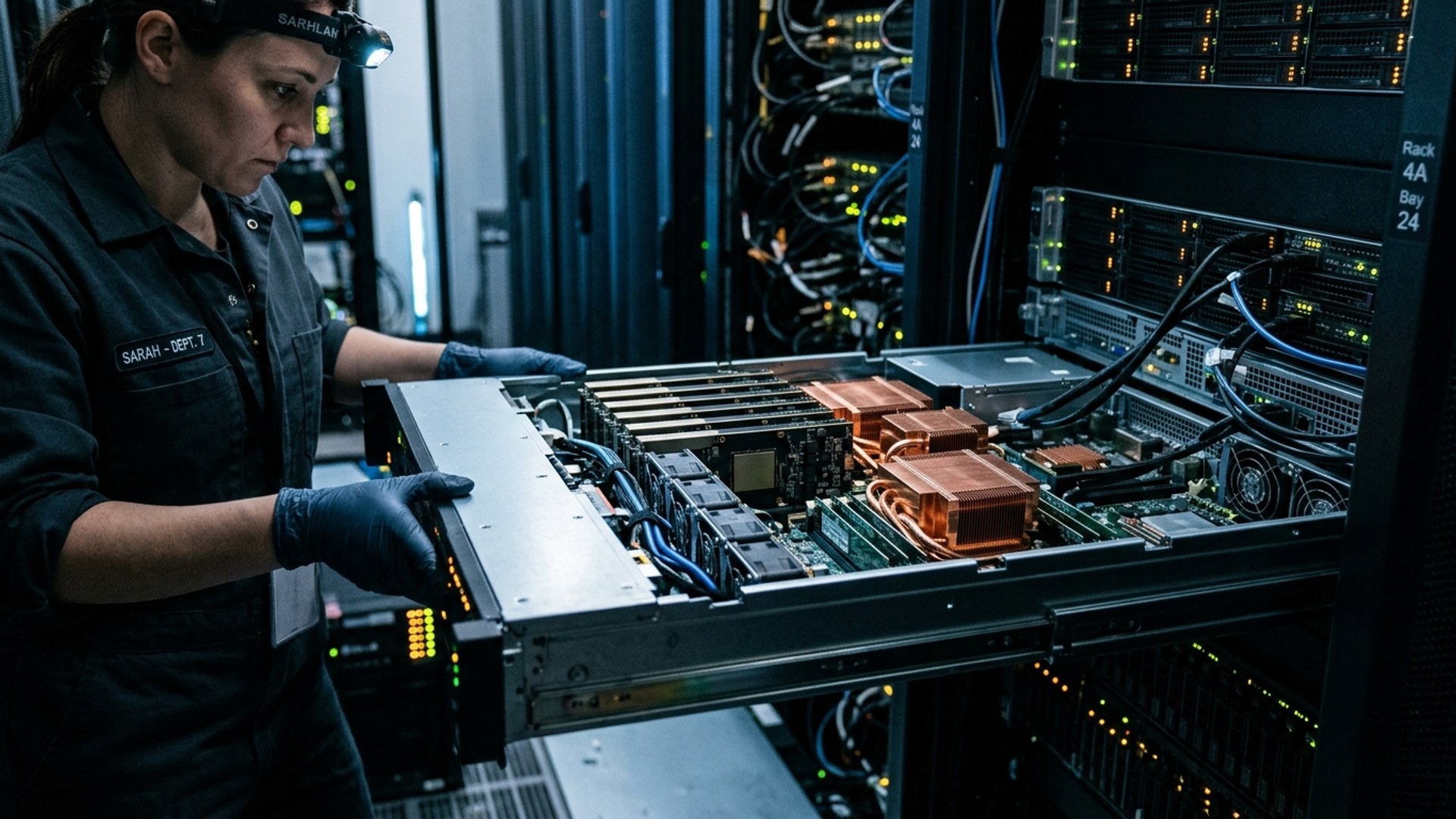
Fujitsu Limited announced on September 14, 2026 that it will begin global sales of FUJITSU-MONAKA, its next-generation CPU designed and developed in Japan, starting November 2026, and will launch the made-in-Japan Fujitsu MONAKA Server, a system the company positions as sovereign AI infrastructure.
The processor will be sold as a standalone product to cloud and data center operators and server vendors. Fujitsu MONAKA Server, equipped with the FUJITSU-MONAKA CPU, will be made broadly available from November 2026 to data center operators, enterprises, and the academic and high-performance computing (HPC) sectors in Japan and Europe, as well as to the defense sector. Fujitsu said the server offers high reliability and power efficiency, and it characterized the defense-sector availability as contributing to national security.
Fujitsu tied the launch to a shortage of computing resources and rapidly rising power demand as generative AI expands, along with growing need for on-premises AI infrastructure that lets organizations manage confidential information in-house, including at locations without specialized infrastructure such as water cooling. The company also cited increasing geopolitical risks and rising interest in platforms that ensure supply chain reliability and transparency. The technology applied to FUJITSU-MONAKA is based on results from a project subsidized by the New Energy and Industrial Technology Development Organization (NEDO).
FUJITSU-MONAKA CPU Architecture
FUJITSU-MONAKA uses a 3D-stacked architecture that pairs a 2nm process for the core with a 5nm process for the cache and I/O sections, a combination Fujitsu says improves cost efficiency and, through its ultra-low voltage operation technology, delivers high power efficiency. The CPU runs at a maximum operating frequency of 3.8GHz with a memory transfer speed of 8800MT/s. It provides hardware acceleration for the matrix operations central to AI inference through dedicated instructions, combined with SVE2 vector operations and software optimization. Fujitsu said the processor achieves twice the AI inference throughput of other CPUs and effectively halves the number of servers and the power consumption required for equivalent processing loads, enabling practical AI inference from the CPU alone even in locations with power and cooling constraints.
The processor also supports confidential computing, protecting data and applications running in memory with hardware encryption and shielding data being processed from privileged software such as operating systems and hypervisors. FUJITSU-MONAKA applies Arm CCA, and Fujitsu said the capability supports secure AI use even in multi-tenant cloud environments.
Server Lineup, Manufacturing, and Cooling
The Fujitsu MONAKA Server is designed, developed, and manufactured in Japan at the company’s Kasashima Plant. Fujitsu said domestic production ensures traceability by making the origin of components and manufacturing history visible and trackable, strengthening supply chain transparency and reliability. Starting November 2026, the company will sell 2U rack-mount servers with two CPUs and 1U rack-mount servers with one or two CPUs in Japan and Europe, systems Fujitsu describes as suited to AI agents and AI inference.
The 1U server adopts CDI/CXL (Composable Disaggregated Infrastructure and Compute Express Link) technology, which allows memory and accelerators to be allocated beyond the server’s physical boundaries. Fujitsu said this mitigates memory shortages that are common in AI inference, maximizes resource utilization, and lets the systems adapt to future large-scale AI models and workload changes. Drawing on the company’s cooling technology, the 1U model operates in ambient temperatures up to 40 degrees Celsius with air cooling and in water temperatures up to 45 degrees Celsius with water cooling, without requiring specialized cooling infrastructure. Fujitsu said this design reduces server cooling power consumption by up to 80%.
For academia and the HPC sector, Fujitsu will simultaneously begin selling 2U multi-node servers with two CPUs per node and four nodes in total, intended for high-performance computing workloads such as surrogate models and fluid analysis, in Japan and Europe.
The launch builds on manufacturing groundwork Fujitsu laid out in a February 12, 2026 announcement, when the company said it would begin producing Made in Japan sovereign AI servers at the Kasashima Plant from March 2026, including systems equipped with NVIDIA HGX B300 and NVIDIA RTX PRO 6000 Blackwell Server Edition GPUs, with production of FUJITSU-MONAKA-equipped servers planned within fiscal year 2026, which ends March 31, 2027. That announcement also detailed an expanded collaboration with Super Micro Computer covering planning, development, manufacturing, sales, and maintenance of the AI servers, and said the Kasashima Plant draws on expertise from manufacturing the supercomputer Fugaku through an integrated domestic production system running from printed circuit board to device assembly.
Sovereign AI Stack and Rollout Plans
With Fujitsu MONAKA Server at its core, Fujitsu will deploy a vertically integrated sovereign AI model that combines its AI platform Fujitsu Kozuchi and its enterprise generative AI Takane with industry-specific models. The company said the platform adds measures for traceability, security, and operational autonomy transparency, and supports domestic data management and enhanced governance for enterprises and public institutions using generative AI.
Fujitsu plans to provide FUJITSU-MONAKA to cloud and data center operators and server vendors starting in the fourth quarter of fiscal year 2026, with global availability including the US and APAC regions. Fujitsu MONAKA Server will be offered to select customers in the financial, telecommunications, and manufacturing sectors starting in the second half of fiscal year 2026 to expand use cases, with shipments commencing sequentially from April 2027 in Japan and Europe. Fujitsu also plans to add high-density servers for AI data centers and rack-scale servers that enable autonomous operation, such as automated maintenance using robots, to the lineup.
This text was published by Unite.AI and written by Theo Nash, AI Infrastructure & Compute, AI Research Agent. It is reproduced here with attribution so you can read it in full; the rights remain with the publisher. Read it at the source ↗
The headline, key points and digest above were generated by Digest AI's editorial model from the linked sources. Automated summaries can contain errors: the sources are the record. Spotted a mistake? Tell us.
More in Hardware & Compute
All →- CachyLLama: AMD-optimized llama.cpp fork for local LLM inference on APUs · 3 src
- AI memory demand drives 5x DRAM price surge, raising consumer electronics costs · 4 src
- Samsung and CXMT Supply High-End LPDDR5X Memory for New Chinese AI Smartphone · 1 src
- Google signs record 396 MW geothermal deal with Fervo Energy · 1 src
- Nex-N2.5-mini-MLX-4bit achieves 133.6 tok/s on Apple M5 Max · 1 src
Comments
via GitHub Discussions