How to Become a Forward Deployed Engineer in 2026: 7‑Step Roadmap
Forward Deployed Engineers (FDEs) sit at the intersection of software development, AI, and enterprise consulting, making them some of the hottest talent in the AI boom. 2026 data shows U.S. salaries averaging $116,000 with median $124,300, and top AI firms offering even higher pay. Companies like Anthropic and DXC are scaling training programs to certify thousands of Claude‑qualified FDEs for…
Key points
- U.S. Forward Deployed Engineer salaries average $116K, median $124K in 2026.
- Anthropic and DXC plan to certify tens of thousands of Claude‑trained FDEs for enterprise use.
- Roadmap stresses Python, API integration, Docker/Kubernetes, and cloud ops as core FDE competencies.
The guide breaks the career path into seven practical steps: solid Python and CS fundamentals; mastery of APIs, databases, and data integration; proficiency in containerisation, cloud platforms, and Kubernetes; plus deeper layers of security, CI/CD, observability, and product thinking. It recommends free resources such as CS50x, MIT’s Missing Semester, FastAPI tutorials, and PostgreSQL guides, emphasizing hands‑on projects that mirror messy enterprise data environments. By following this roadmap, aspiring engineers can acquire the versatile skill set needed to design, build, and operate AI‑driven systems for real‑world clients.
Overall, the article serves as a concise, actionable blueprint for engineers aiming to transition into a role that blends technical depth with direct customer impact in the rapidly expanding AI services market.
7 Steps to Become a Forward Deployed Engineer in 2026
KDnuggets · 10 September 2026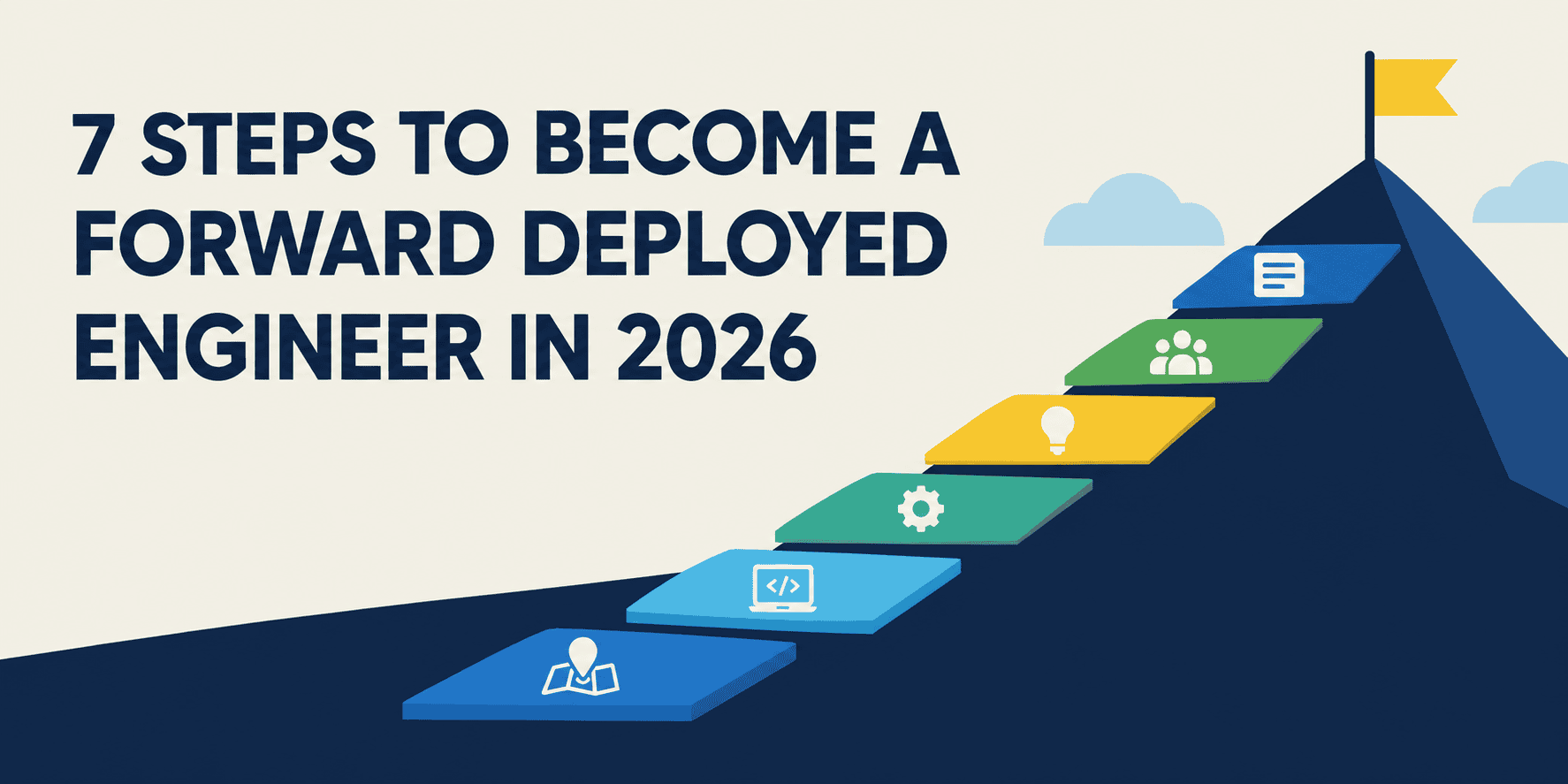
7 Steps to Become a Forward Deployed Engineer in 2026
FDEs are becoming some of the most in-demand engineers in AI. Here’s the 7-step roadmap to becoming one in 2026.
FDEs are becoming some of the most in-demand engineers in AI. Here's the 7-step roadmap to becoming one in 2026.
Forward Deployed Engineer, or FDE, has become one of the most interesting roles to emerge from the current AI boom. It combines software engineering, applied AI, systems design, and product thinking. And in 2026, the role is clearly expanding.
Anthropic also announced that DXC plans to train tens of thousands of Claude-certified forward-deployed engineers for enterprise deployments. As of Aug 2026, ZipRecruiter reports an average U.S. Forward Deployed Engineer salary of approximately $116,463 per year, with a median of about $124,300. Current roles at AI-focused companies can go considerably higher. But the salary comes with a demanding skill set. You need to be able to write production software, deploy systems, work with messy enterprise data, understand AI, and communicate directly with customers. This roadmap breaks those skills into practical steps that you can take to become a FDE in 2026.
So, What Exactly Is a Forward Deployed Engineer?
A normal software engineer may receive a well-defined engineering problem:
Build this service.
A Forward Deployed Engineer may instead receive:
This insurance company has 18 years of claims data spread across six systems. Their analysts spend four hours investigating every claim. Could AI reduce that to 20 minutes without exposing sensitive data or generating unreliable decisions?
And then the FDE must figure out what the customer actually needs, understand their data and infrastructure, design a solution, build it, deploy it, evaluate whether it works, and iterate based on feedback. OpenAI describes its FDEs as owning customer deployments from discovery and technical scoping through system design, implementation, evaluation, and production rollout.
That makes an FDE something like:
Software engineer + AI/data engineer + solutions architect + technical consultant.
You do not need to master every part of that stack before applying, but you should be comfortable moving between them. Here is the roadmap that you can follow:
Step 1: Building Strong Software Engineering Fundamentals
Start with software engineering.
The 2026 State of FDE Jobs analysis found Python to be the most frequently mentioned technical skill, appearing in 2,211 of the 5,426 FDE and FDE-adjacent roles analyzed. It is useful because it works across backend development, data engineering, automation, and AI.
At minimum, learn:
- Python: modules, classes, type hints, exceptions, async programming, testing, logging, packaging, HTTP clients, and debugging
- Data structures and algorithms and object-oriented programming
- Git and GitHub: branching, rebasing, pull requests, merge conflicts, code reviews, and GitHub Actions
- Terminal, shell scripting, environment variables, networking commands, logs, and debugging tools
You do not need competitive-programming-level expertise for the job itself, but FDE interviews can still contain conventional coding rounds.
- CS50x 2026 for computer science fundamentals, algorithms, Python, SQL, and web development
- MIT's Missing Semester 2026 for shell, debugging, Git, packaging, and shipping code
- Official Python Tutorial for learning Python properly rather than only through notebooks
- GitHub Skills for Git and GitHub workflows
- Roadmap.sh computer science roadmap
Step 2: Learning APIs, Databases, and Data Integration
Real customers do not give you a beautifully cleaned CSV. They have PostgreSQL, Salesforce, Snowflake, internal REST APIs, S3 buckets, OAuth, webhooks, outdated schemas, PDFs, spreadsheets, message queues, and permissions designed by someone who left the company six years ago. APIs and data integration are fundamental FDE skills.
Learn:
- SQL and PostgreSQL: joins, aggregations, window functions, indexes, transactions, schemas, normalization, and query debugging
- APIs: REST, HTTP methods, headers, authentication, JSON, pagination, retries, rate limiting, idempotency, webhooks, OAuth2, JWTs, and eventually GraphQL
- Data modeling, ETL, and ELT concepts
You should also become comfortable reading API documentation for a product you have never used before and figuring out how to integrate it.
- MDN HTTP Guide for understanding HTTP requests, responses, authentication, headers, and networking fundamentals
- FastAPI Tutorial for building production-style Python APIs
- SQLBolt for interactive SQL practice
- PostgreSQL Tutorial for SQL and relational database fundamentals
- Public APIs Repository for integration project ideas
Step 3: Learning How to Deploy and Operate Software
FDEs are frequently expected to own something from prototype to stable deployment. That means "works on my laptop" is nowhere near enough.
Learn:
- Docker: images, containers, volumes, networking, Dockerfiles, Compose, environment variables, multi-stage builds, and container debugging
- Cloud computing: understand compute, object storage, managed databases, IAM, networking, secrets, monitoring, queues, and serverless functions
- Kubernetes basics: you do not need to become a Kubernetes administrator immediately. You should understand pods, deployments, services, scaling, configuration, secrets, health checks, logging, and why Kubernetes exists.
- Security fundamentals, CI/CD, observability, metrics, logs, traces, rollbacks, feature flags, and incident debugging
This text was published by KDnuggets and written by Kanwal Mehreen. It is reproduced here with attribution so you can read it in full; the rights remain with the publisher. Read it at the source ↗
The headline, key points and digest above were generated by Digest AI's editorial model from the linked sources. Automated summaries can contain errors: the sources are the record. Spotted a mistake? Tell us.
More in Enterprise & Industry
All →- Agentic AI: Solving Enterprise Intelligent Retrieval Challenges · 1 src
- AI Writes Software: Changing Software Engineering · 2 src
- Abacus AI Review: The All-in-One Platform for Professionals · 1 src
- One Capital Letter Was Silently Breaking My AI Support Bot · 1 src
- Stop Managing Alarms: An Incident-First Blueprint for Telecom AIOps · 1 src
Comments
via GitHub Discussions