Lagarde warns Europe must build own AI models and datacentres to avoid US/China cut‑off
European Central Bank President Christine Lagarde told a Vienna audience that the continent faces a strategic dilemma: without home‑grown AI models and sufficient datacentre capacity, Europe could be forced to choose between stalling AI adoption or becoming dependent on foreign providers. She highlighted the stark disparity in AI output, noting the United States released 59 notable models last…
Key points
- Lagarde said Europe produces only one AI model each in France and the UK, versus 59 US and 35 Chinese models last year.
- She warned that the US controls 75% of global AI computing capacity while Europe holds just 5%, creating a strategic vulnerability.
- Lagarde estimated AI could boost European productivity by up to 4% over a decade, but datacentre capacity must expand sixfold to meet demand.
Lagarde warned that the U.S. currently hosts 75% of the world’s AI computing power compared with Europe’s 5%, and that a sudden loss of access would ripple through every sector—from customs screening to banking. She argued that investing in domestic AI could lift productivity by up to 4% over a decade, but warned Europe’s datacentre gap could grow sixfold unless capacity is rapidly expanded, underscoring the urgency for a coordinated European AI strategy.
Europe must build own AI or risk getting cut off by US or China, says ECB’s Lagarde
The Guardian AI · 14 September 2026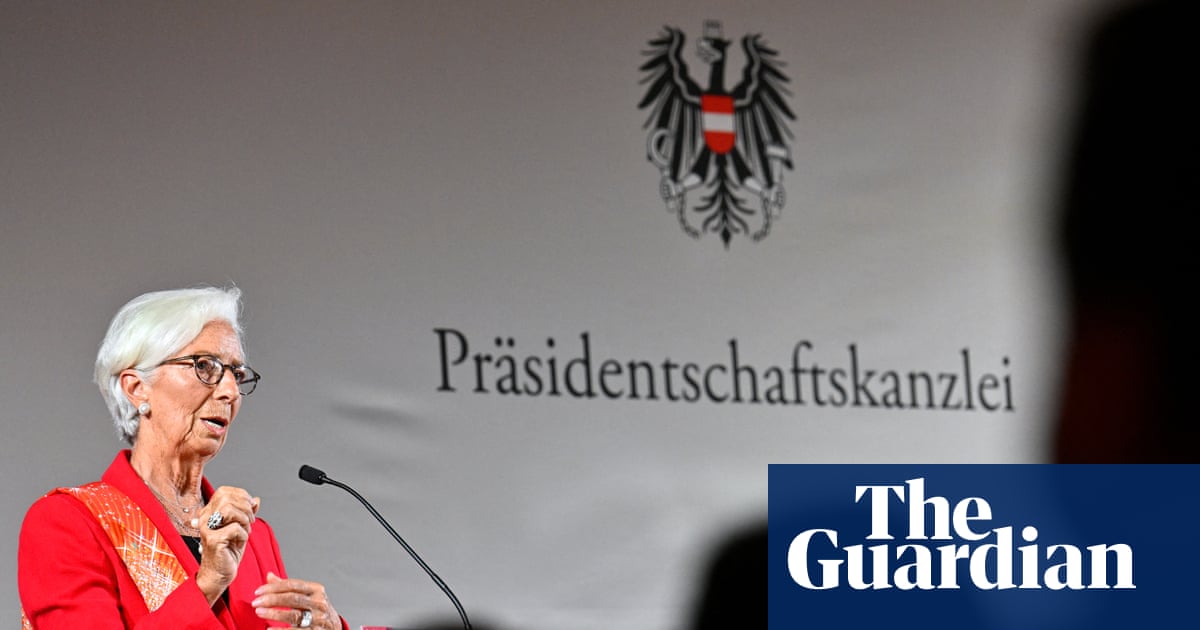
Europe must develop its own AI technology and build more datacentres in order to nullify the threat of being cut off by the US or China, according to the president of the European Central Bank.
Christine Lagarde said the continent needed AI models – the technology that powers AI tools such as chatbots – that were “good enough” to carry out most tasks and run from domestic datacentres. If Europe invests in its own AI tech, said Lagarde, “the threat of being cut off loses its force”.
AI is being built elsewhere, the ECB boss said in a speech in Vienna, with the US producing 59 notable models last year and China 35, while France and the UK produced one each. She added that the US hosts 75% of the world’s AI computing capacity – produced by datacentres – and Europe just 5%.
Lagarde said Europe faced “an awkward choice”. “Either it holds back on adopting, because it cannot protect its data, and forgoes the growth. Or it adopts AI quickly, becomes highly dependent, and risks losing the freedom to organise its economy according to its own values.”
Cutting Europe off from AI or changing the terms of its access would have a widespread and immediate economic impact, she said.
“Within a few years it will be screening goods at the border, deciding which tax returns are audited, dispatching trains, watching patients on wards and clearing payments at banks. A withdrawal of access, or a change in its terms, would then reach every sector at once,” she said.
Lagarde said this represented leverage that “no trade partner has ever held over Europe, and it could be used in any negotiation, on tariffs or on digital taxes, for example”.
While the EU and the US remain key allies, the Trump administration has shaken that trust in a range of episodes including the imposition of tariffs, demands to take over Greenland – a largely autonomous territory that is part of the Danish commonwealth – and the withdrawal of US troops from Europe over political disagreements.
If adopted quickly, AI could lift the level of productivity – a measure of economic performance – by up to 4% over a decade, which would be transformative for public finances, Lagarde said.
Urging Europe to build more computing capacity, she said: “Europe already has too little datacentre capacity to meet its own demand, and on current trends, that gap is projected to grow more than sixfold within a decade.”
US technology firms’ investment needs are so large that they are doing some of their borrowing in Europe, pushing up costs for everyone else as they crowd out others in the debt market. European pension funds also invest heavily in US tech stocks, so any market correction would affect European savings, she added.
Reuters contributed to this report.
This text was published by The Guardian AI and written by Dan Milmo and agency. It is reproduced here with attribution so you can read it in full; the rights remain with the publisher. Read it at the source ↗
The headline, key points and digest above were generated by Digest AI's editorial model from the linked sources. Automated summaries can contain errors: the sources are the record. Spotted a mistake? Tell us.
More in Policy & Regulation
All →- OpenAI pledges to match Anthropic's embedded evaluator safety commitment · 137 src
- OpenAI Supports California AI Bills, Calls for National Rules · 3 src
- Trump's AI Approval Rating Low as Safety Concerns Rise · 1 src
- Meta Blocks AI-Generated Kerala CM Satheesan Dance Video in India · 4 src
- AI Leaders' Doomsday Predictions: A Form of Hype · 1 src
Comments
via GitHub Discussions