Nvidia Launches RTX Pro 5500 with 84GB GDDR7 to Bridge Performance Gap
Nvidia has unveiled the RTX Pro 5500 Pro Blackwell Workstation Edition, a GPU that mirrors the GeForce RTX 5090’s core architecture but adds a massive 84 GB of GDDR7 memory—2.6 × the flagship’s 32 GB. The card uses the same GB202 die, delivering 21,760 CUDA cores and 170 SMs, while the memory subsystem is built from 28 GDDR7 chips in a clamshell layout, offering 1,400 GB/s bandwidth.
Key points
- RTX Pro 5500 adds 84 GB GDDR7, 2.6× more than RTX 5090’s 32 GB
- Shares GB202 die, 21,760 CUDA cores, 170 SMs, matching RTX 5090 performance
- Priced between $9,209 and $15,599, bridging RTX Pro 5000 and 6000
The move positions the RTX Pro 5500 between the RTX Pro 5000 (72 GB) and RTX Pro 6000 (96 GB), targeting professionals who need more VRAM for AI and data‑science workloads without the premium price of the 6000. Nvidia’s strategy appears to be maximizing margins by re‑using the GB202 die and adding memory, rather than boosting compute, and the card is expected to retail between $9,209 and $15,599.
While the GPU’s performance matches the RTX 5090, its memory advantage makes it attractive for large‑scale model training and inference, underscoring Nvidia’s continued focus on the AI‑centric workstation market.
The story so far
2 episodes →- Nvidia Launches RTX Pro 5500 with 84GB GDDR7 to Bridge Performance Gap this story
Gaming takes a backseat as Nvidia overhauls the RTX 5090 for maximum AI margins — RTX Pro 5500 delivers 2.6X VRAM at matching specs
Tom's Hardware · 14 September 2026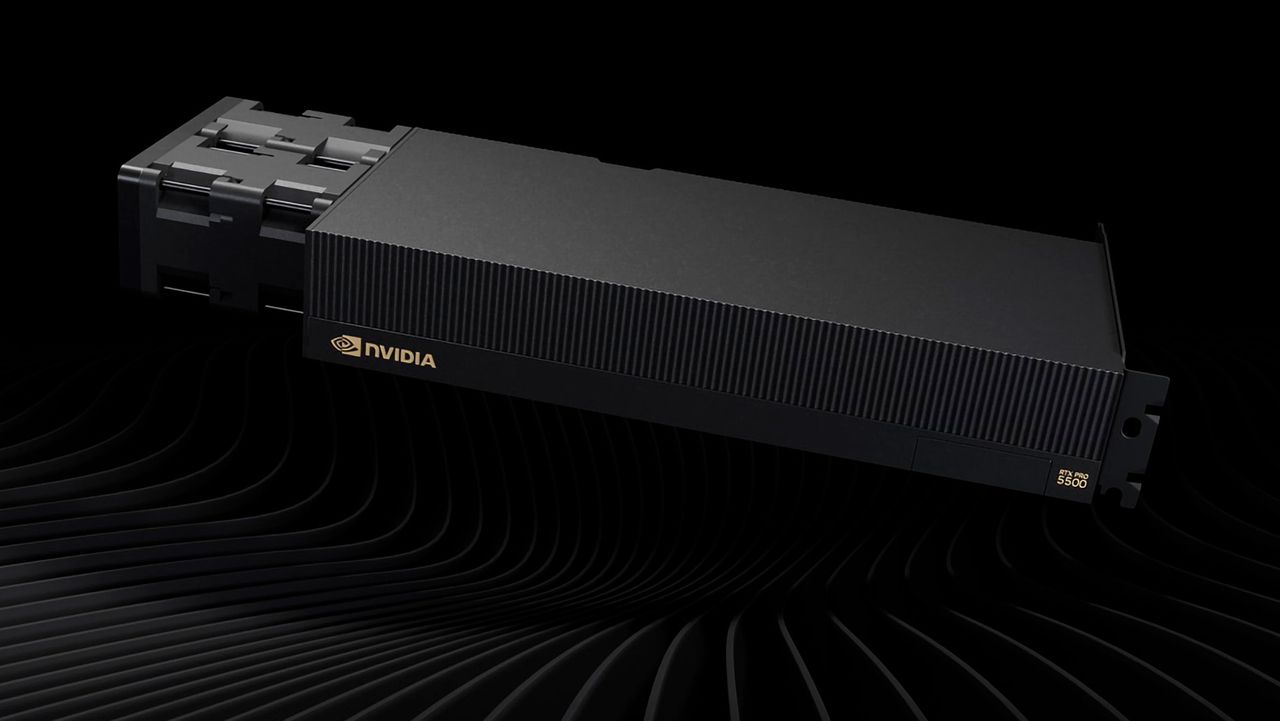
The GeForce RTX 5090 is undeniably one of the best graphics cards money can buy. Banking on the fact that many already use it for AI, Nvidia has bolstered it with even more memory and launched it as the new RTX 5500 Pro Blackwell Workstation Edition. It offers comparable specifications to the GeForce RTX 5090 but distinguishes itself with 84GB of GDDR7 memory, 2.6X more than the Blackwell gaming flagship.
The RTX Pro 5500 features the GB202 silicon, the powerhouse die that powers other high-end mainstream and professional Blackwell graphics cards, including the GeForce RTX 5090, RTX Pro 6000, and RTX Pro 5000. In fact, the RTX Pro 5500 uses the same die as the GeForce RTX 5090, which means 170 Streaming Multiprocessors (SMs) are enabled out of a possible 192. As a result, the RTX Pro 5500 has 21,760 CUDA cores and offers performance comparable to the GeForce RTX 5090. The differentiator is the memory subsystem, where the RTX Pro 5500 excels.
Nvidia equipped the RTX Pro 5500 with 84GB of GDDR7 memory. This is the second time Nvidia has launched a graphics card with 84GB of memory, with the first being the China-exclusive RTX Pro 6000D. The RTX Pro 5500's memory capacity lets the Blackwell graphics card sit comfortably between the RTX Pro 5000 and the upgraded RTX Pro 6000, with 72GB and 96GB of GDDR7 memory, respectively.
Nvidia RTX Pro 5500 Workstation Edition Specifications
Nvidia achieved the 84GB memory capacity by outfitting the RTX Pro 5500 with 28 GDDR7 memory chips in a clamshell configuration. Each side of the PCB houses 14 24Gb (3GB) GDDR7 memory modules. They run at 25 Gb/s across a 448-bit memory interface, delivering up to 1,400 GB/s of bandwidth, which aligns with Nvidia’s official specification of 1,398 GB/s. In other words, the RTX Pro 5500 shares the same memory subsystem as the RTX Pro 6000D.
Samsung, Micron, and SK hynix only produce standard 28 Gb/s memory packages. Therefore, Nvidia downclocks the RTX Pro 5500's GDDR7 chips for its own reasons, whether to meet thermal and power targets or avoid cannibalizing higher-tier SKUs. From a memory-bandwidth perspective, the RTX Pro 5500 is not particularly impressive. Its bandwidth is only 4% ahead of the RTX Pro 5000, and it lags 22% behind both the flagship RTX Pro 6000 and the GeForce RTX 5090, which fully leverage 28 Gb/s GDDR7 memory chips.
To sum it all up, if RTX Pro 6000D and GeForce RTX 5090 had a child, it would be the RTX Pro 5500. Nvidia's main motivation was to launch the RTX Pro 5500 to fill the large performance and pricing gap between the RTX Pro 6000 and RTX Pro 5000. Also, the chipmaker makes substantially more profit by putting recycled GB202 into an RTX Pro 5500 than into a GeForce RTX 5090. By giving the former more memory with similar core specifications as the latter, Nvidia seemingly hopes to win more customers over to the RTX Pro 5500.
We reached out to both Nvidia and PNY for official pricing on the RTX Pro 5500, but neither company has responded. For reference, the flagship RTX Pro 6000 retails for $15,599, while an RTX Pro 5000 72GB starts at $9,209. Given the RTX Pro 5500's role as a bridge between the two models, it is reasonable to expect its launch price to fall somewhere within this range.
Zhiye Liu is a news editor, memory reviewer, and SSD tester at Tom’s Hardware. Although he loves everything that’s hardware, he has a soft spot for CPUs, GPUs, and RAM.
This text was published by Tom's Hardware and written by Zhiye Liu. It is reproduced here with attribution so you can read it in full; the rights remain with the publisher. Read it at the source ↗
Coverage and discussion
3 sourcesThe headline, key points and digest above were generated by Digest AI's editorial model from the linked sources. Automated summaries can contain errors: the sources are the record. Spotted a mistake? Tell us.
More in Hardware & Compute
All →- Robotics AI Faces On-Device vs Datacenter Inference Trade‑offs · 1 src
- AMD Radeon RX 9060 XT Enables CUDA Workloads on Windows via ZLUDA and ROCm · 2 src
- Backblaze to Present AI Infrastructure Solutions · 1 src
- OpenAI's Jalapeño Chip: AI-Driven Design in Under Two Years · 1 src
- Broadcom Anticipates Strong Sales Growth to Anthropic · 1 src
Comments
via GitHub Discussions