Writer Tests $4,000 Unitree Robot Dog in Washington, D.C., Finds Limited Practical Use
A writer spent $4,000 on a quadruped robot dog built by Chinese company Unitree and took it on a two‑mile commute through Washington, D.C. The mechanical companion drew curious looks, photos, and questions from passersby, with children especially fascinated by its tricks.
Key points
- The author bought a $4,000 quadruped robot from Chinese maker Unitree and walked it two miles to work in D.C.
- The robot attracted public attention but struggled uphill, overheating to 84 °C and battery dropping to 5 % before collapsing.
- The experience highlighted limited practical utility of current consumer‑grade robot dogs despite high price.
During the walk the robot performed well on flat ground but began to struggle on the uphill return, its battery dropping to 5 % and internal temperature climbing to 84 °C. It eventually collapsed near the writer’s home, rolling onto its back without a graceful shutdown. The author concludes that, despite the high price tag, the robot offers little practical utility for everyday tasks.
I spent $4,000 on a robot dog from China
Ars Technica AI · 12 September 2026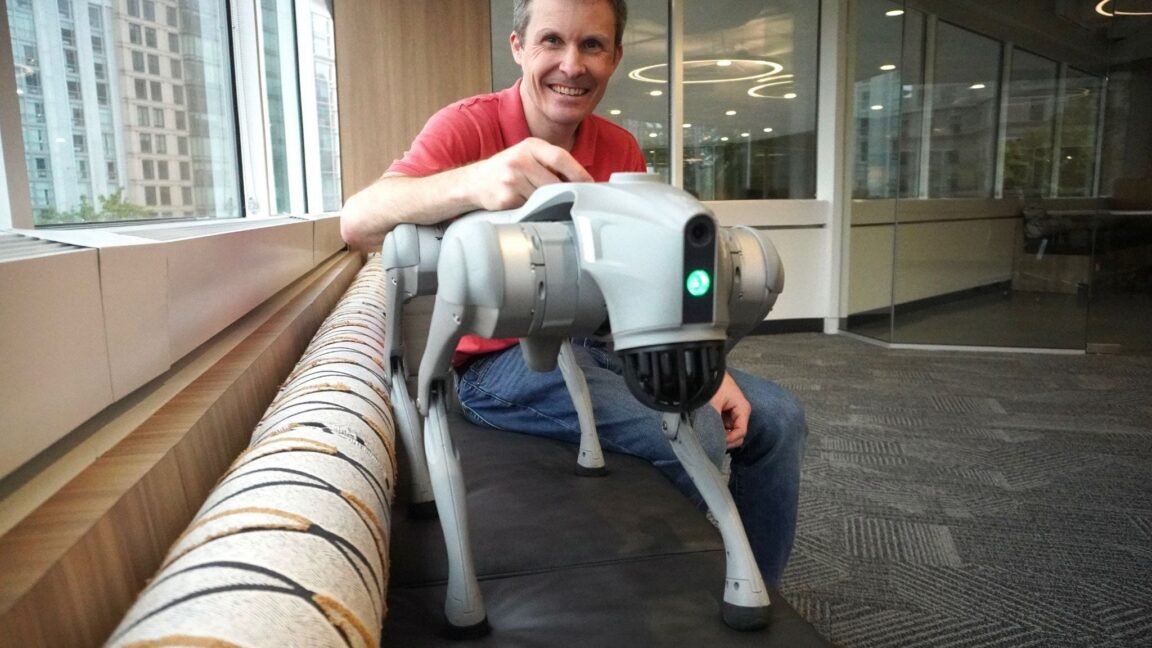
On a sunny morning in June, I walked to work with a quadruped robot beside me. I’ve never gotten more attention from strangers.
A bunch of people snapped pictures of my robot dog. Several people asked me questions. Was it mine? (Yes.) Did I build it? (No.) Was it being used for surveillance? (No.)
Biological dogs kept a safe distance from my mechanical companion. Some growled or barked at it.
Children were fascinated. I paused and had it do tricks for several of them: “shake hands,” do a handstand, or leap into the air.
I live in a leafy Washington, DC, neighborhood called Mount Pleasant. The neighborhood lives up to its name, so my morning commute is mostly downhill. My robot companion, manufactured by the Chinese company Unitree, walked the two miles to my office near the White House with battery capacity to spare.
I recharged the battery during the workday, but it still struggled on the afternoon walk home. We were now mostly walking uphill, and the temperature had risen to 87°F (30°C). The robot’s steps seemed increasingly labored as the path got steeper.
As I entered my own neighborhood, I glanced at two indicators in the corner of my phone screen. One showed that the robot’s battery was at 5 percent—dangerously close to empty. The other showed the internal temperature was 84°C (183°F).
We were within sight of my front door when the robot suddenly collapsed. I’m not sure if it ran out of power or overheated, but either way it didn’t shut down gracefully—it rolled onto its back with its legs in the air.
Several people have asked me what my robot is useful for, and the honest answer is not much.
This text was published by Ars Technica AI and written by Timothy B. Lee. It is reproduced here with attribution so you can read it in full; the rights remain with the publisher. Read it at the source ↗
The headline, key points and digest above were generated by Digest AI's editorial model from the linked sources. Automated summaries can contain errors: the sources are the record. Spotted a mistake? Tell us.
More in Robotics & Physical AI
All →- Vision AI becomes critical safety layer for mixed human-robot construction sites · 1 src
- Humanoid Robots Face Hardware Limits · 1 src
- Vention opens Montreal Physical AI Lab to scale industrial robot data collection · 1 src
- Swarmer to acquire Ukrainian UGV maker Ratel Robotics for up to $224 million · 1 src
- Teradyne sues JAKA Robotics over Universal Robots patents in Europe · 1 src
Comments
via GitHub Discussions