Apple Vision Pro in Surgery; Brain Interface; IFA Tech
In a significant development, an orthopedic surgeon at Duke Health recently performed hip surgery using Apple’s $3,499 Vision Pro headset. The FDA authorized the first intraoperative app for the device, allowing surgeons to view live arthroscopy video, CT scans, and surgical planning data within the headset. This marks a promising new application for the expensive spatial computer in medicine.…
Key points
- Apple Vision Pro used for intraoperative surgery at Duke Health
- Ray Kurzweil backs a brain interface via nasal delivery
- IFA 2026 showcases experimental hardware in Europe
Apple Vision Pro scrubs into surgery
The Rundown AI · 4 September 2026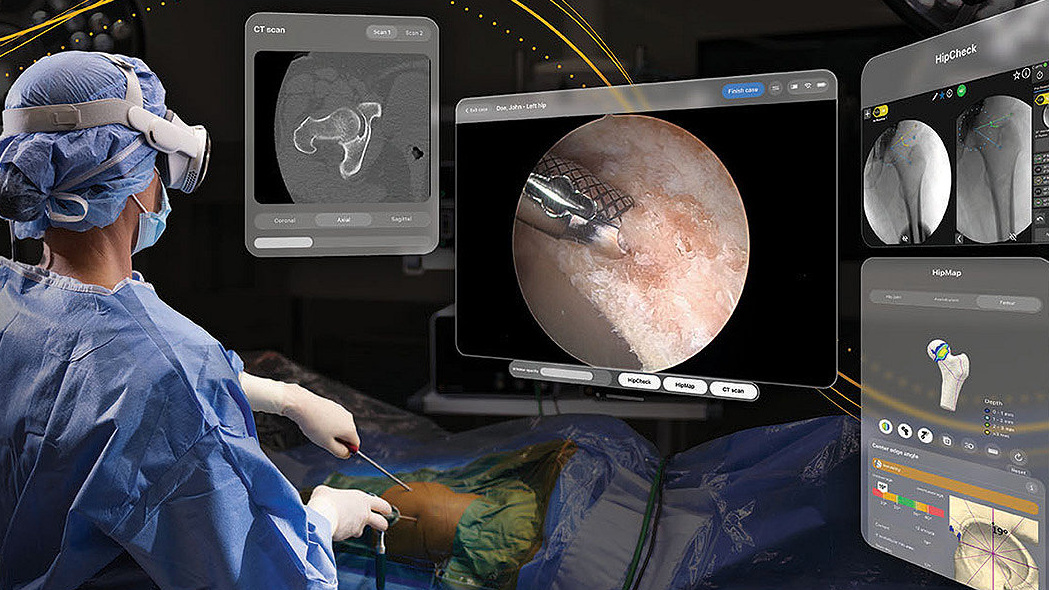
Good morning, tech enthusiasts. Apple’s spatial headset has landed in the OR: A surgeon at Duke Health just operated on a hip while wearing a $3,499 Vision Pro, using the first app the FDA has authorized for intraoperative use on the headset.
Also today: AI futurist Ray Kurzweil backs a brain interface delivered through your nose, and a wave of wild new tech debuts at IFA in Berlin.
- A surgeon just operated in Apple Vision Pro
- Ray Kurzweil backs a brain interface you snort
- Top new tech coming out of IFA 2026
- Ultrahuman wants to make its smart ring an AI controller
MEDTECH
The Rundown: Apple’s Vision Pro is getting a new job in the operating room: A Duke Health surgeon used Stryker’s FDA-authorized app during hip surgery to view live arthroscopy video, CT scans, and surgical-planning data inside the headset.
- A Duke Health orthopedic surgeon performed the first case, a hip arthroscopy, wearing the headset while he operated.
- The app pulled the live arthroscope feed, CT imaging, and Stryker’s HipCheck and HipMap data into a single field of view.
- The FDA granted De Novo authorization on July 17 — the first for intraoperative use with Vision Pro.
- Other surgical apps are already on Vision Pro: ClearSurgery won CE marking for ClearSphere, while ScopeXR has been used in hundreds of cataract procedures.
Why it matters: Apple’s $3,499 Vision Pro has struggled to find a mass-market identity, but medicine could be where the pricey spatial computer finds some real purpose— giving surgeons access to multiple scans and tools without forcing them to look across multiple screens.
BRAIN COMPUTER INTERFACE
Image source: Wikimedia Commons / Jay Dixit
The Rundown: AI futurist Ray Kurzweil is joining neurotech startup Subsense as an advisor, backing an experimental brain-computer interface that uses nanoparticles snorted through the nose instead of implanted electrodes.
- Kurzweil will serve as product and vision advisor, as Subsense explores how neural interfaces could eventually connect more directly with AI*.*
- Subsense’s system uses two types of nanoparticles: one designed to read neural signals and another to stimulate neurons, paired with an external wearable.
- The particles would be administered intranasally, potentially avoiding the permanent electrodes and surgery required by companies such as Neuralink.
- It’s still very early: Subsense is preclinical, has raised $27M, and currently targets clinical pilots for 2027–29, with no consumer BCI on its roadmap until 2031.
Why it matters: Subsense is trying to achieve direct neural access without the permanent electrode implants used by Neuralink, Synchron, and Precision Neuroscience. Kurzweil’s famous name brings attention, but the technology still has to prove it can work safely and reliably in people.
IFA 2026
Image source: IFA 2026 Berlin
The Rundown: IFA 2026 is underway in Berlin, with a fresh wave of experimental hardware, from a sub-1cm fanless laptop and solar-powered PC to local-AI smart-home hubs and increasingly ambitious household robots.
- Alongside the CameraJet toothbrush, Dyson unveiled Nurovi robot vacuums, a slim Pencilwash floor cleaner, and an expanded HushJet air-purifier lineup.
- Lenovo’s Project AeroBlade concept appeared, packing a 14-inch OLED into a body under 10mm thick, replacing traditional fans with solid-state AirJet cooling.
- Oukitel put a solar panel on a PC**:** The rugged RG14-P can pull up to 15W from panels built into its lid, enough to charge its 95Wh battery to 50% in 6 hours.
- Anker wants to give the smart home a local brain: MindBase connects devices while running its AI and storing data inside the home, with support for Matter.
Why it matters: IFA is Europe’s biggest consumer tech show, bringing together major names across phones, TVs, audio, smart homes, and appliances. This year, robotics and AI are taking a bigger role, alongside experimental hardware pointing to thinner devices and less reliance on the cloud.
ULTRAHUMAN
The Rundown: Ultrahuman just raised $70M from Qualcomm Ventures and others to turn its smart rings from passive health trackers into mini-computers capable of running apps, AI interactions, and controls directly on your finger.
- The round includes $65M in equity and $5M in debt and reportedly values the Bengaluru-based startup at $365M, about triple its 2023 valuation.
- Ultrahuman is working with Qualcomm on a future ring using its silicon, adding enough processing power to run more algorithms on-device.
- The company says a Sept. software update will let rings work with apps and games; it’s also exploring the ring as a pointer, car key, and gesture controller.
- The company says it has sold about 800K rings, is running at $140M in annualized revenue, and expects to hit $200M by January 2027.
Why it matters: Ultrahuman wants smart rings to move beyond health tracking into controls for apps, devices, and AI. Qualcomm’s involvement gives that push a major chip partner as Oura heads toward an IPO after posting $1.2B in revenue in the first nine months of 2026.
Uber is cutting 10% of its workforce, or ~3,600 jobs, as CEO Dara Khosrowshahi strips out management layers, consolidates teams, and drastically limits remote work.
Apple is facing a £2B ($2.7B) UK lawsuit alleging its App Tracking Transparency rules unfairly restricted third-party devs while giving Apple’s own ad business an advantage.
TikTok is turning its comment section into a more interactive social layer, rolling out 60-second voice comments, creator polls, nine-photo carousels, and Live Photo replies.
Circular unveiled its Ring 3 smart ring models, adding NFC contactless payments and on-finger vibration alerts, with the Pro also offering FDA-cleared ECG/AFib detection.
Apple reportedly canceled its rumored foldable MacBooks, while adding a new 13.8-inch OLED MacBook to its lineup.
Corporate America is cutting “micro-team” managers who oversee just a few people, with Uber, Intel, Google, and others flattening org charts, the Wall Street Journal reports.
Microsoft’s Xbox will start capping monthly cloud gaming on Game Pass in Nov.— 15 hours for Ultimate, 10 for Premium, and 5 for Essential — citing rising costs.
Jeff Bezos-backed Slate reportedly expects the first deliveries of its stripped-down $24,950 electric pickup to begin as early as Dec. 2026.
More than 200 U.S. employees at the Wikimedia Foundation, the nonprofit behind Wikipedia, voted 158–14 to unionize with the Communications Workers of America.
Apple Maps joined Google Maps in relabeling Lake Ontario as “Lake America” for U.S. users, following Trump’s executive order.
Hamburg is moving to ban smart glasses on public transit and at swimming pools, while Norway is considering tighter nationwide restrictions.
French AI biotech Owkin signed a licensing deal giving Boehringer Ingelheim access to its K Pro “AI scientist” and multimodal patient data to help discover drugs.
This text was published by The Rundown AI and written by Jennifer Mossalgue. It is reproduced here with attribution so you can read it in full; the rights remain with the publisher. Read it at the source ↗
The headline, key points and digest above were generated by Digest AI's editorial model from the linked sources. Automated summaries can contain errors: the sources are the record. Spotted a mistake? Tell us.
More in Enterprise & Industry
All →- Older Pixel Smartphones Can Run Advanced AI Models · 1 src
- Accenture & Google Cloud Form Gemini Enterprise Business Group · 3 src
- ChatGPT, Gemini & Claude Lead AI Visibility; Is Perplexity Still Relevant? · 1 src
- How To Get AI Recommended By ChatGPT & Google Overviews In 90 Days · 1 src
- Trump Touts AI Data Centers as 'Oil of Next 50 Years' · 1 src
Comments
via GitHub Discussions