NTU AI Tool among OpenAI Funded Projects
- Researchers from Nanyang Technological University (NTU) have developed an AI tool that can predict economic outcomes based on real transaction data. The tool, led by Hyeokkoo Eric Kwon, has received $100,000 in funding from OpenAI.
Key points
- NTU team receives $100,000 funding from OpenAI
- Trained on anonymised spending data from over one million users
- Aims to predict economic outcomes and household responses
The team's model was trained on anonymised spending data from over one million users of a South Korean mobile budgeting app. This includes information like how much people spend and at which retailers.
By using AI to simulate household responses to government policies, the tool aims to estimate additional spending and its impact. It can predict human behavior better than traditional models due to its understanding of complex patterns and vast knowledge of human behaviour.
The NTU team will validate their system against real-world data from South Korea's cash handout experiments in 2025 before making the tool open-source for any population.
NTU team’s AI tool among 14 projects worldwide funded by OpenAI
bing.com · 12 September 2026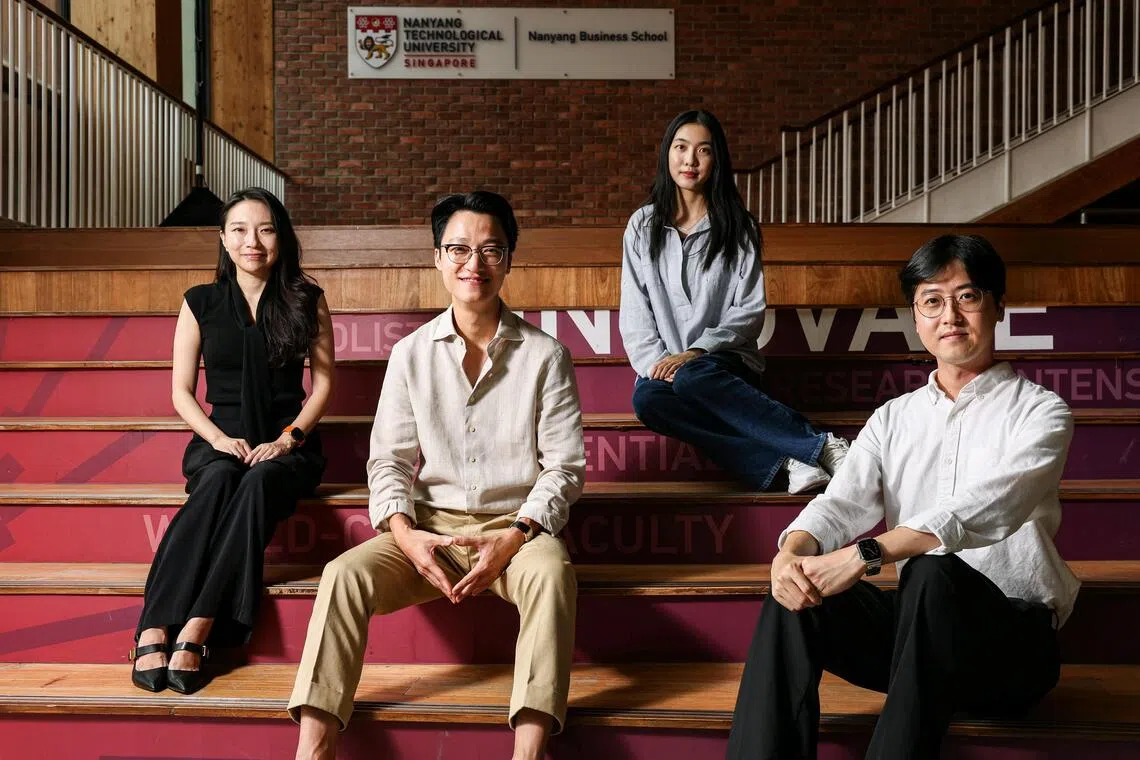
NTU team’s AI tool among 14 projects worldwide funded by OpenAI
SINGAPORE – Researchers in Singapore are building an artificial intelligence tool that can predict how economic policies such as cash handouts may boost the economy.
The tool forecasts economic outcomes, such as whether people will save or spend their money, with far greater accuracy than traditional simulation models. This allows policymakers to test more alternative policies to achieve the desired economic outcome.
Developed by four researchers at Nanyang Technological University, it is among 14 projects worldwide to receive funding from OpenAI as part of the company’s commitment to promoting economic opportunity and societal resilience through AI.
The 14 projects were selected from over 400 submissions to OpenAI’s call for proposals in April.
The NTU team, led by Nanyang Business School Provost’s Chair Professor in Information Systems Hyeokkoo Eric Kwon, will receive US$100,000 (S$126,800).
He said the money will go towards developing and testing the tool, which has not been named, over the next six months.
The NTU team’s AI prediction system is trained on real transaction data from more than one million users of a South Korean mobile budgeting app, which Kwon declined to name.
The data contains information on how much users spend, which retailers they spend at, and how much monthly income they received between 2023 and 2025.
The app obtains the data by tracking notifications, messages and e-mails that are sent to users by banks when transactions are made. Names and bank account numbers are removed. Spending amounts, income and purchase times are also grouped into broader ranges.
The NTU team’s AI tool ingests only the anonymised data to prevent the identification of users.
“There should never be a situation where the data can only be matched to one profile. Depending on the level of sensitivity of the data, a profile is sufficiently anonymised if a minimum of three, five or 10 users share those exact same characteristics,” said Kwon.
AI agents are then used to simulate how households may respond to a proposed government policy.
For example, if the government is planning to give $100 in cash vouchers to every citizen, the system aims to estimate how much additional spending it could generate, what it would be spent on, and how the outcome would change with a different policy, said Kwon.
As AI understands complex patterns and has a vast knowledge of human behaviour, it can predict human behaviour better than traditional simulations based on deterministic rules, he said.
“Qualitative interviews and surveys are conducted to set these rules, but there is often a gap between how people actually behave and how they respond in surveys,” said Kwon, adding that the complex relationship between factors such as income and age cannot be represented in traditional simulation models.
To ensure that the system does not hallucinate and can accurately predict real-world outcomes, it will be validated against real spending data in 2025.
This data was recorded before and after the South Korean government distributed two tranches of cash handouts in July and September 2025. These handouts had to be spent at eligible retailers by November 2025.
Half of the NTU team’s US$100,000 funding will be in cash, while the other half will be in credits for OpenAI’s AI model subscription plans.
By February 2027, the NTU researchers aim to have the tool work for any population.
The tool, which will be made open-source, will also be able to analyse sentiments such as interests and political views to improve prediction accuracy and explain how it arrives at its conclusion.
This text was published by bing.com and written by Sarah Koh. It is reproduced here with attribution so you can read it in full; the rights remain with the publisher. Read it at the source ↗
The headline, key points and digest above were generated by Digest AI's editorial model from the linked sources. Automated summaries can contain errors: the sources are the record. Spotted a mistake? Tell us.
More in Generative AI & Models
All →- Fly Language Model Wires Fruit Fly Brain, Finds No Advantage · 1 src
- Qwen3.8-27B-GGUF Updated with New Tensor Layout · 1 src
- Benchmark Saturation: Why Leading Systems Approach Ceiling · 1 src
- Benchmarking Qwen 3.8: Config Matters in AI Models · 1 src
- Google releases TimesFM-3, a multivariate AI model for time-series forecasting · 1 src
Comments
via GitHub Discussions