Fly Language Model Wires Fruit Fly Brain, Finds No Advantage
The Fly Language Model (FLM) is a public chatbot that couples the complete fruit fly connectome to a frozen LiquidAI LFM2.5-1.2B-Instruct backbone. The model was built on an architecture called GPF and is described as the world's first connectome language model, though it explicitly disclaims being the first. The FLM uses a reservoir computer bolted onto a language model with all 166,700…
Key points
- FLM couples fruit fly brain to frozen LFM2.5-1.2B-Instruct backbone
- Only 278,528 parameters of readout are trained from 166,700 nodes of MaleCNS graph
- Fly readout improves NLL by 0.0222 nats/token compared to backbone
Fly Language Model (FLM) Wires the Full Fruit Fly Connectome Into a Frozen 1.2B LLM, and Its Own Controls Show the Wiring Does Not Help
MarkTechPost · 12 September 2026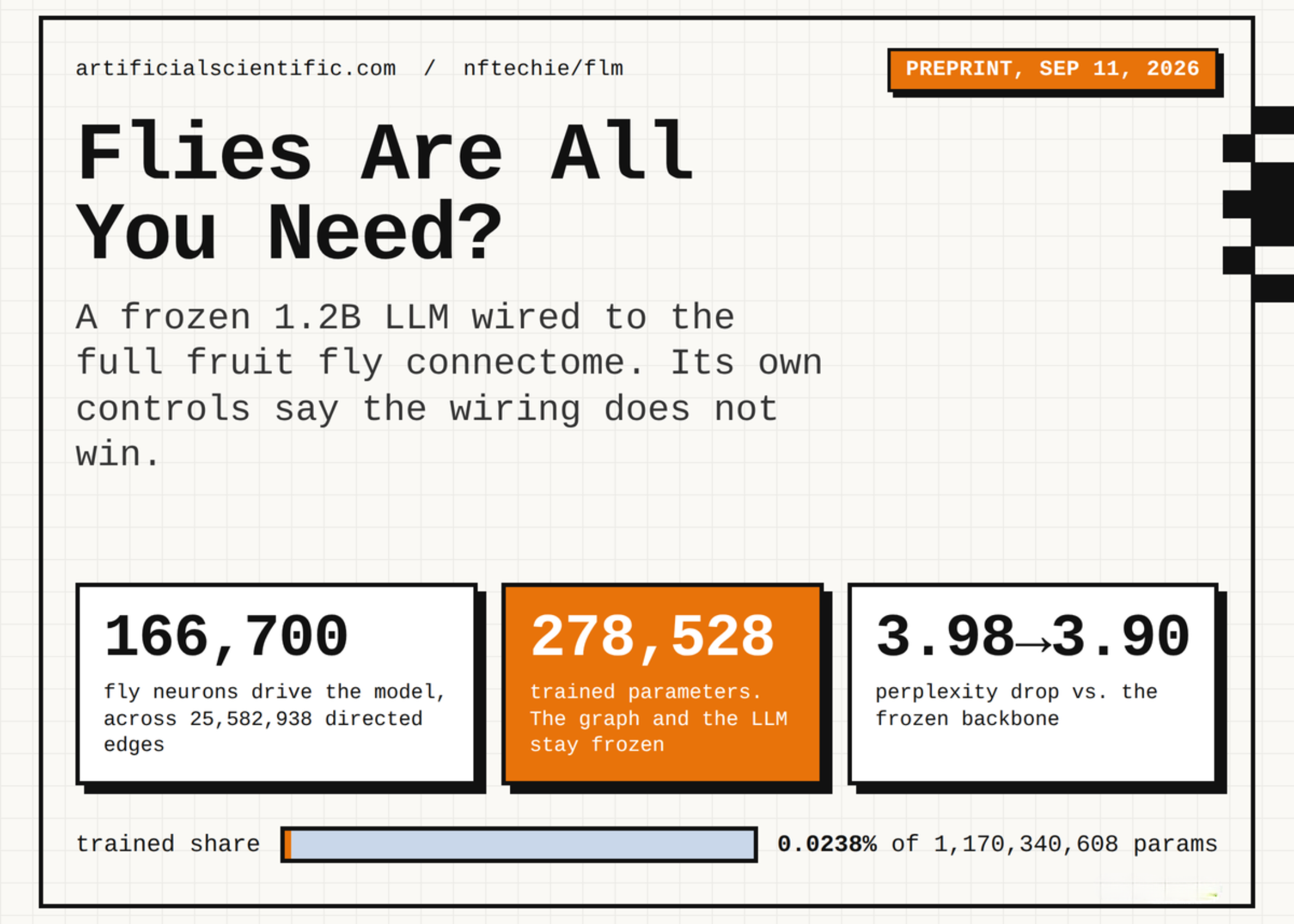
The Fly Language Model (FLM) is a public chatbot that couples the complete retained MaleCNS v1.0 fruit fly connectome to a frozen LiquidAI LFM2.5-1.2B-Instruct backbone. The developer who created the FLM calls it the world’s first Fly Language Model, built on an architecture called GPF (Generative Pre-trained Fly). It does not use the GPF label, explicitly disclaims being the first connectome language model, and reports that a parameter-matched control without the fly graph performs slightly better.
Deployable: Yes, locally. The nftechie/flm repo is MIT-licensed and runs on Python 3.12 (macOS or Linux, MPS, CUDA, or CPU) with no API key.
What was actually built
The system is a reservoir computer bolted onto a language model. All 166,700 retained nodes and 25,582,938 directed edges of the MaleCNS graph participate. The graph, the backbone, and the random input and output projections are all fixed. Only a 278,528-parameter readout is trained, which is about 0.0238% of the 1,170,340,608 backbone parameters.
At each token, a fixed Gaussian projection compresses the 2,048-dimensional token embedding to 128 channels. Each reservoir node receives one channel with a random sign. The whole graph then updates with x = tanh(W(0.6x + 0.4Bc)), where W holds incoming-normalized anatomical contact counts. States are pooled into 128 bins, passed through two trained bias-free matrices (U at 128 by 128, V at 2,048 by 128), and projected through the frozen vocabulary head as a bounded residual added to the backbone logits. The residual is capped at an RMS of 0.25 across vocabulary coordinates.
The results
On a freshly frozen set of 32 SmolTalk everyday-conversation dialogues (1,236 target tokens), three fit seeds gave:
The fly readout improved on the backbone by 0.0222 nats per token (perplexity 3.98 to 3.90). But a direct-input control, which feeds the same 128-channel token projection straight into an identical readout with no graph, did better in all 3 seeds by 0.000488 nats per token. The paired bootstrap interval (+0.00000502 to +0.00104) does not support a fly-specific gain.
Two other controls matter. Setting W to zero removes the residual exactly, reproducing the backbone’s per-token losses, so the graph verifiably participates. Relabeling node identities without retraining returns NLL near baseline, which shows the readout depends on its learned interface alignment, not that fly topology beats random wiring.
The research report also proves the recurrence contracts initial-state differences by at most 0.6 per token. After 10 tokens that bound is 0.00605; after 20 it is 0.0000366. Piling in 166,700 cells does not buy long memory. Context still comes from the backbone.
Prior work and the ‘first’ claim
The research report cites ngxson/fly-hf, an earlier prototype that used a 49,393-cell central-brain subset of MaleCNS as a reservoir trained on TinyStories without a pretrained backbone, and states plainly that it makes no claim to be the first connectome-based language model. FLM’s distinction is scale (the full retained graph) and the frozen-backbone design that keeps the source of language competence identifiable.
Interactive explainer
Key Takeaways
- Full 166,700-node fly connectome drives a frozen LFM2.5-1.2B; only 278,528 parameters train.
- Fly readout cuts NLL by 0.0222 nats/token, but a no-graph control beats it in every seed.
- Disconnection zeroes the residual exactly; relabeling breaks it. The graph participates, it does not win.
- State forgets at 0.6 per token, so the connectome adds no long-range memory.
- MIT code runs locally on Python 3.12; study artifacts stay private, so results are not independently reproducible yet.
Check out the Paper, GitHub repo, and live demo. Also, feel free to follow us on Twitter and don’t forget to join our 150k+ML SubReddit and Subscribe to our Newsletter. Wait! are you on telegram? now you can join us on telegram as well.
Need to partner with us for promoting your GitHub Repo OR Hugging Face Page OR Product Release OR Webinar etc.? Connect with us
This text was published by MarkTechPost and written by Asif Razzaq. It is reproduced here with attribution so you can read it in full; the rights remain with the publisher. Read it at the source ↗
The headline, key points and digest above were generated by Digest AI's editorial model from the linked sources. Automated summaries can contain errors: the sources are the record. Spotted a mistake? Tell us.
More in Generative AI & Models
All →- Qwen3.8-27B-GGUF Updated with New Tensor Layout · 1 src
- Scientists Turn to ChatGPT for Daughter's Health Clues · 2 src
- Benchmark Saturation: Why Leading Systems Approach Ceiling · 1 src
- Benchmarking Qwen 3.8: Config Matters in AI Models · 1 src
- Google releases TimesFM-3, a multivariate AI model for time-series forecasting · 1 src
Comments
via GitHub Discussions