Unitree founder's micromanagement drives low-cost humanoid robot success
Unitree Robotics has established itself as a global leader in affordable humanoid and quadruped robots, a position largely attributed to the extreme cost-cutting and micromanagement style of founder Wang Xingxing. Following the company's initial public offering on the Shanghai Stock Exchange in August 2025, Wang became significantly wealthier, yet internal reporting suggests his leadership…
Key points
- Unitree founder Wang Xingxing personally oversees minute design details to enforce strict cost-cutting measures across the company.
- The G1 humanoid robot sells for $13,500 and the R1 consumer robot for $4,900, making them among the cheapest on the market.
- Early quality control issues led to high repair return rates, though the company states reliability has since improved.
This strategy has allowed Unitree to undercut competitors significantly. The G1 humanoid robot, targeted at developers, is priced at $13,500, while the consumer-focused R1 model costs just $4,900. These prices are achieved through specific structural engineering choices and design optimizations that minimize hardware costs. However, this focus on affordability has historically come with trade-offs in quality control. Early reports indicated high return rates for repairs, though the company claims reliability has improved sufficiently to meet standard warranty periods. The situation highlights a tension between rapid scaling and the detailed oversight required to maintain Unitree’s competitive edge in the physical AI market.
The story so far
4 episodes →- Unitree founder's micromanagement drives low-cost humanoid robot success this story
Founder’s cost-cutting obsession drove Unitree lead in cheap humanoid robots
Ars Technica AI · 14 September 2026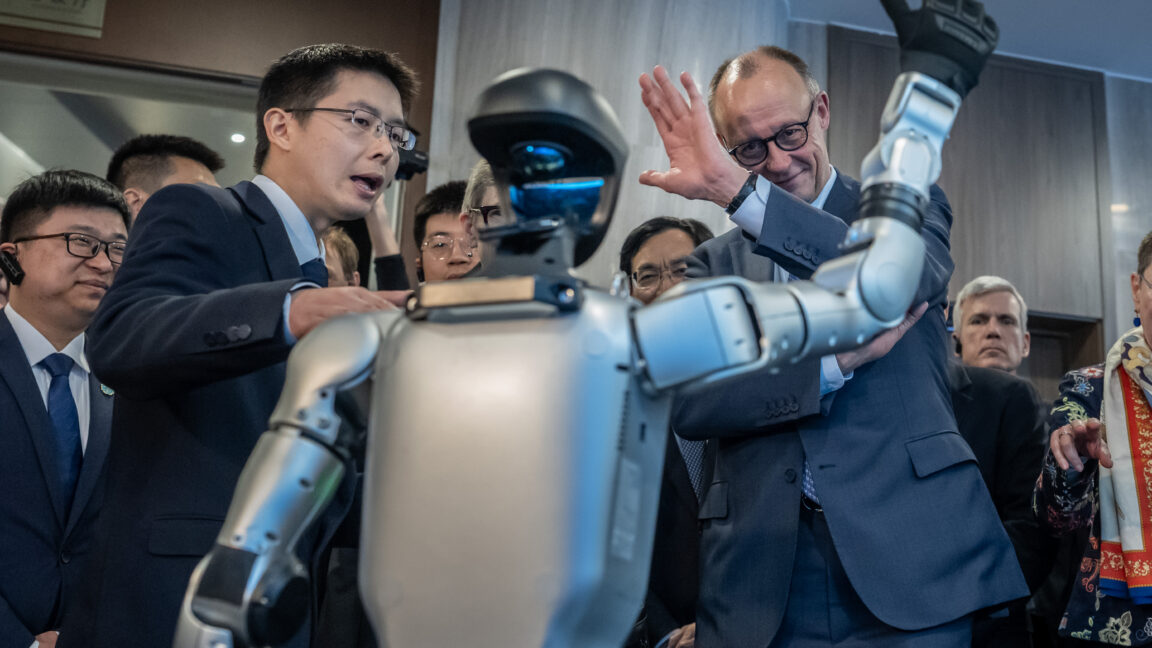
China leads the world in churning out humanoid robots and four-legged robot dogs that also happen to be the most affordable on the market—and Unitree Robotics’ founder Wang Xingxing is arguably one of the people most responsible for that Chinese lead.
The introverted founder, who prominently appeared at a 2025 business symposium hosted by Chinese President Xi Jinping, became phenomenally wealthy after Unitree launched an initial public offering on the Shanghai Stock Exchange STAR Market on August 19. But extensive reporting by Beijing-based Caijing Magazine suggests Unitree’s success so far has been driven by Wang’s extreme micromanagement leadership style—an approach that may be more suited to a small startup than a fast-growing robotics company.
Caijing’s interviews with Unitree employees and investors paint a picture of Wang as someone who personally decides nearly every aspect of corporate strategy or product design, including the colors of materials and lengths of individual screws. The Caijing Magazine feature published on August 31, titled “The King of Unitree,” was translated into English by ChinaTalk, a US-based think tank and media organization, on September 10.
The founder’s obsession with details coupled with his cost-cutting focus has driven Unitree to produce some of the cheapest walking robots on the market. Robotics hardware engineers told Caijing Magazine that Unitree achieved this cost advantage through design choices and structural engineering—and Ars has done a deep dive into the specific design decisions on hardware components that make Unitree robots so cheap.
For example, a baseline Unitree G1 humanoid robot designed for robot developers and researchers sells for $13,500, not including shipping costs, while the Unitree R1 robot intended for more casual consumers sells for $4,900.
However, this cost-cutting drive comes at the expense of quality control, according to Caijing Magazine. Unitree employees described the company’s robots as having an “extremely high” rate of returns for repairs in the early years, although that has supposedly improved to the point where the company’s robots can survive the one-year or six-month warranty periods without breaking down.
This text was published by Ars Technica AI and written by Jeremy Hsu. It is reproduced here with attribution so you can read it in full; the rights remain with the publisher. Read it at the source ↗
The headline, key points and digest above were generated by Digest AI's editorial model from the linked sources. Automated summaries can contain errors: the sources are the record. Spotted a mistake? Tell us.
More in Robotics & Physical AI
All →- Arm VP to discuss scaling trusted physical AI at RoboBusiness 2026 · 1 src
- Hyundai Motor Group Launches Data Flywheel and Outlines Autonomous Driving Roadmap · 1 src
- UltraSense proposes ultrasound for scalable, durable robotic tactile sensing · 1 src
- Writer Tests $4,000 Unitree Robot Dog in Washington, D.C., Finds Limited Practical Use · 1 src
- Monumental builds bricklaying robot fleet to tackle construction labor shortage · 2 src
Comments
via GitHub Discussions