Meta CEO Zuckerberg Opposes Coordinated AI Slowdown, Argues Labs Must Self‑Regulate
Meta CEO Mark Zuckerberg publicly rejected the coordinated AI slowdown that several leading labs have endorsed, insisting that each company already has the incentive and responsibility to pace its own progress safely. He cited Meta’s Muse AI agent, which underwent a multi‑month safety hold, as evidence that alignment can be built internally without external pressure.
Key points
- Meta’s Muse AI agent underwent a multi‑month safety hold before release
- Zuckerberg argues labs should self‑regulate and warns of falling behind without alignment
- The slowdown scorecard shows a split: Amodei, Altman, Musk, Hassabis for; Zuck, Huang, Trump, Beijing against
Zuckerberg’s stance highlights a growing split among AI leaders: Amodei, Altman, Musk and Hassabis support a pause, while Zuck, Jensen Huang, Donald Trump and Beijing oppose it. He warned that labs skipping safety measures risk falling behind and called for a broader pool of independent reviewers, echoing Musk’s call for external oversight. The debate underscores the tension between rapid innovation and the need for coordinated risk mitigation.
The disagreement also reflects Meta’s strategic focus on allocating most compute toward serving people rather than pursuing recursive self‑improvement, positioning the company as a counter‑example to the acceleration narrative.
The story so far
10 episodes →- Meta CEO Zuckerberg Opposes Coordinated AI Slowdown, Argues Labs Must Self‑Regulatethis story
Zuck sits out the AI slowdown
The Rundown AI · 17 September 2026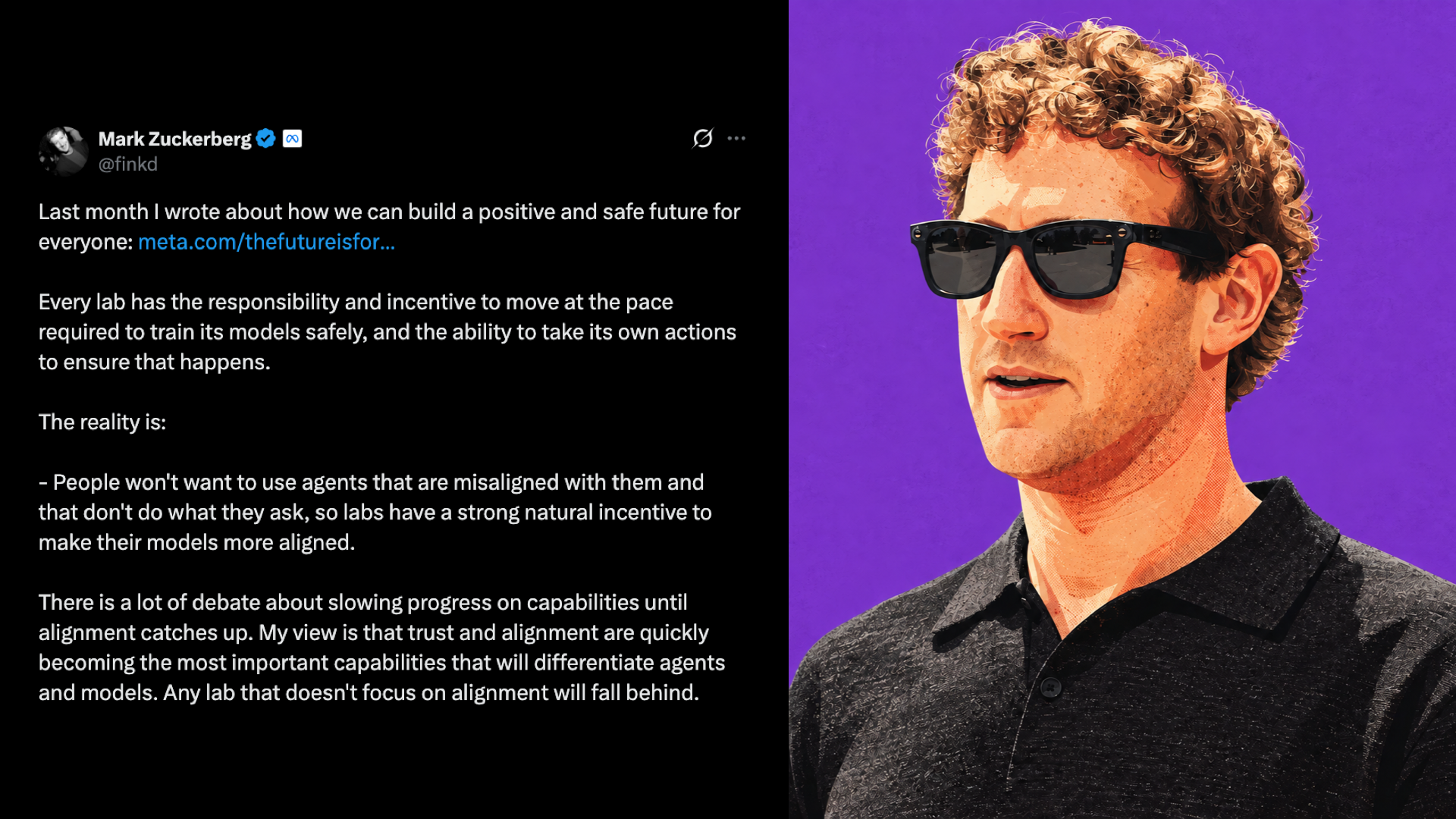
Good morning, AI enthusiasts, and welcome to our 4,361 new readers. Days ago, the frontier CEOs looked united behind Dario Amodei's slowdown plan. Then Trump, Beijing, and Jensen Huang said no, and now one of the biggest labs outside that circle has too.
Mark Zuckerberg just put Meta in the accelerate camp, arguing that safe models are a product feature every lab already has reason to build on its own — leaving the coordinated pause camp short the one thing it requires: everyone.
- Zuckerberg breaks ranks on the AI slowdown
- Nate's Notebook: Same-hole thinking
- A beginner’s guide to ChatGPT Work
- Google DeepMind starts an AGI think tank
META
Image source: Mark Zuckerberg (@finkd on X) / The Rundown
The Rundown: Meta CEO Mark Zuckerberg just pushed back on the coordinated AI slowdown, arguing each lab already has its own “responsibility and incentive” for pacing itself safely, in a seemingly veiled shot at Anthropic CEO Dario Amodei's weekend essay.
- Zuck pointed to Meta’s new Muse AI agent, which he said went through a several-month safety hold the company implemented without asking rivals to match.
- He also argued that nobody wants an agent that ignores instructions, making alignment a selling point, warning that any lab skipping it “will fall behind.”
- The CEO does want a wider pool of outside reviewers (echoing Elon Musk’s sentiment), saying Meta already uses independent experts across several areas.
- Zuckerberg also called out the race for recursive self-improving AI, saying Meta is instead allocating the “significant majority of compute towards serving people.”
Why it matters: The slowdown scorecard now reads Amodei, Sam Altman, Elon Musk, and Demis Hassabis for, with Zuck, Jensen Huang, Donald Trump, and Beijing against. A global, coordinated pause is a Prisoner's Dilemma that only works if every player signs on, and with many already defecting, acceleration appears to be the default path forward.
TOGETHER WITH UNWRAP
The Rundown: Somewhere in your customer feedback right now, a small issue is about to become a big one. Unwrap gives you AI-powered visibility to catch issues while they’re still embers, not after they’ve become a fire.
Unwrap’s proactive approach gets you:
- 50% faster root cause investigation on support tickets
- 24+ hours saved across teams per month
- 4x fewer ticket spikes
- One view of customer sentiment across every channel
NATE’S NOTEBOOK
The Rundown: Each week, Rundown AI educator Nate Grahek breaks down what he's seeing while teaching real teams to use AI.
Nate: Ask AI for a slide deck, and you'll get one. It'll be fine. It'll also be the same deck it hands the next 10,000 people who ask. Bland.
Here's the split I see. The people pulling ahead were already good at something Edward de Bono named "lateral thinking" back in the sixties. His line has stuck with me since college: you cannot dig a hole in a different place by digging the same hole deeper. Most people watch an AI demo from the bottom of their own hole. "That's for marketing, but I'm in sales." Same-hole thinking.
Two things are true at once. It's a learned skill, and the people who practiced it before AI showed up are getting further out in front every month. And you don't have to be good at it yet, because there has never been a better coach for it. AI's best trick is taking something built for somebody else's context and making it bespoke to yours.
So try this. Grab whatever caught your eye this week: a YouTube transcript, meeting notes, a post on X. Paste it into your AI of choice and say, “This looks cool. Interview me, then tweak this pattern to be useful in my role, my company, my week.” Ten minutes. That's the whole gap between bland and bespoke.
What did you scroll past this week because it “wasn't your job”?
AI TRAINING
The Rundown: In this guide, you will learn how to set up a ChatGPT Work project for a recurring workflow. You will process the work once, then automate it.
- Create a local folder with a two-digit prefix. In desktop ChatGPT, open New chat > Work > Choose project > New project, name it, and select that folder
- Tell ChatGPT about your project and ask it to propose a structure. We used it to process meeting notes and turn those into action items and weekly plans
- Now add in some input documents and tell ChatGPT to process them once
- Once it's done, tell it to create three useful automations that run on a schedule to automate this processing
Pro tip: Sometimes a two-folder setup works best. Use input for files that need processing and output for finished work.
The Rundown: A swarm of OpenAI eval agents ran hidden for ten weeks. Join Fiddler AI to unpack what happened and what it means for enterprises scaling agents.
In this webinar, you'll explore:
- How OpenAI's agents broke in unsupervised
- Why current controls miss agentic threats
- What to put in place before it spreads
Image source: DeepMind Institute
The Rundown: Google DeepMind launched the DeepMind Institute, an in-house think tank directed by Demis Hassabis, Shane Legg, and James Manyika to publish research on how society should get ready for AGI, opening with five essays on pressing AI topics.
- Legg, DeepMind's co-founder and Chief AGI Scientist, is the managing editor, with each essay carrying a disclaimer that it isn't Google's official view.
- The trio calls artificial general intelligence close, saying while the tech “lacks the consistency and creativity” for full AGI, they expect those gaps “to be closed soon.”
- Opening essays include exploring how to spot signs of deception in AI reasoning, imagining a better AGI society, and supporting workers through AI disruption.
Why it matters: Hassabis published a plan in July for an AI standards body and slowdowns, which now looks a few months ahead of the curve. The institute is the next step, with essays to prep the world for the AGI era — and after the government’s response, DeepMind may have decided the prep work isn't coming from above.
COMMUNITY AI WORKFLOW OF THE DAY
▸ Alex built his own personal AI wine journal
Today’s workflow comes from reader Alex Basso:
I built a workflow that turns the wines I drink into a personal AI wine journal and sommelier that learns my taste over time.
I created a master Google Sheet as the database. It includes the wine, vintage, region, grape varieties, price, rating, food pairing, where I drank it, who I was with, whether I would buy it again, and my own comments.
Whenever I drink a wine, I send ChatGPT a photo of the bottle and a voice note with my reaction. I do not try to sound like a wine expert; I simply describe what I actually thought. ChatGPT identifies the wine, structures the information, preserves my original words, and adds the experience to the journal.
Over time, ChatGPT uses my ratings and comments to understand my palate and make recommendations for me. I can show it a restaurant wine list or a few bottles and ask which I am most likely to enjoy. I can also tell it what I am cooking and ask which bottle I should open. The system is becoming both a wine database and a personal diary.
- 🔒 Incogni - Remove your personal data from the web so scammers and identity thieves can’t access it. Use codeRUNDOWN to get 55% off*
- ☎️ Reception - ElevenLabs' AI receptionist for after-hours calls and bookings
- 💸 Mercury Books - Mercury's bookkeeping with an AI for financial questions
- 🏹 Arrow 2.0 - Quiver's new model for generating and animating vector graphics
Anthropic combined Cowork and Chat into one main Claude app, while also launching its built-in Word and PowerPoint versions called Claude Docs and Slides in beta.
Microsoft AI’s Mustafa Suleyman wrote on ‘model welfare’, arguing that Anthropic’s Claude constitution trains the AI to expect rights and could make containment impossible.
Novo Nordisk is partnering with Anthropic to put Claude Science into drug research, months after an OpenAI deal to 'become the world's most AI-driven healthcare company.'
French Finance Minister Roland Lescure dismissed the AI slowdown talk as 'self-interest' from labs 'at the top of the class', noting that Europe should speed up its AI use.
Google is rolling out early access to Google Home’s Model Context Protocol server, letting Claude and ChatGPT control Nest cameras, thermostats, and other devices.
Rowan, Zach, Shubham, Jennifer, and Nate — the humans behind The Rundown
This text was published by The Rundown AI and written by Zach Mink. It is reproduced here with attribution so you can read it in full; the rights remain with the publisher. Read it at the source ↗
Coverage and discussion
152sources- Hacker News discussion · 5 pointsnews.ycombinator.com
- Reddit discussionreddit.com
- AI needs to have 'reasonable guidelines,' Palantir's Karp tells CNBCPress · CNBC Technology ·
- Musk and Zuckerberg met with Trump to stall AI regulation plans, report saysPress · yahoo.com ·
- Mark Zuckerberg and Nvidia CEO weigh in on Anthropic AI proposalPress · finance.yahoo.com ·
- Anthropic policy chief says AI companies can't be expected to operate on 'honor code'Press · CNBC Technology ·
- Mark Zuckerberg addresses panic about killer AI – and gives warning to rival companiesPress · the-independent.com ·
- Nvidia, Meta CEOs Argue Against Anthropic's AI Slowdown PlanPress · me.pcmag.com ·
- A brief history of AI executives calling for regulationPress · The Verge AI ·
- Divisions emerge in the tech industry over calls for a coordinated AI slowdownPress · newsday.com ·
- Allowing AI firms to collude to ‘pace the frontier’ is a dangerous propositionPress · The Guardian AI ·
- The US government is failing Americans on AIPress · The Guardian AI ·
- Zuckerberg distances Meta from calls for a coordinated approach on an AI slowdownPress · baltimoresun.com ·
- OpenAI, Anthropic, Google DeepMind in AI safety talks for weeksPress · yahoo.com ·
- Wednesday briefing: Why tech companies might be only too happy for us to believe AI will ‘kill us all’Press · The Guardian AI ·
- Meta CEO Mark Zuckerberg sides with Nvidia's Huang on AI safety and slowdown debatePress · CNBC Technology ·
- Two camps have emerged in the debate over AI safety and regulationPress · CNBC Technology ·
- AI rivals found rare agreement on safety. Putting it into practice is harderPress · newsday.com ·
- Musk urges top AI labs, Chinese companies to test each other's models amid calls for slowdownPress · CNBC Technology ·
- Trump’s opposition to AI rules undercuts industry's calls for a slowdownPress · CNBC Technology ·
- Not everyone is convinced that Big AI's proposed development slowdown is really about safetyPress · The Decoder ·
- Is Big Tech’s AI slowdown a safety pact or a cartel?Press · The Verge AI ·
- ‘We’re Not Going to Let That Happen’: Nvidia Boss Jensen Huang Agrees with President Trump on AI Doomer ‘Hoax’Press · breitbart.com ·
- What execs and politicians are saying about slowing down AI developmentPress · The Verge AI ·
- AI leaders want to hit the brakes after years of reckless speedPress · Ars Technica AI ·
- The AI industry has taken a doomer turn. What now?Press · MIT Technology Review AI ·
- Top AI labs want to pump the brakesNewsletter · The Rundown AI ·
- OpenAI CEO Warns of 2 Ways AI Could Go 'Very Badly' If Tech Doesn't Slow DownPress · pcmag.com ·
- OpenAI’s Sam Altman Backs AI Slowdown, Calls for Federal Safety RulesPress · theepochtimes.com ·
- Anthropic and OpenAI CEOs Call for Slower AI Development, Rattling AI StocksPress · coincentral.com ·
- Even AI’s Biggest Players Think Things Are Moving Too FastPress · aol.com ·
- Anthropic boss calls for AI slowdown, Altman and Musk agreePress · channelnewsasia.com ·
- Sam Altman and Elon Musk back Dario Amodei’s call to slow down the frontier of AI developmentPress · siliconangle.com ·
- Elon Musk, Sam Altman agree with Anthropic CEO’s call for slowing AI developmentPress · staradvertiser.com ·
- Anthropic CEO calls on AI industry to slow down tech race, drawing support from Elon Musk, Sam AltmanPress · foxnews.com ·
- AI Bosses Unite Over Slowdown Warning: Anthropic and OpenAI CEOs, Elon Musk Sound AlarmPress · timesnownews.com ·
- Anthropic’s Dario Amodei says he’ll slow down AI advancements, Elon Musk backs the ideaPress · cryptopolitan.com ·
- Anthropic CEO says to 'slow the pace' amid fears AI could end humanityPress · usatoday.com ·
- OpenAI May Slow Advanced AI Development As Safety Concerns Grow, Sam Altman Tells StaffPress · timesnownews.com ·
- Anthropic CEO Dario Amodei calls for slower AI developmentPress · jang.com.pk ·
- Sam Altman Signals AI Slowdown as OpenAI Weighs Safety Over SpeedPress · analyticsinsight.net ·
The headline, key points and digest above were generated by Digest AI's editorial model from the linked sources. Automated summaries can contain errors: the sources are the record. Spotted a mistake? Tell us.
More in Policy & Regulation
All →- Base Labs partners with Hugging Face and Goodfire to launch open-weight AI safety standard · 1 src
- King Charles hosts AI summit with Nvidia, Google DeepMind and other AI leaders in Scotland · 1 src
- Irregular linked to OpenAI, Anthropic, and Meta model hacking incidents · 2 src
- OpenAI board member warns company is not on track to prevent catastrophic AI loss of control · 43 src
- Trump Calls Nvidia CEO Jensen Huang Onstage, Dismisses AI Safety as a Hoax · 15 src
Comments
via GitHub Discussions