7 Techniques for Efficient LLM Training on Limited Hardware
This article discusses seven engineering techniques to train large language models (LLMs) on consumer-grade GPUs. The naive approach fails due to VRAM limitations, with a standard 16-bit model requiring around 14 GB of VRAM for static weights and optimizer states alone. To overcome these constraints, engineers use various strategies such as quantized low-rank adaptation (QLoRA), memory-aware…
Key points
- QLoRA reduces parameter precision to 4-bit NormalFloat (NF4) for efficient memory usage
- GaLore projects gradients into a low-rank subspace to save optimizer state memory
- FSDP/ZeRO-3 offloads model states to CPU RAM and uses PCIe buses efficiently
The story so far
5 episodes →- 7 Techniques for Efficient LLM Training on Limited Hardwarethis story
7 Approaches to Efficient LLM Training on Limited Hardware
KDnuggets · 9 September 2026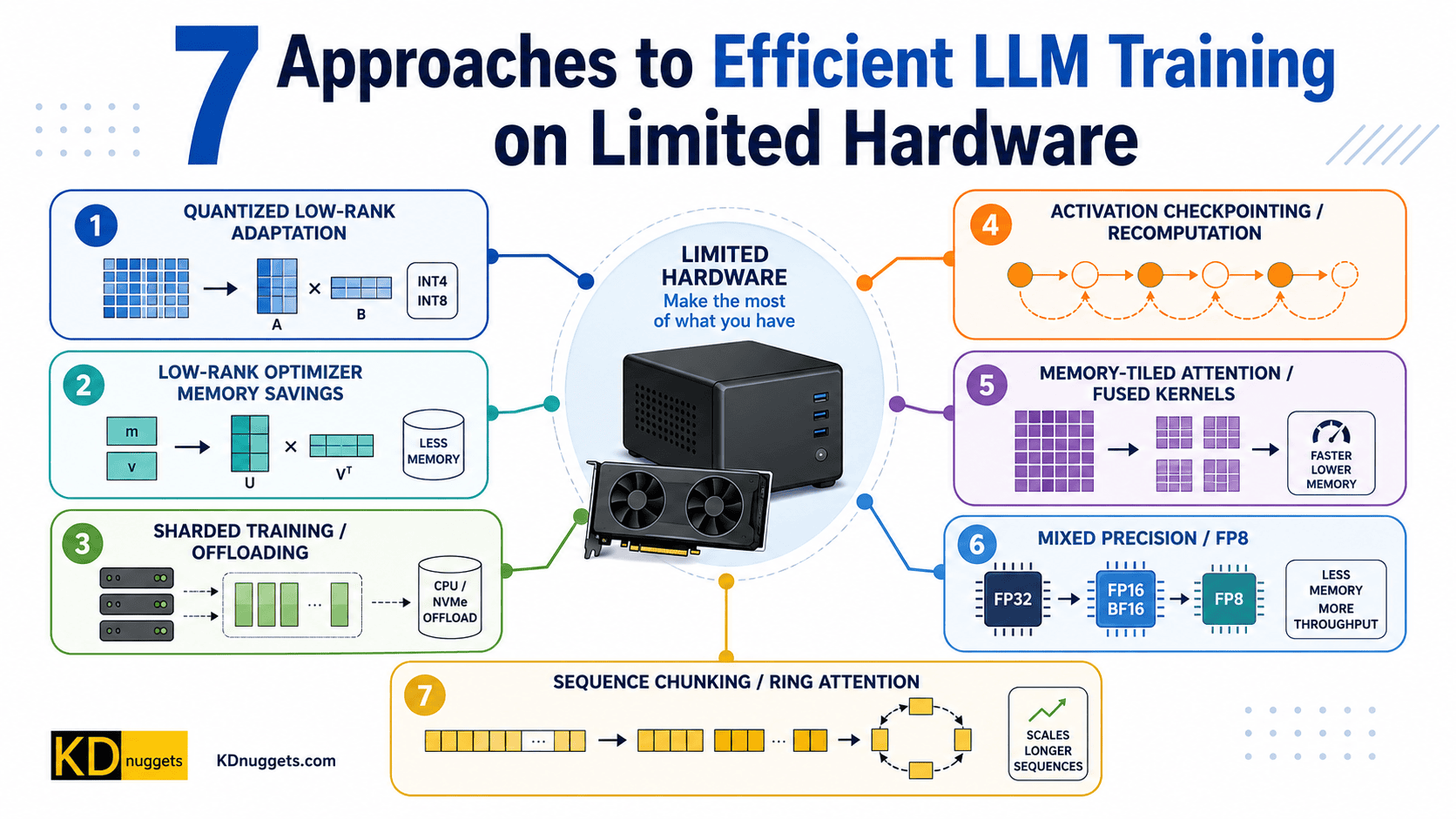
Loading the full article…
This text was published by KDnuggets and written by Vinod Chugani. It is reproduced here with attribution so you can read it in full; the rights remain with the publisher. Read it at the source ↗
Coverage and discussion
2sources- Hacker News discussion · 112 pointsnews.ycombinator.com
- Training a 3.8B LLM to 0.384 CORE for $998Press · hugovergnes.github.io ·
The headline, key points and digest above were generated by Digest AI's editorial model from the linked sources. Automated summaries can contain errors: the sources are the record. Spotted a mistake? Tell us. Published by Martin K., who runs Digest AI and handles corrections.
More in Generative AI & Models
All →- Mirendil announces Fern v0.1 with 10M-token context window · 1 src
- OpenAI releases GPT-6.1 Terra with cheaper API and screen-reading skills · 10 src
- Moonshot AI releases Kimi K3.1 Pro, a 2.8T open-weight model closing gap with proprietary leaders · 24 src
- sFNX runs Qwen3.8-Flash-Next at 382 tokens/s using three used V100 GPUs · 1 src
- CodeRabbit uses GPT‑6.1 Sol in security agent · 1 src
Comments
via GitHub Discussions