Agentic RAG adds reasoning loops to retrieval systems for complex queries
Retrieval-Augmented Generation (RAG) systems ground AI responses in external data to reduce hallucinations, but standard RAG pipelines fail on multi-step or cross-referenced queries. Naive RAG retrieves once, passes context to a model, and generates an answer—like a student grabbing three books and writing an essay without verifying relevance. This works for simple queries but cracks under…
Key points
- Naive RAG retrieves once and generates an answer, failing on multi-step or cross-referenced queries
- Agentic RAG uses reasoning loops to plan, execute, evaluate, and retry searches until confident
- Agentic RAG adds query decomposition, self-critique, and tool use but increases cost and latency
Agentic RAG reframes retrieval as a dynamic loop: the model plans, executes, evaluates, and repeats searches until confident in the results. It decomposes queries into sub-questions, routes searches to appropriate data sources, critiques retrieved chunks, and even calls external tools like calculators or APIs. While Naive RAG is cheaper and faster for straightforward tasks, Agentic RAG excels at high-stakes workflows requiring accuracy over speed. The trade-off is cost and latency: each reasoning step adds to token usage and response time. Hybrid approaches—fast pipelines for simple queries and agentic loops for complex ones—are increasingly common in production systems.
Agentic RAG vs. Naive RAG: When Your Retrieval System Should Think for Itself
KDnuggets · 16 October 2026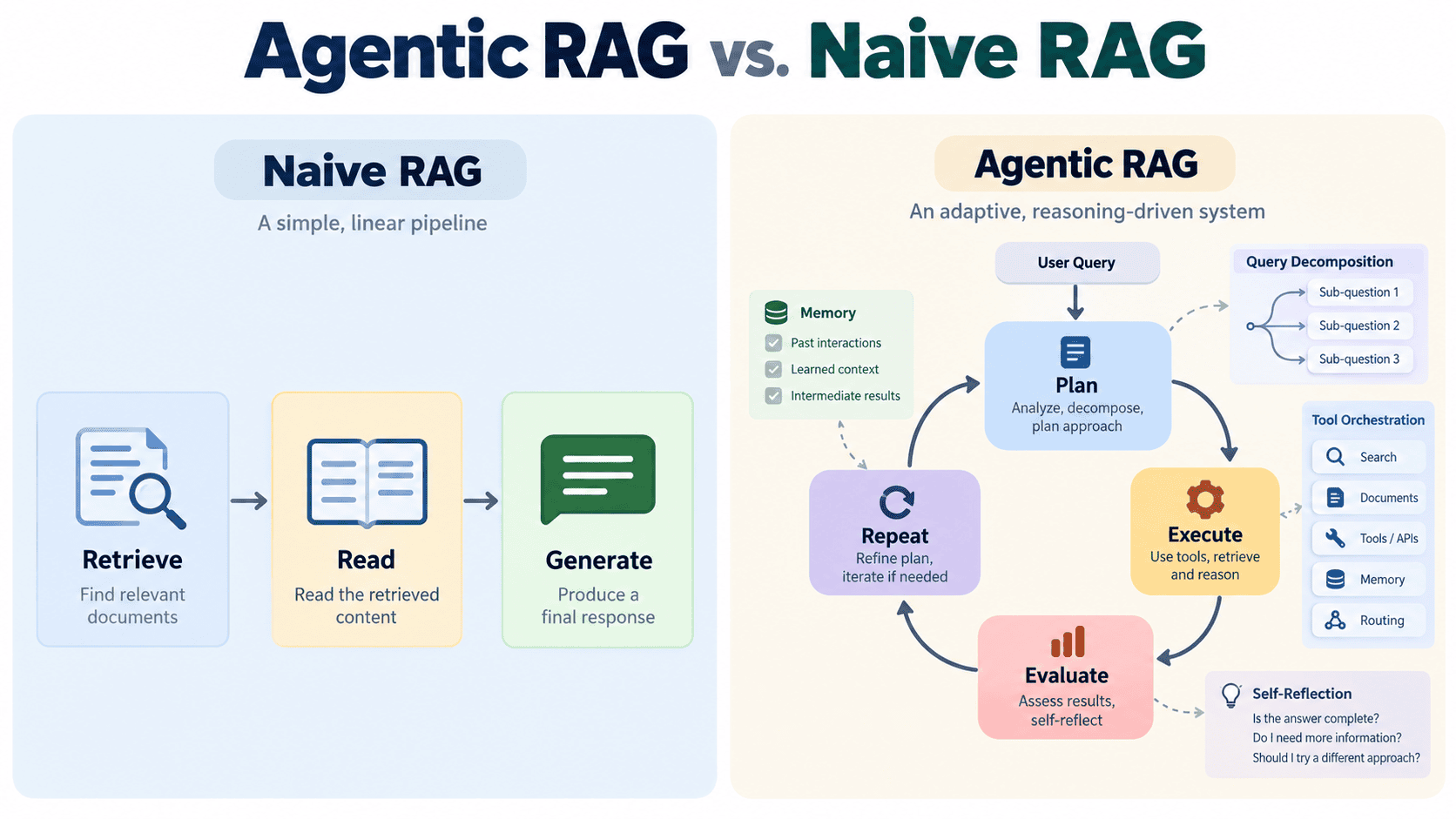
Loading the full article…
This text was published by KDnuggets and written by Vinod Chugani. It is reproduced here with attribution so you can read it in full; the rights remain with the publisher. Read it at the source ↗
The headline, key points and digest above were generated by Digest AI's editorial model from the linked sources. Automated summaries can contain errors: the sources are the record. Spotted a mistake? Tell us. Published by Martin K., who runs Digest AI and handles corrections.
More in Research
All →- Tencent releases Hy-Memory-30B-A3B for external memory frameworks · 1 src
- Linus Torvalds posts first AI-assisted Linux kernel patch with 23x benchmark gain · 2 src
- FPT expands Nemotron-Personas-Vietnam dataset to 1M personas with NVIDIA · 1 src
- Llama.cpp merges AVX2 tiled accumulator reduction update · 1 src
- GLM-5.3 shows rare update-aware reasoning during training · 1 src
Comments
via GitHub Discussions