Andrew Yang proposes taxing AI to fund universal dividends
Andrew Yang, a tech futurist and former presidential candidate, argued at MAICON 2026 that the U.S. economy is unprepared for the scale of AI-driven job displacement. He noted that nearly half of American jobs, specifically in clerical, retail, food service, transportation, and manufacturing, are directly exposed to automation. Yang highlighted that the U.S. now spends more on data centers than…
Key points
- Yang states 49% of U.S. jobs in five sectors are directly in AI’s path.
- He proposes taxing AI bots to fund a universal dividend for all citizens.
- Yang argues AI value concentrates in capital holders, while worker GDP share drops below 50%.
Yang warned that value from the roughly $3 trillion AI industry is concentrating among capital and data holders, while the worker share of GDP falls below 50%. He criticized the current model where AI companies achieve trillion-dollar valuations using data created by people who received no compensation. Additionally, he raised concerns about social impacts, such as young people outsourcing thinking and relationships to AI, noting his son’s preference for an AI girlfriend over a human one.
To address these issues, Yang proposed a "Human-Centered Economy" based on three shifts: taxing AI and bots rather than human workers, distributing the resulting revenue as a universal dividend, and rewarding sectors like arts, health, and care. He emphasized that friction and difficulty are essential to human development and urged a move from scarcity to abundance.
AI Stands to Replace Jobs. Here’s a Plan to Put People First
Marketing AI Institute · 23 November 2026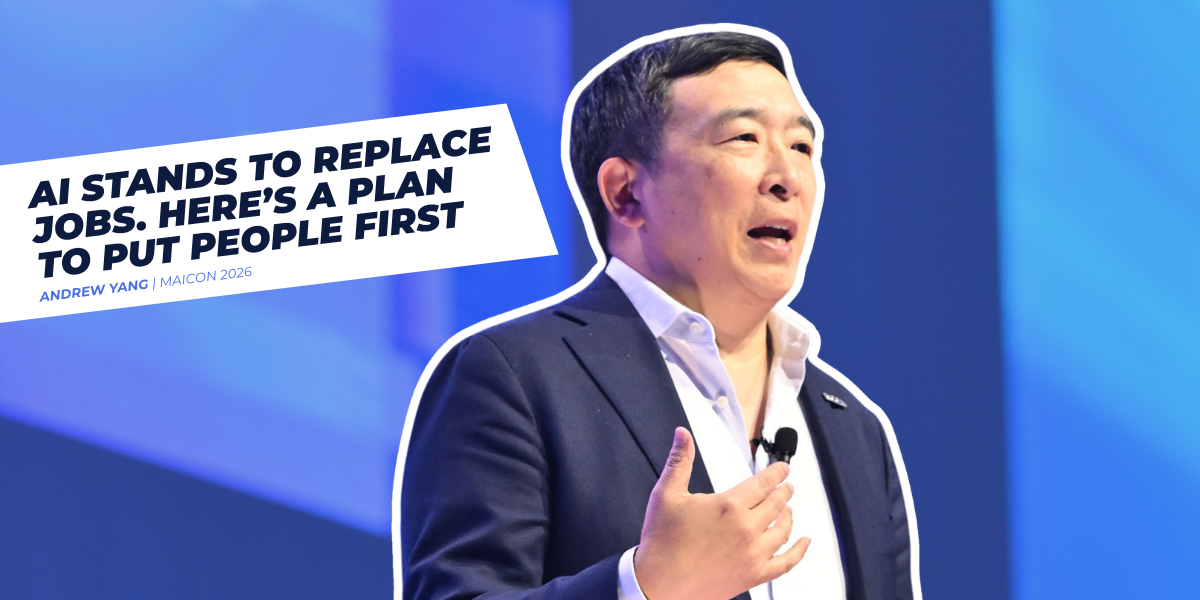
Loading the full article…
This text was published by Marketing AI Institute and written by Cathy McPhillips. It is reproduced here with attribution so you can read it in full; the rights remain with the publisher. Read it at the source ↗
The headline, key points and digest above were generated by Digest AI's editorial model from the linked sources. Automated summaries can contain errors: the sources are the record. Spotted a mistake? Tell us. Published by Martin K., who runs Digest AI and handles corrections.
More in Policy & Regulation
All →- Wang: Super Intelligence Arrived; Musk — Singularity · 2 src
- U.S. probes Megaspeed and former executive Alice Huang in Nvidia chip case · 3 src
- LeCun accuses Amodei of pushing for open AI model bans to retain control · 1 src
- Oregon and Virginia sue SpaceX over Grok Imagine’s ‘spicy mode’ for sexualized images · 2 src
- Trump threatens tax on US firms building data centers abroad · 4 src
Comments
via GitHub Discussions