Claude Opus 5.5 designs analog synthesizer PCB with 200 discrete components
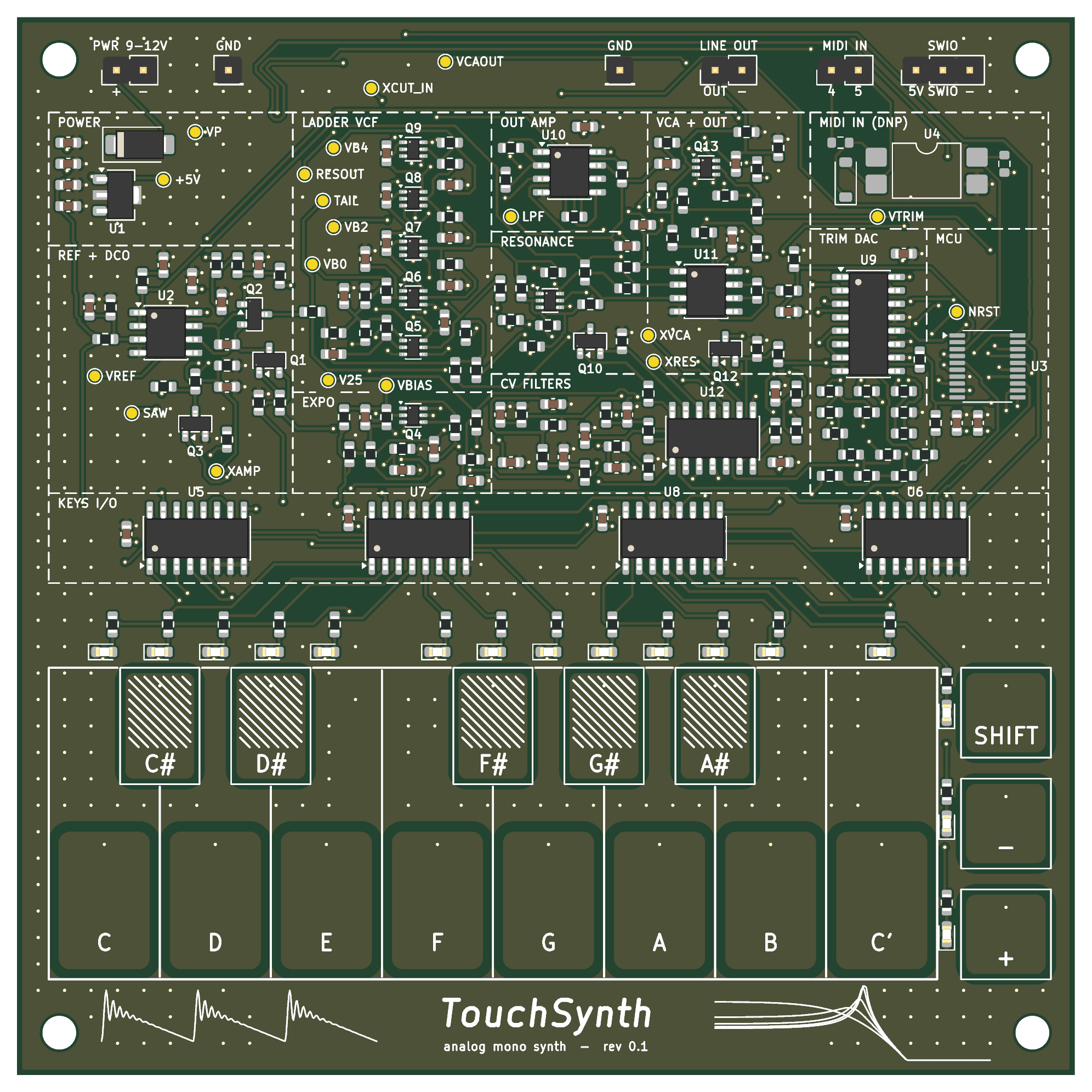
The project used the JLCPCB free parts list and targeted a CH32V00x microcontroller. Opus 5.5 generated the circuit design, ran ngspice simulations, created a behavioral Python model, wrote firmware, produced KiCad layout files, and prepared manufacturing outputs.
Key points
- Claude Opus 5.5 designed a full analog synthesizer PCB with ~200 discrete parts
- Design-to-order took ~19 hours; automated bring-up matched SPICE sims to hardware
- User only intervened on PCB floorplan and a hand-soldered MCU bridge
The signal chain includes a digitally controlled oscillator, a Moog-style transistor ladder filter, and a voltage-controlled amplifier, all built from roughly 200 discrete components. The user reviewed but did not alter the AI's design choices. PCB routing required several iterations and a move to four layers before Freerouting succeeded. Fabricated boards arrived after two weeks. Automated bring-up using an audio loopback to the MCU and an oscilloscope showed excellent match between SPICE simulations and hardware. The only hardware fix was a hand-soldered bridge on the MCU. Total design time from first prompt to order was about 19 hours, mostly unattended routing runs.
Model pages: Claude Opus 5.5 → · GPT-6 Astra →
Coverage and discussion
1source- Reddit discussionreddit.com
The headline, key points and digest above were generated by Digest AI's editorial model from the linked sources. Automated summaries can contain errors: the sources are the record. Spotted a mistake? Tell us. Published by Martin K., who runs Digest AI and handles corrections.
More in Generative AI & Models
All →- Z.ai introduces GLM-5.4 with iterative depth for reasoning tasks · 3 src
- Google releases Gemini 4 Neon for AI Pro subscribers · 76 src
- GPT-6.2 Astra and Sol score lower on transparency than Claude · 2 src
- OpenAI releases GPT-6.2 Astra and Sol; Google launches Gemini 4 Neon and free Gemini Tasks · 5 src
- Gemini 4 Neon gets rave reviews on X, users say it beats Claude Opus 5.5 · 1 src
Comments
via GitHub Discussions