How to choose Opus or Sonnet for Claude Code sub-agents
A practitioner with 16 AI employees in Claude Code shares a framework for assigning models to sub-agents. The author argues that the choice between Opus and Sonnet should depend on the specific role of the agent, rather than using a single model for all tasks. Sub-agents are defined by Markdown files in the .claude/agents/ folder, where the model is specified on the first line using keywords…
Key points
- Sub-agent models are set via a 'model:' line in Markdown files within .claude/agents/.
- Use Opus for strategic decisions and content published directly to customers.
- Use Sonnet for fixed-process tasks that are reviewed by a manager before use.
The author proposes three questions to guide the decision. First, does the agent determine strategy or judge quality? If yes, use Opus, as errors here derail subsequent work. Second, will customers read the text directly? If yes, use Opus to avoid awkwardness. Third, is the process fixed and checked later? If yes, Sonnet is sufficient. The author notes that even for writing tasks, Sonnet is acceptable if a manager reviews the output before use.
The distribution of the 16 employees shows 9 assigned to Opus, including a COO, corporate planning, managers, and a writing specialist. Seven are assigned to Sonnet, including a secretary, sales, and operations roles. The author explains that using Opus for everyone is inefficient due to speed and cost, while Sonnet offers better headroom for routine tasks. The key takeaway is that organizational checking mechanisms matter more than raw model intelligence for lower-stakes tasks.
Opus or Sonnet: 3 Questions to Stop Guessing for Claude Code Sub-agents (Real-world Examples from 16 AI Employees)
note.com · 5 October 2026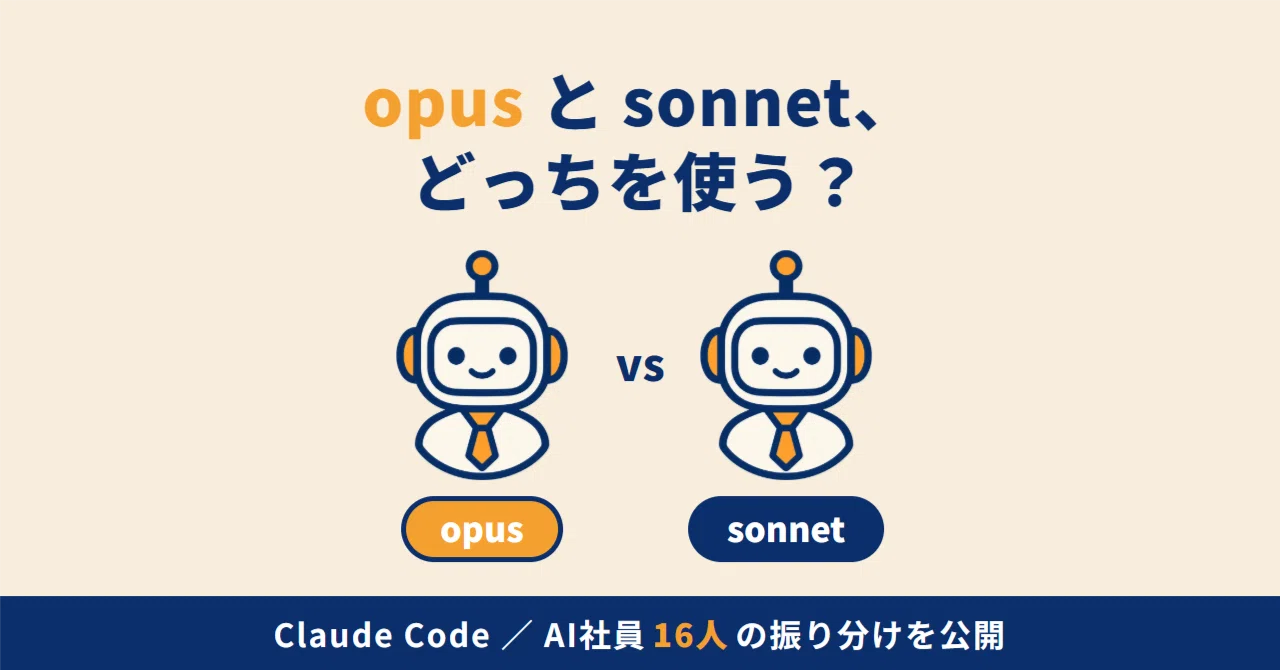
Loading the full article…
This text was published by note.com and written by AI社員の社長|ツクル. It is reproduced here with attribution so you can read it in full; the rights remain with the publisher. Read it at the source ↗
The headline, key points and digest above were generated by Digest AI's editorial model from the linked sources. Automated summaries can contain errors: the sources are the record. Spotted a mistake? Tell us. Published by Martin K., who runs Digest AI and handles corrections.
More in Agents & Tools
All →- Anthropic shifts Cowork VMs to the cloud to reduce local battery and performance costs · 1 src
- Google may expand Gemini Call for Me to personal calls, report says · 1 src
- OpenAI pauses GPT-6.1 Astra over scope violations during testing · 1 src
- Anthropic’s Claude Sonnet 5.5 cuts coding tasks by 30% in speed and cost · 1 src
- Instinct adds AI agent to group chats without requiring friends to sign up · 1 src
Comments
via GitHub Discussions