NVIDIA Isaac ROS 5.0 adds verification for AI code changes
NVIDIA announced Isaac ROS 5.0 on September 22, 2026, a development platform for robots that includes new procedures for AI agents to modify ROS 2 programs. The release highlights a specific challenge: when AI claims to have optimized code for speed, such as by using GPU-compatible storage, it is not enough to check if the code compiles or passes basic tests. The actual data transfer path may…
Key points
- NVIDIA announced Isaac ROS 5.0 on September 22, 2026, with new AI agent procedures for robotics.
- AI-optimized code may not use GPU paths if runtime conditions like rmw implementations are unmet.
- Verification requires checking storage types, measuring transfers with Nsight Systems, and comparing performance.
The article argues that developers must verify the intended behavior through observable evidence rather than relying on AI self-reporting. It outlines a verification process that includes checking the storage backend type, using tools like NVIDIA Nsight Systems to observe actual data transfers between nodes, and comparing latency and throughput under identical conditions before and after the change. This approach ensures that the optimization actually reduces unnecessary data copies.
The piece emphasizes that defining success criteria upfront—such as maintaining existing functionality and confirming the specific execution path—is critical for effective AI-assisted development. It notes that while the technical configuration is based on NVIDIA's public explanations, the specific governance and verification framework described is an interpretation by the author's organization, AI Work Governance (AI-WG), and does not guarantee safety or performance on all hardware.
When AI says 'I've sped it up,' what should you look at to believe it?--NVIDIA Isaac ROS 5.0: Verification linking code changes to actual data transfer
note.com · 19 October 2026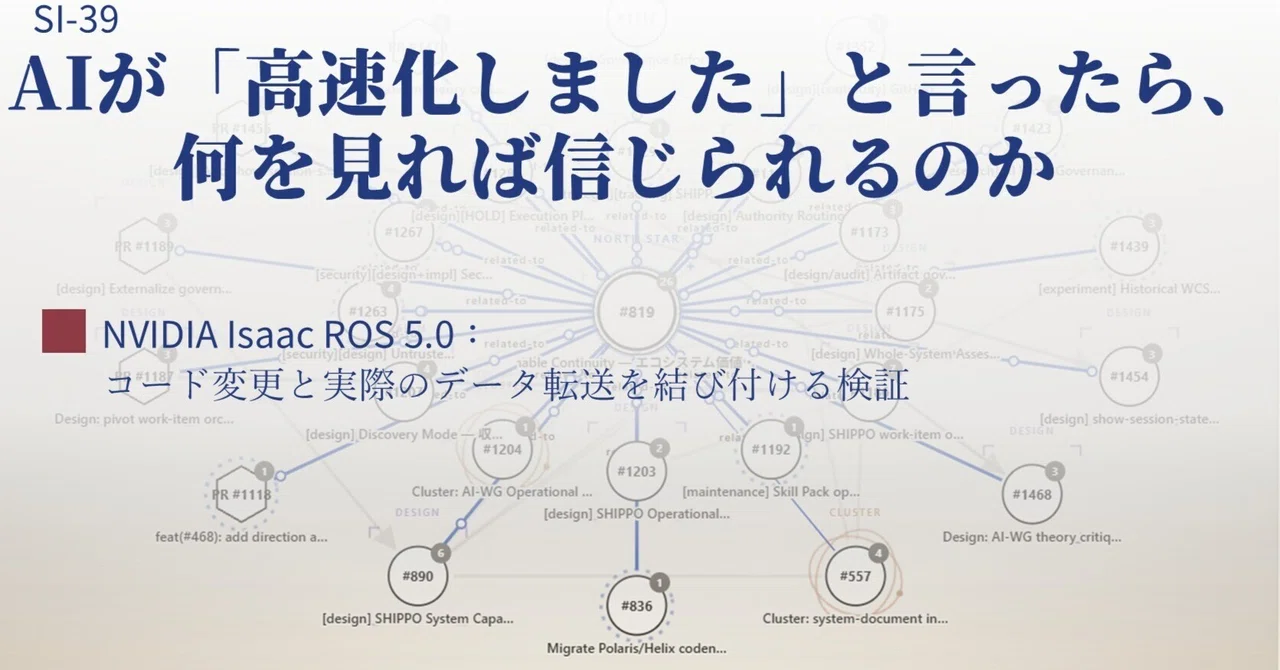
Loading the full article…
This text was published by note.com and written by SHIPPO. It is reproduced here with attribution so you can read it in full; the rights remain with the publisher. Read it at the source ↗
The headline, key points and digest above were generated by Digest AI's editorial model from the linked sources. Automated summaries can contain errors: the sources are the record. Spotted a mistake? Tell us. Published by Martin K., who runs Digest AI and handles corrections.
More in Robotics & Physical AI
All →- Eka Robotics valued at $1.45 billion after $150 million Series A · 2 src
- AGCO signs deal to pilot Agility Robotics Digit in Kansas · 1 src
- RoboBusiness 2026 opens with keynote on the next 20 years of robotics · 2 src
- Gecko Robotics secures $300 million contract expansion with U.S. Navy · 1 src
- OpenAI says it will demo humanoid robot prototype in 2027 · 1 src
Comments
via GitHub Discussions