Open Source vs. Proprietary LLMs: Framework for Decision
Open Source vs. Proprietary LLMs: A Practical Guide
Key points
- Open-source LLMs like Meta's Llama 4 and DeepSeek V3 are leading the market, especially for complex reasoning and coding tasks.
- Proprietary models from OpenAI (GPT-5), Anthropic (Claude), and Google (Gemini) offer distinct advantages in specific use cases.
- The practical factors such as data sensitivity and regulatory compliance often outweigh capability gaps when choosing between open-source and proprietary LLMs.
A new decision framework has emerged to help data scientists and machine learning engineers choose between open-weight and commercial large language models (LLMs). The shift in capability gaps, combined with varying cost dynamics and practical considerations such as data privacy and regulatory compliance, makes the choice more nuanced than ever. This guide focuses on four key questions: What does your data sensitivity require? What's your usage volume? How much do you need to customize the model? And what can your team’s infrastructure handle?
Open-Weight Landscape
The open-weight landscape is dominated by Meta's Llama 4 family, with notable models like Llama 4 Scout and DeepSeek V3. The MIT license remains permissive but less so than Apache 2.0. Qwen 3.5 from Alibaba leads in multilingual performance.
Proprietary API Landscape
Proprietary APIs are accessed through managed services, with providers handling infrastructure, updates, and scaling. Leading models include GPT-5 from OpenAI, Claude from Anthropic, and Gemini from Google. Pricing ranges widely, from $0.05 per million input tokens to over $30.
Practical Factors
While open-weight models have closed 70–90% of the capability gap against frontier proprietary models on standard benchmarks, practical factors like data sensitivity and regulatory compliance often outweigh raw benchmark scores in real-world decisions. For about 80% of text classification, summarization, structured data extraction, and retrieval-augmented generation tasks, open-weight models deliver results functionally indistinguishable from proprietary APIs.
Conclusion
For nuanced long-form reasoning or applications where output reliability at the tail end matters a lot, proprietary frontier models still hold an edge. The decision framework helps you evaluate models on your actual use cases rather than relying solely on published leaderboard scores for tasks you won’t run in production.
Open Source vs. Proprietary LLMs: A Decision Framework for 2026
KDnuggets · 20 November 2026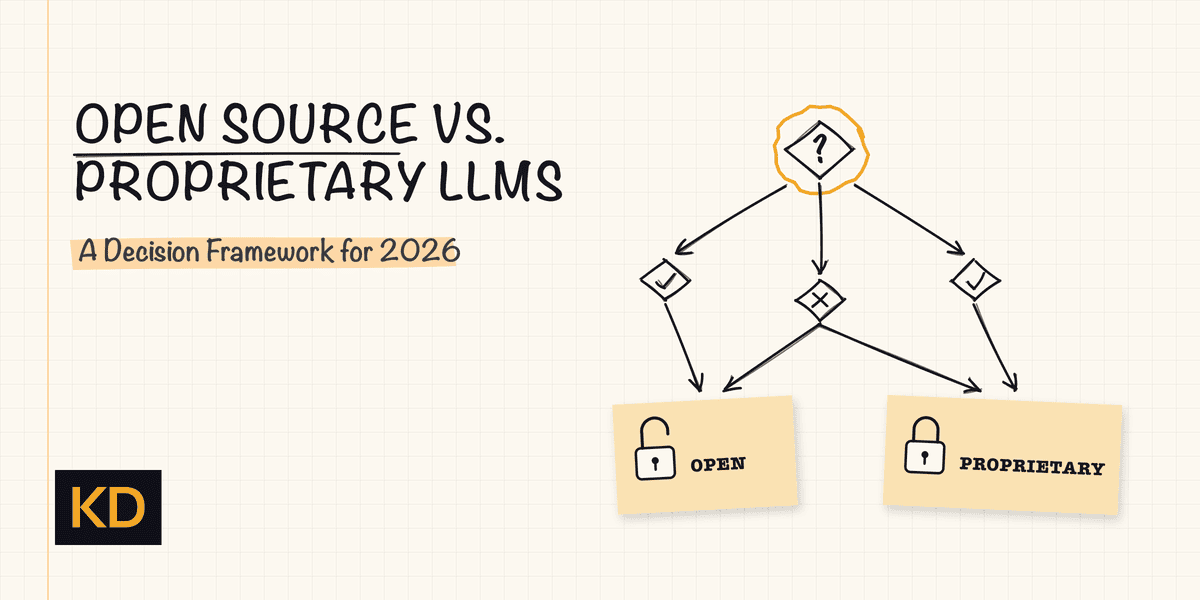
Loading the full article…
This text was published by KDnuggets and written by Vinod Chugani. It is reproduced here with attribution so you can read it in full; the rights remain with the publisher. Read it at the source ↗
The headline, key points and digest above were generated by Digest AI's editorial model from the linked sources. Automated summaries can contain errors: the sources are the record. Spotted a mistake? Tell us. Published by Martin K., who runs Digest AI and handles corrections.
More in Marketing & Small Business
All →- Google Wallet: Google Search gets more tailored with apps integration · 1 src
- Google introduces Gemini 4 Neon for faster, cheaper deep tasks at 2,900 yen/month · 8 src
- Ao schedules Claude tasks: AI works while he sleeps · 2 src
- Claude verifies 167-year-old math proof · 3 src
- Claude AI adds voice support to Apple CarPlay for iPhone users · 2 src
Comments
via GitHub Discussions