RAVEL and Sandia to study power-aware AI scheduling across three US labs
Project Quicksilver is a new research collaboration between RAVEL and Sandia National Laboratories, announced on November 12, 2026. The project aims to investigate whether AI workload scheduling can optimize power use, cooling efficiency, and operational costs across geographically distributed data centers.
Key points
- RAVEL and Sandia launch Project Quicksilver to study power-aware AI scheduling across three US labs
- Phase One compares air-cooled and immersion-cooled systems, measuring energy, TUE, PUE, and TCO
- Orchestrate AI orchestrates workloads across distributed environments to optimize power, cost, and performance
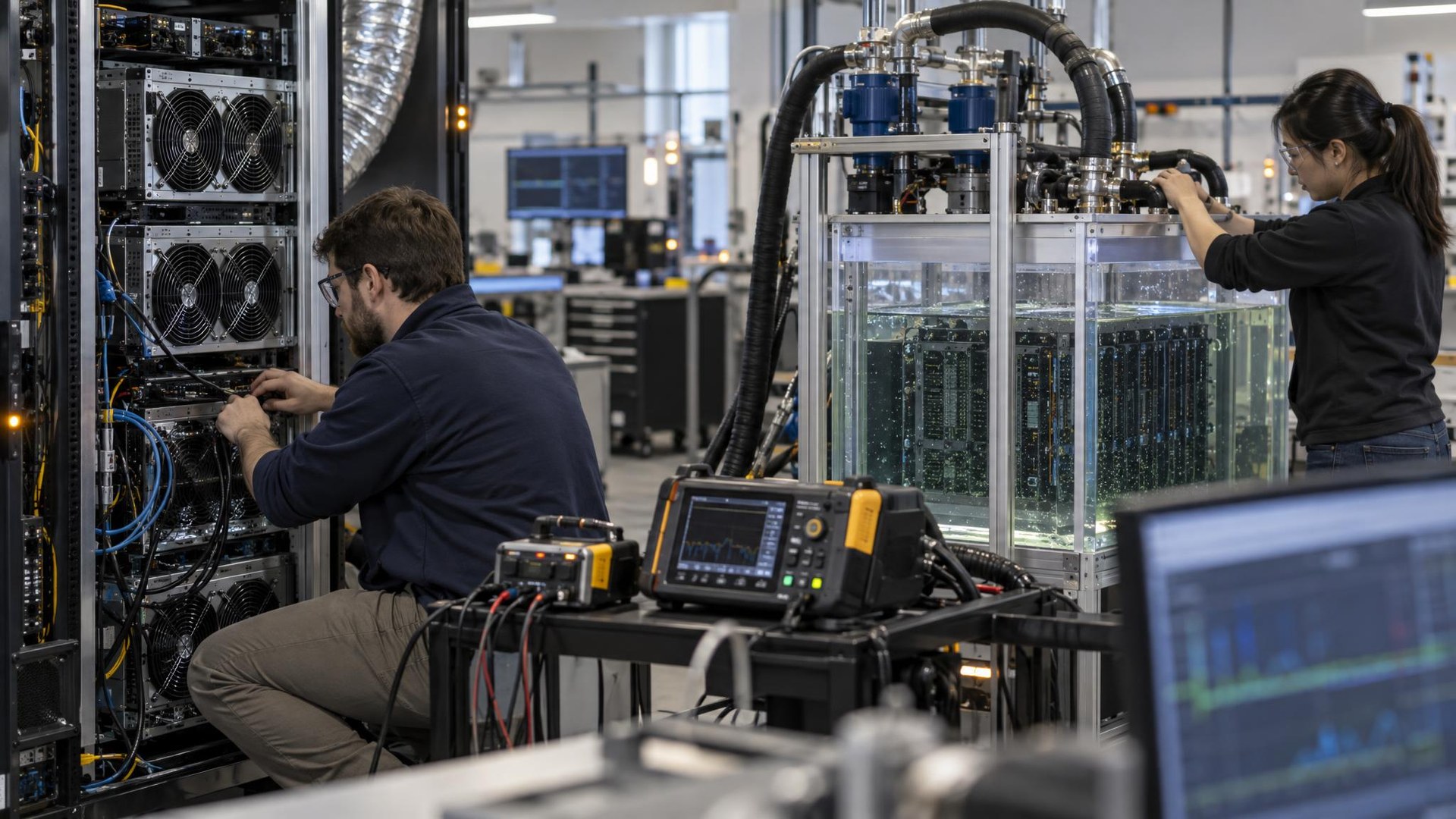
Phase One will compare air-cooled and immersion-cooled systems at three Sandia locations, measuring energy consumption, TUE (trillion useful operations), PUE-adjusted efficiency, and total cost of ownership (TCO). The study also evaluates execution time alongside energy and cost trade-offs, with a federated orchestration layer called Orchestrate AI coordinating workload placement across environments.
RAVEL CEO Denise Muyco emphasized the goal of making AI infrastructure investments more productive while promoting responsible energy use. Sandia’s Dave Martinez framed the work as exploring dynamic workload placement to balance performance, cost, and power availability. The project will expand beyond Sandia to other US Department of Energy labs and will be discussed at SC26 on November 17, 2026. No results or savings have been demonstrated yet—only planned measurements are announced.
The headline, key points and digest above were generated by Digest AI's editorial model from the linked sources. Automated summaries can contain errors: the sources are the record. Spotted a mistake? Tell us. Published by Martin K., who runs Digest AI and handles corrections.
More in Research
All →- OpenAI publishes a preprint that claims to prove that the matrix multiplication exponent (ω) is exactly 9/4, addressing a major open problem in mathematics · 2 src
- Study of 58 Anthropic customers finds 80% of AI-built apps automate manual tasks · 2 src
- Anthropic researcher proves Riemann Hypothesis with Claude, verified by Lean community · 17 src
- Google DeepMind proves Signal encryption code with AlphaProof Code · 1 src
- OpenAI reports GPT-6 designs proteins with reasoning, lab tests show binding · 4 src
Comments
via GitHub Discussions