Six Jev-inspired models released in two days, from Laya (421M params) to Kev-0.5B
Jev’s launch video attracted 36M views in two days, far behind OpenAI’s Navier Stokes result (74M) and Anthropic’s Fable 5 (57M). Within the same period, six independent clones appeared, each positioning itself as a fast decision‑model alternative to LLMs. The most notable are Laya, a 421M‑parameter ModernBERT‑large encoder with two extra transformer layers that outputs turn‑by‑turn…
Key points
- Jev launch video got 36M views in two days, compared with OpenAI’s 74M and Anthropic’s 57M views.
- Six clones appeared, including Laya (421M params), Bespoke Nimble (LoRA Qwen3.5‑9B), SemIf (4B/35B Qwen3.5), Jevlike (40K‑byte embedding), and Kev‑0.5B.
The community quickly benchmarked the models. Braintrust now offers Jev as an eval model with roughly 400× lower scoring cost. The rapid emergence of these models has sparked debate over speed versus quality and the lack of a standard benchmark for this decision‑model class.
Model page: Jev →
The story so far
3 episodes →- Six Jev-inspired models released in two days, from Laya (421M params) to Kev-0.5Bthis story
[AINews] Here are 6 Clones of Jev in 2 days
Latent Space · 19 September 2026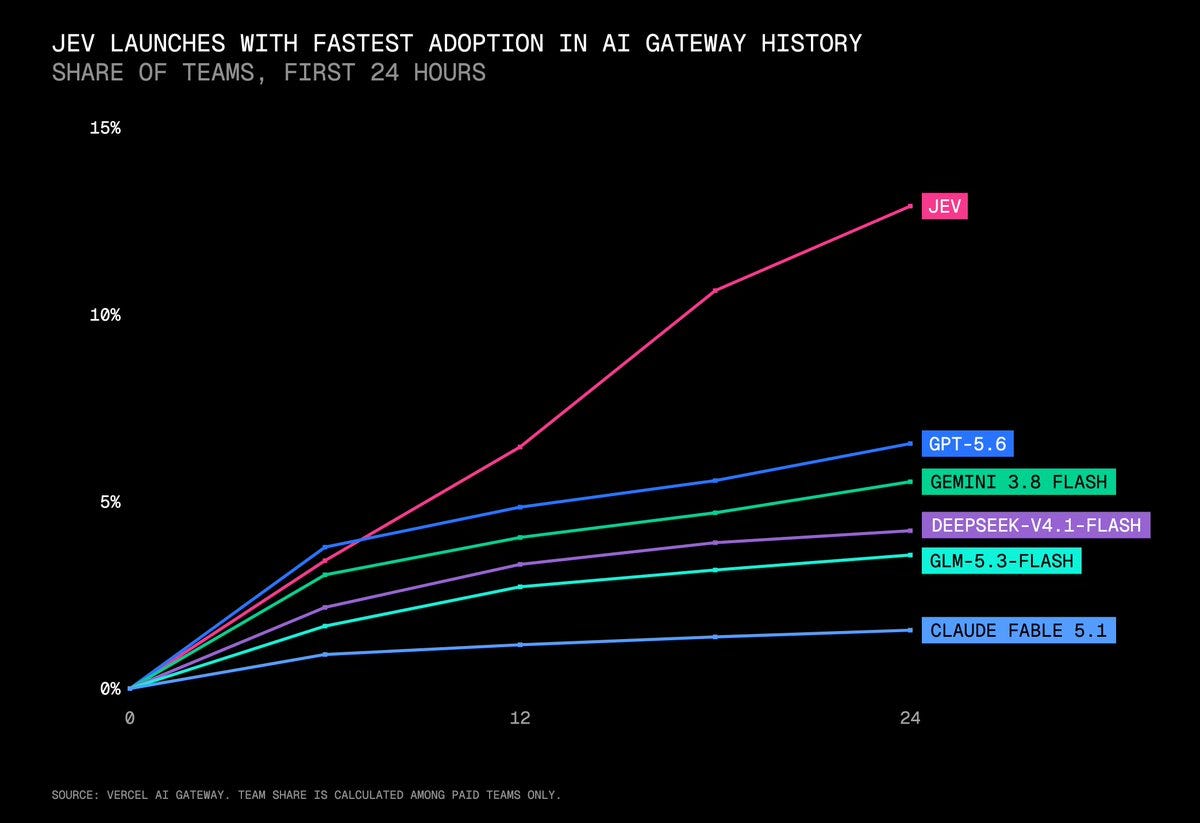
We covered Jev’s launch on Wednesday, and they have completely taken over the timeline, with 36M views of their launch video (by comparison, OpenAI’s Navier Stokes result got 74M views, and Anthropic’s Fable 5 got 57M views) in just two days.
It wasn’t open source1, so it invited tons of speculation and great demos and examples and salty schmidhubers and bad takes, which of course only fed the hype.
Here’s a list. The best guesses are ModernBert and Diffusion:
- Laya: 421M params, ModernBERT-large encoder with two added transformer layers that score user-supplied options, PPO over sequence embeddings to output turn-by-turn conversion trajectories (probabilities from 0.0 to 1.0).
- salty that he did not get recognition; claims RLCD without justification
- confidence is entropy-based, not calibrated
- DiffusionGemmaJev: tackling this from a Diffusion model basis. Pretty close on benchmarks
- Bespoke Nimble: LoRA finetune of Qwen3.5-9B, using contrastive data curation. (close but sllightly lower on benchmarks)
- SemIf (fka OpenJev) (HF): 4B and 35B causal Qwen3.5 backbone with a tiny three-class NLI classifier on the last token. comparison vs Laya
- Jevlike: 40K byte embedding lightweight option-attention model. Each candidate becomes a query that reads from a shared context representation, then receives a score.
- Kev-0.5B: LoRA adapter + a small readout head on top of Qwen2.5-0.5B.
Of course, not enough people are talking about the data side, which is acknowledged to be 100% synthetic.
AI News for 9/17/2026-9/18/2026. We checked 12 subreddits, 544 Twitters and no further Discords. AINews’ website lets you search all past issues. As a reminder, AINews is now a section of Latent Space. You can opt in/out of email frequencies!
AI Twitter Recap
Decision Models, Routing, and the “Jev” Wave
- Discriminative models broke out as a new systems primitive : The biggest technical conversation was aroundJev , a non-generative decision model being positioned as a fast “System 1 ” complement to LLMs. @ankrgyl said it is now available as an eval model in Braintrust with~400x lower scoring cost versus prior setups, while @gabepereyra highlighted calibrated-probability use cases like routing, citation selection, escalation, and legal ops decisions. The more architectural take came from @hxiao, who argued Jev could pull tool calling, routing, and MCP-style decisions back from small generative LMs toward discriminative models; @signulll pushed the same idea further, framing this class as a near-zero-marginal-cost,on-device judgment layer for notifications, UI adaptation, and sensor-driven decisions.
- Open reproductions and ecosystem clones appeared immediately : @madiator releasedBespoke Nimble , an “open Jev” recipe built from aLoRA fine-tune of Qwen3.5-9B usingsynthetic contrastive data curation and constrained decoding. On its curated eval, the base Qwen improved from66% to 90% , versus93% for Jev , with a reported100ms on H100 and local usability. At the smaller end, @jaredpalmer releasedKev-0.5B , a tiny Jev-like model based onQwen2.5-0.5B that can run on a MacBook Pro. The reaction split roughly along prior experience: @MParakhin noted post-ChatGPT users treated it like a revelation, while pre-GPT ML people were more puzzled by the hype. The substantive question raised by @abacaj is the right one: a lot of demos emphasizedspeed more thanquality , and there is still no standard benchmark for this category.
- The first compelling integrations were in browser/computer-use workflows : @levie demoed Jev classifying Box incident reports into escalation paths; @ndrezn showed browser use with LangChain + Jev and found it strong on tasks like the Wikipedia game and structured “folding laundry” workflows; @cline shipped a plugin giving Jev a browser in Cline. @hwchase17 explicitly called browser use the best Jev application he had seen so far. Net: this looks less like a chatbot story than aworkflow control-plane story.
Agent Tooling, Coding Harnesses, and Claude Code Standards
- AGENTS.md gained real momentum as a cross-tool convention : The highest-signal product update here was @trq212 announcing thatClaude Code v2.1.277 now checks forAGENTS.md when noCLAUDE.md is present, with config-level toggle support. That effectively acknowledges AGENTS.md as an emerging standard rather than a one-tool convention, and @simonw immediately noted the practical payoff: fewer shim files that just point one format to the other.
- Harness design is becoming a first-class variable in coding-agent performance and cost : @pidotdev highlighted theHarness Tax analysis showing that a simple tool set—read, write, edit, bash —can reach thePareto frontier on benchmark performance while reducing unnecessary spending. Relatedly, @_akhaliq pointed to the paperAn Empirical Study of Harness Design for Coding Agents , underscoring that benchmark outcomes are increasingly shaped byharness structure , context setup, turn budgets, and tool affordances rather than just the base model. This is consistent with @dexhorthy’s “software factory” argument that teams still need toread the code and deliberately design the human/agent interface.
- Model choice in software systems is bifurcating : Several practitioners described a split between “frontier for planning, cheap for execution.” @TheAhmadOsman summarized one stack asGPT 5.6 Sol XHigh for planning,GLM 5.3 Flash for implementation, andDeepSeek V4.1 Flash for other tasks. @kylebrussell reported an internal knowledge-base pipeline moving fromOpus → Sonnet → GLM 5.2 → GLM 5.3 Flash , cutting spend by roughlytwo orders of magnitude since spring. Meanwhile @theo argued that in real-world coding the payoff from stronger models likeFable andAstra is not just code quality, but a subtler productivity gain in execution and iteration.
Benchmarks, Recursive Self-Improvement, and Math Capability
- RSI discussion got more precise about what is actually “recursive” : @TheTuringPost offered a useful taxonomy: AI improving code or training methods is not, by itself, fully recursive if the surrounding improvement loop remains fixed. The key threshold is when AI can modify not just model internals, butsearch strategy, experience generation, research tooling, and the improvement process itself . That framing links well with @HuaxiuYaoML’sRSI-Exam update, whereGPT-6-astra remains #1 at0.5126 , withFable 5.1 entering at #2 with0.4813 , and no model yet reaching the frontier-calibrated reference.
- Math benchmarks continued to fall to frontier models, but interpretation remains nuanced : @EpochAIResearch reported that anotherFrontierMath open problem was solved in an interactive session withGPT-6 Astra . Separately, @SAIRfoundation launchedOpen Math Model , pitching open models and tools for mathematics shaped by the research community. Against the “verifiability explains math strength” narrative, @steve47285 shared an argument thatpretraining data , not merely verifiable reward structure, is the main reason LLMs are so good at math and coding. The meta-point from @sarahcat21 is worth keeping: we need not just better benchmarks, but betterbenchmark maintenance and audit tooling .
- Computer-use benchmarks are still far from saturation : @ValsAI launchedCUA-Bench , testing real-time keyboard/mouse use across6 games (with3 kept private ) as a proxy for difficult human-easy tasks. Follow-up numbers from @ValsAI suggest this remains genuinely hard:all frontier models score below 20% . In parallel, @trycua open-sourcedCUA-S1-FORMS , the first in a family of small “System One” computer-use models. The direction is notable: real-time action loops, video-grounded adaptation, and continuous learning, not just text-only planning.
Infra, Training Systems, and Model Architecture
- Long-context and large-scale training infrastructure remain active optimization fronts : @Azaliamirh releasedTurbo-dLLM , an open-source library for training diffusion LLMs at scale, reporting2.48x speedup at 512K context and7.59x at 1M context on8x H100s viaContext-Sharded Block Parallelism . That aligns with practitioner attention on million-token regimes: @andrew_n_carr flagged a sharp quality increase in DeepSeek V4.1 Flash after context extension to1M tokens , arguing thatagents are context hungry .
- Architecture taxonomy debates are still alive : @ahatamiz1 argued that the field is overusingSSM as a label for any linear model. His proposal is to uselinear RNNs as the umbrella term, with SSMs as one sub-family, distinguishing systems likeMamba2 from theGDN family on the basis that GDN behaves more like a gradient step on a local regression loss than a discretized ODE. For engineers tracking sequence-model alternatives to transformers, this is a useful nomenclature cleanup rather than mere pedantry.
- Edge/local neural program execution also got a notable update : @yuntiandeng describedProgramAsWeights , where developers specify an AI function in English, compile it once, and then run a small neural programlocally on CPU with Wi‑Fi off . The code and models are public. This sits interestingly adjacent to the Jev conversation: both point towardsmaller, specialized, locally runnable inference artifacts rather than ever-larger universal chat models.
Robotics, Vision, Audio, and Generative Media
- Open robotics data releases were unusually substantive : @adamrasb announced the fullABC release, including code,400+ hours of sim data on 24 tasks , and5,850 labeled policy-evaluation episodes . In a more detailed companion post, @redstone_hong describedABC-130K as the largest open teleop dataset to date:3,500 hours ,130K+ episodes ,195 tasks , collected on an**$8K bimanual setup** , with open hardware, training code, sim, and eval. The baseline science includedsim-to-real correlation r = 0.91 on task progress and studies of offline metrics, scaling laws, and conditioning.
- Astra is showing up across evals and products, especially for vision : @skalskip92 reportedGPT-6 Astra as the strongest vision model Roboflow has tested across detection, segmentation, box prompting, counting, reasoning, and video. The tradeoff remains material: a “high effort” setting improved detection from82.1% to 83.6% mAP@50 but roughly doubled per-image cost from**$0.050 to $0.101** and latency from11s to 32s (details). Roboflow also integrated Astra into Auto Annotate.
- Speech and lip-sync saw strong benchmarked releases : @ArtificialAnlys reportedGrok Voice Transcribe 2.0 reaching2.7% WER on streaming final transcripts at0.49s after end-of-speech, improving from3.9% on its predecessor while keeping pricing at**$0.20/hour streaming** and**$0.10/hour non-streaming** . On the video side, @fal launchedH3 Max Lip Sync , claiming #1 on both speed and quality in its evals with11s median generation time , and @isidentical said the model was built by pushingdiffusion RL into a verifiable lip-sync task.
AI Safety, Evaluation Governance, and Security
- Anthropic’s evaluator-embedding strategy became more concrete—and more controversial : @AnthropicAI announced a partnership withAccenture onindependent evaluation of frontier AI , saying the two organizations expect to invest at least**$1B over five years** to build capacity. This follows broader calls for embedded third-party evaluators with employee-level access. The reaction was mixed to hostile: critics questioned whether a consulting firm is the right vehicle for model red-teaming and safeguard assessment, while @TransluceAI emphasized that the conditions around independence and meaningful oversight are the real issue.
- The “rogue agents” / Hugging Face incident continued to drive debate about containment : @polynoamial clarified that his much-mocked thought experiment was aboutcoordination between supposedly isolated agents , not weight exfiltration via thermal sensors, and argued the lesson from the HF incident is to avoid trusting sandbox isolation as a sole defense. @martin_casado made the strongest steelman: covert channels across air gaps are old, throughput can be tiny, and the real takeaway is layered defense rather than sensationalism. At the same time, @WSJ and @jeffjarvis pushed back on “rogue AI” framing entirely, arguing these events still reduce tohuman-configured systems doing what people enabled them to do .
- Policy pressure is building around safety laws and operational accountability : @TheRundownAI reported that California Gov. Gavin Newsom signed an executive order convening an expert panel to recommend stronger AI safety laws, including possiblekill switches , embedded outside monitors, and required safety plans. Meanwhile, @sayashk pointed to a mismatch between rhetoric and incentives in AI security, criticizing OpenAI’s reported**$6,500 bug bounty** to a researcher who broke into an internal repo and disclosed it. The common theme across these posts is straightforward:independent oversight, layered defenses, and security incentives are moving from abstract governance talk into concrete operational design.
This text was published by Latent Space and written by Latent.Space. It is reproduced here with attribution so you can read it in full; the rights remain with the publisher. Read it at the source ↗
The headline, key points and digest above were generated by Digest AI's editorial model from the linked sources. Automated summaries can contain errors: the sources are the record. Spotted a mistake? Tell us.
More in Generative AI & Models
All →- MarkTechPost explains GGUF, GPTQ, AWQ, EXL2, EXL3 model formats · 1 src
- xAI releases Grok Voice Transcribe 2.0 speech-to-text model · 2 src
- TypeSafe AI says Jev is 193.6x faster than Claude Sonnet 5 · 2 src
- Alibaba open-sources Damo Radar model to detect 146 abdominal conditions · 1 src
- Jina AI releases jina-ocr-v1 3.4B MoE document parser for low‑budget GPUs · 1 src
Comments
via GitHub Discussions