STABL launches to study AI’s societal bottlenecks and resilience
STABL, a new non-profit research organization, argues that AI’s societal impact hinges less on capability improvements than on institutional adaptation and resilience. Its founders—authors of AI Snake Oil—advocate for a ‘top-right quadrant’ approach: recognizing AI’s transformative potential while addressing bottlenecks like regulatory inertia, labor market disruption, and the limits of…
Key points
- STABL argues AI’s societal impact depends more on institutional adaptation than capability alone, calling for resilience-focused strategies beyond alignment
- Research will include open-ended evaluations of RSI, domain-specific resilience planning (e.g., cybersecurity for critical infrastructure), and economic studies on AI’s role in augmentation vs. automation
- Advisory board includes Erik Brynjolfsson, Audrey Tang, and Robb Willer; STABL is fundraising and hiring across four workstreams
STABL’s work spans four pillars: empirical research (e.g., CRUX’s agent benchmarks), policy guidance (influencing US/EU AI governance), economic impact studies (e.g., how AI reshapes professions like software engineering), and conceptual synthesis to bridge polarized debates. Its advisory board includes Erik Brynjolfsson, Audrey Tang, and Robb Willer. The organization is fundraising and hiring, aiming to build an ecosystem of organizations that prioritize both AI’s potential and its downstream constraints.
The missing quadrant in responses to AI
AI Snake Oil · 10 November 2026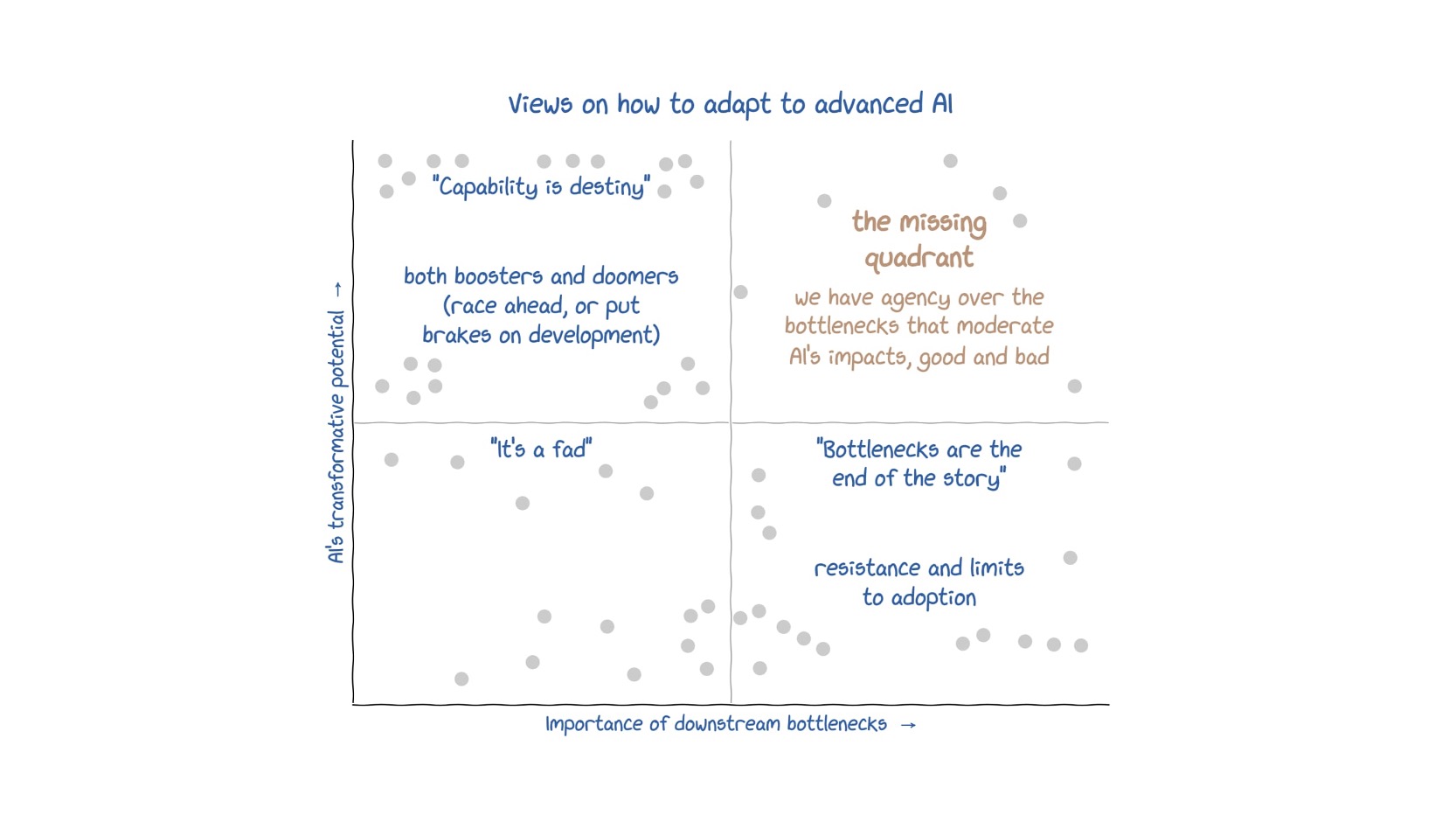
Loading the full article…
This text was published by AI Snake Oil and written by Sayash Kapoor. It is reproduced here with attribution so you can read it in full; the rights remain with the publisher. Read it at the source ↗
The headline, key points and digest above were generated by Digest AI's editorial model from the linked sources. Automated summaries can contain errors: the sources are the record. Spotted a mistake? Tell us. Published by Martin K., who runs Digest AI and handles corrections.
More in Research
All →- Google DeepMind cuts quantum circuit costs with Gemini 4 agents · 1 src
- Hi-TPH dataset improves T cell receptor binding predictions · 1 src
- OpenAI releases 'yardstick for intelligence': Let's pause here · 1 src
- Hugging Face outlines steps for building and maintaining agentic evaluations · 1 src
- Apple launches 200,000-person study on health AI trust with OpenEvidence · 1 src
Comments
via GitHub Discussions