Tsukunobi tests Claude, ChatGPT, Gemini on CAD plan conversion from hand-drawn sketches
Tsukunobi, an AI firm for construction firms, compared Claude, ChatGPT, and Gemini by feeding them a hand-drawn floor plan of a two-story wooden house. The goal was to generate a usable DXF file for CAD software, with precise millimeter measurements and no line-by-line tracing.
Key points
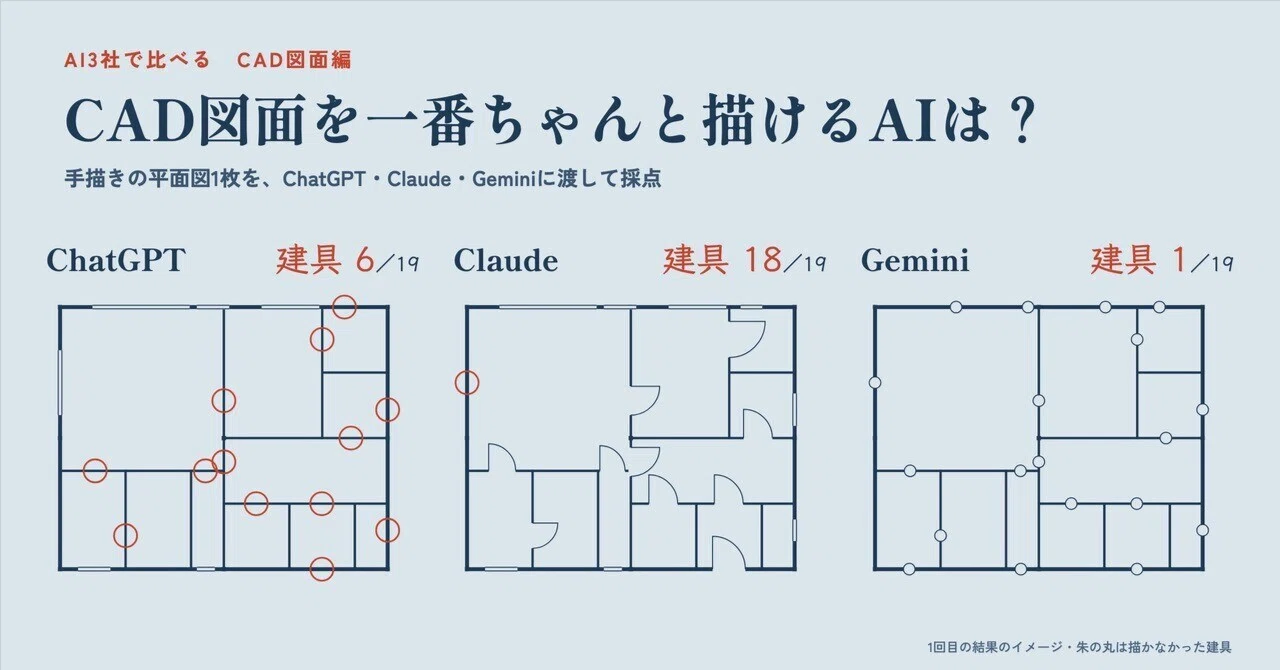
- Claude drew 18/19 fittings, 36/36 dimensions, and 66/67 text items on first try with no tweaks to the prompt
- ChatGPT and Gemini missed most fittings without dimensions but improved to 17/19 and 19/19 fittings after adding one prompt sentence
- All three models output DXF files matching the 9,100mm width and 12 grid lines, but only Claude’s first attempt was ready for CAD edits
All three models succeeded in matching the building’s width (9,100mm) and grid lines, but their handling of doors, windows, and fittings without dimension labels varied widely.
Claude outperformed the others in the first round, drawing all 25 columns, 36 dimensions, 18 of 19 fittings, and 66 of 67 text items. ChatGPT missed 19 fittings, citing lack of dimension data, while Gemini only placed symbolic markers for fittings and omitted swing directions. Adding a single prompt tweak—‘measure doors/windows without labels using the scale and list measured areas’—boosted ChatGPT’s fitting count from 6 to 19 and Gemini’s from 1 to 17. Tsukunobi’s representative, Nitta, emphasized that Claude delivered the most usable output on first try, reducing manual corrections needed. The tests highlight how prompt engineering can drastically improve results, though human verification remains critical for accuracy.
The headline, key points and digest above were generated by Digest AI's editorial model from the linked sources. Automated summaries can contain errors: the sources are the record. Spotted a mistake? Tell us. Published by Martin K., who runs Digest AI and handles corrections.
Comments
via GitHub Discussions