Ahead of AI releases eight‑hour video course on building reasoning models from scratch
Ahead of AI has published a new eight‑video series, totaling about 11 hours, that walks through building a reasoning model from a pre‑trained Qwen3 0.6B model using Python and PyTorch. The course starts with loading the base model, adds KV caching and compilation, then implements verification, inference‑time scaling, self‑consistency, scoring, self‑refinement, and reinforcement learning with…
Key points
- Eight coding videos (≈11 hours) teach building a reasoning model on Qwen3 0.6B.
- Techniques covered include KV caching, self‑consistency, scoring, and RLVR with GRPO.
- Evaluation uses the MATH‑500 benchmark; book available from Manning and Amazon.
The videos complement the companion book Build a Reasoning Model (From Scratch), available from Manning and Amazon, and reference related material such as the Build a Large Language Model (From Scratch) book and a LinkedIn Learning course on AI reasoning models. Prerequisites include familiarity with Python and PyTorch; early examples run on a CPU, while later training steps benefit from a GPU. The material is positioned as a sequel to the author’s earlier coding‑LLM course and aims to help readers understand and implement modern reasoning‑model techniques.
Building Reasoning Models from the Ground Up: A Video Course
Ahead of AI (Sebastian Raschka) · 24 October 2026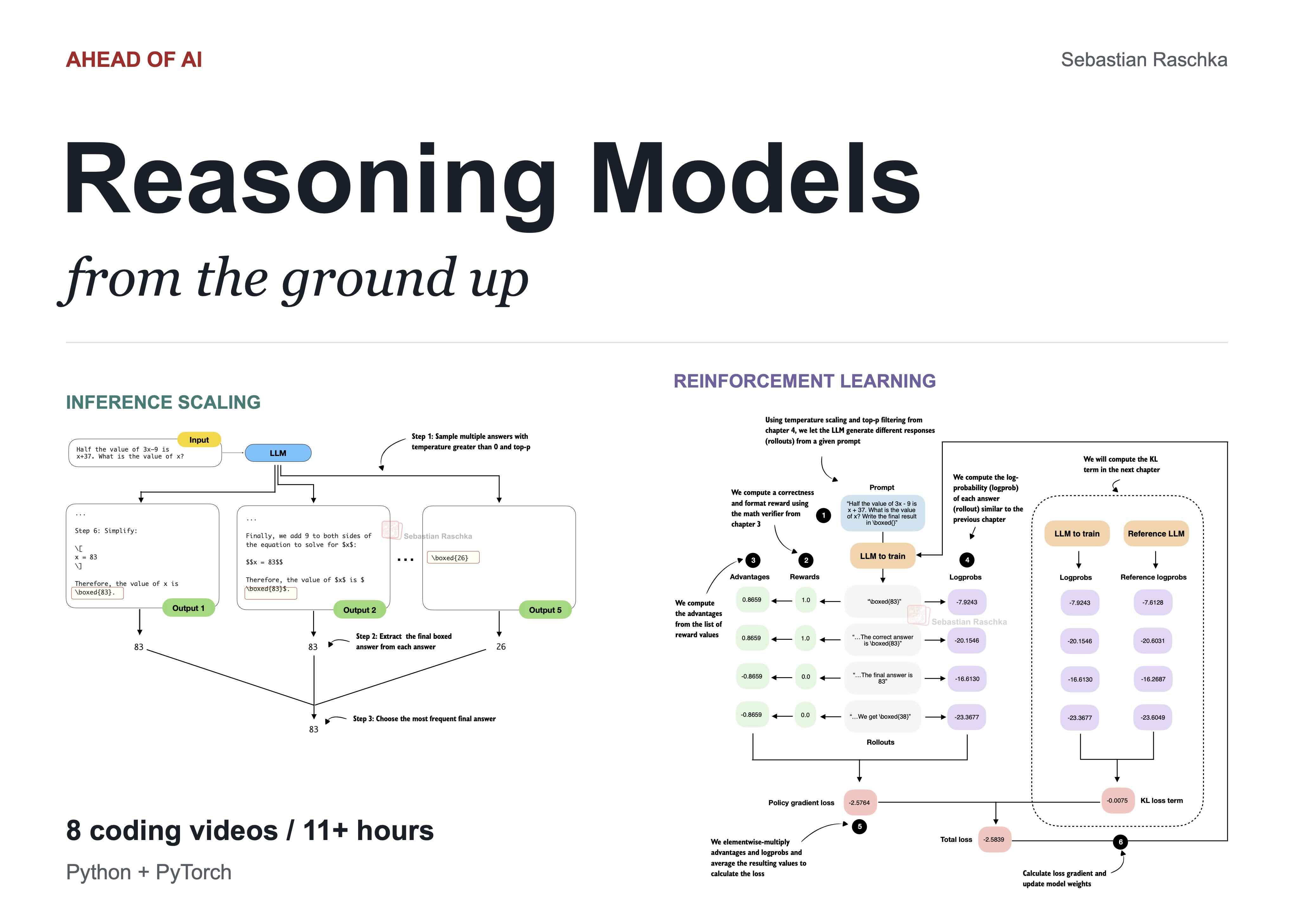
Loading the full article…
This text was published by Ahead of AI (Sebastian Raschka) and written by Sebastian Raschka, PhD. It is reproduced here with attribution so you can read it in full; the rights remain with the publisher. Read it at the source ↗
The headline, key points and digest above were generated by Digest AI's editorial model from the linked sources. Automated summaries can contain errors: the sources are the record. Spotted a mistake? Tell us. Published by Martin K., who runs Digest AI and handles corrections.
More in Generative AI & Models
All →- Anthropic Claude Opus 5.5 rejects disabled thinking, causing 400 errors · 1 src
- How Do AI Video Generators Work? From Diffusion to World Simulation · 1 src
- Nvidia and University of Washington unveil open-source protein design model RFD4-Proteina · 2 src
- Moonshot AI releases Kimi K3.1 Pro, a 2.8T open-weight model closing gap with proprietary leaders · 6 src
- NVIDIA releases Nemotron 3.5 Bolt E4B for local voice agents and robots · 2 src
Comments
via GitHub Discussions