Building Graph-Enhanced GenAI Apps with graphrag-toolkit
Building Graph-Enhanced GenAI Applications
Key points
- Graph-Enhanced RAG connects related facts missed by plain vector search
- Builds multi-hop research assistants using AWS Labs' `graphrag-toolkit` and Neo4j
- Uses a knowledge graph to follow relationships between pieces of information
Learn how graph-enhanced RAG connects related facts that plain vector search misses. Build a multi-hop research assistant using AWS Labs' open-source graphrag-toolkit, Neo4j, and pgvector.
A standard retrieval-augmented generation (RAG) chatbot handles 'what does the return policy say' without any trouble: it finds the chunk, hands it to the model, and it's done. But for complex queries like 'how does the return policy interact with the warranty terms for international orders,' plain vector search struggles.
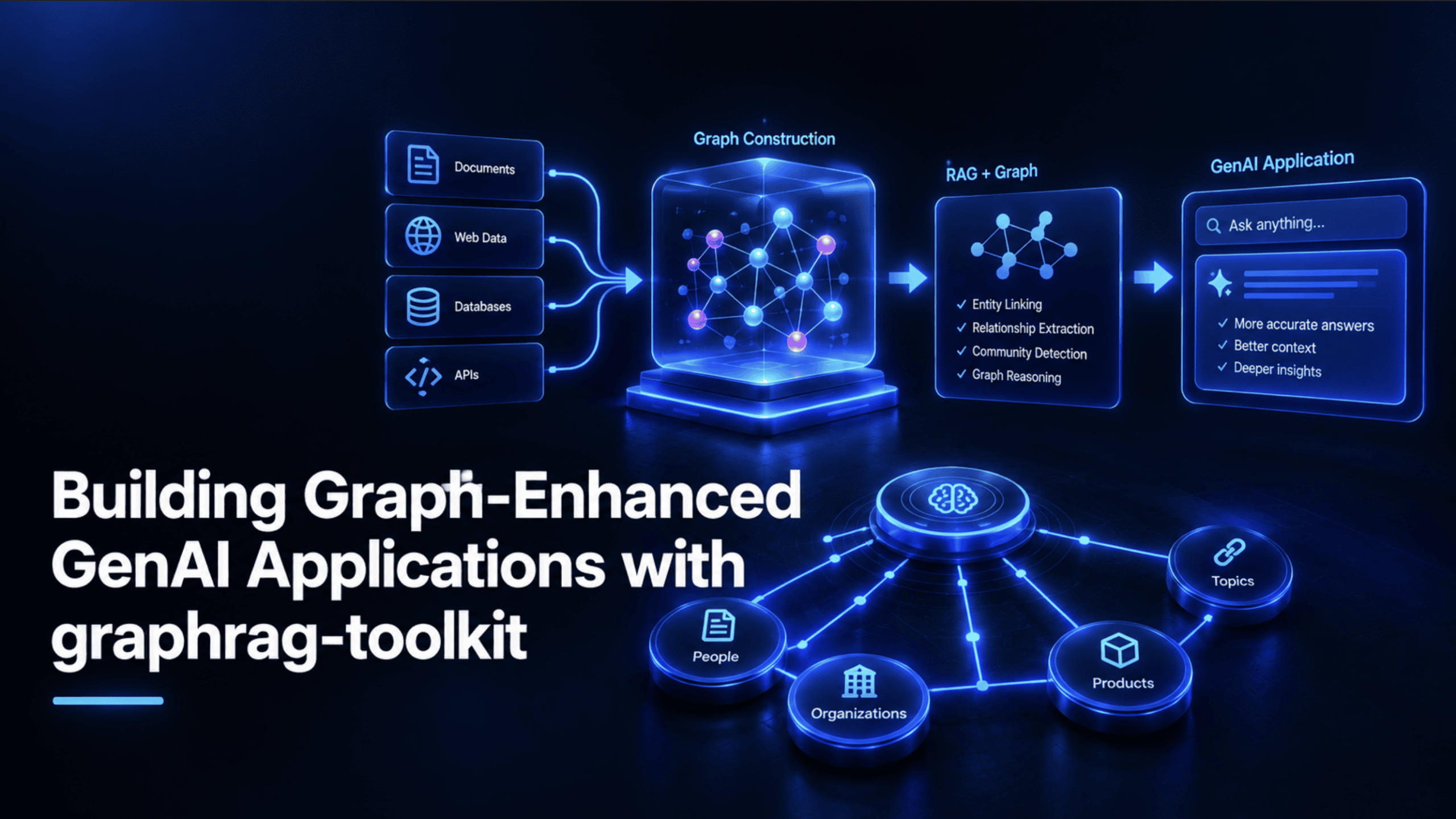
Graph-enhanced RAG uses a knowledge graph instead of a plain vector index, allowing applications to follow actual relationships between pieces of information rather than only finding text that sounds similar to the question. This is crucial for multi-hop questions, which require connecting two separate pieces of the document that were never near each other in the source text.
AWS Labs' graphrag-toolkit closes this gap by automatically building a hierarchical knowledge graph from unstructured documents and querying it. It's made up of two components: lexical-graph, for extracting content into six connected levels (source, chunk, topic, statement, fact, entity), and BYOKG-RAG, for teams with existing knowledge graphs.
This article walks through what that actually means, introduces the toolkit, and builds a real, working graph-enhanced research assistant from scratch. Every piece of code is checked directly against the toolkit's own documentation rather than assumed from memory.
The headline, key points and digest above were generated by Digest AI's editorial model from the linked sources. Automated summaries can contain errors: the sources are the record. Spotted a mistake? Tell us. Published by Martin K., who runs Digest AI and handles corrections.
More in Generative AI & Models
All →- Hill-climbing Inkling 2 Mini inference · 2 src
- Google showcases six Gemini 4 Hydrogen demos, including a reactive moth · 5 src
- OpenAI rolls out GPT-6.2 Sol for ChatGPT Plus, Pro, and Enterprise users · 8 src
- Perplexity users shift from Opus 5.5 and Sol 6.2 to Gemini 4 Neon at 15% daily growth · 2 src
- Google DeepMind releases 544-prompt HFE test to measure LLM consistency · 1 src
Comments
via GitHub Discussions