Thinking Machines Lab releases Inkling 2 Mini for local use on RTX 3090
Thinking Machines Lab has launched Inkling 2 Mini, a 26B-parameter open-weight model optimized for local deployment.
Key points
- Inkling 2 Mini runs locally on an RTX 3090 with 24GB VRAM via 4-bit quantization, delivering 52 tokens/sec
- Outperforms Qwen3.8-27B on coding and agentic benchmarks despite having 26B parameters
- Community optimizations achieve up to 300 tokens/sec; model supports custom tools and inference engines
The model uses a Mixture-of-Experts architecture and speculative decoding to achieve fast inference—delivering 52 tokens per second on an RTX 3090 with 24GB VRAM—while matching Qwen3.8-27B on benchmarks like the Artificial Analysis Intelligence Index and outperforming it in coding and agentic tasks.
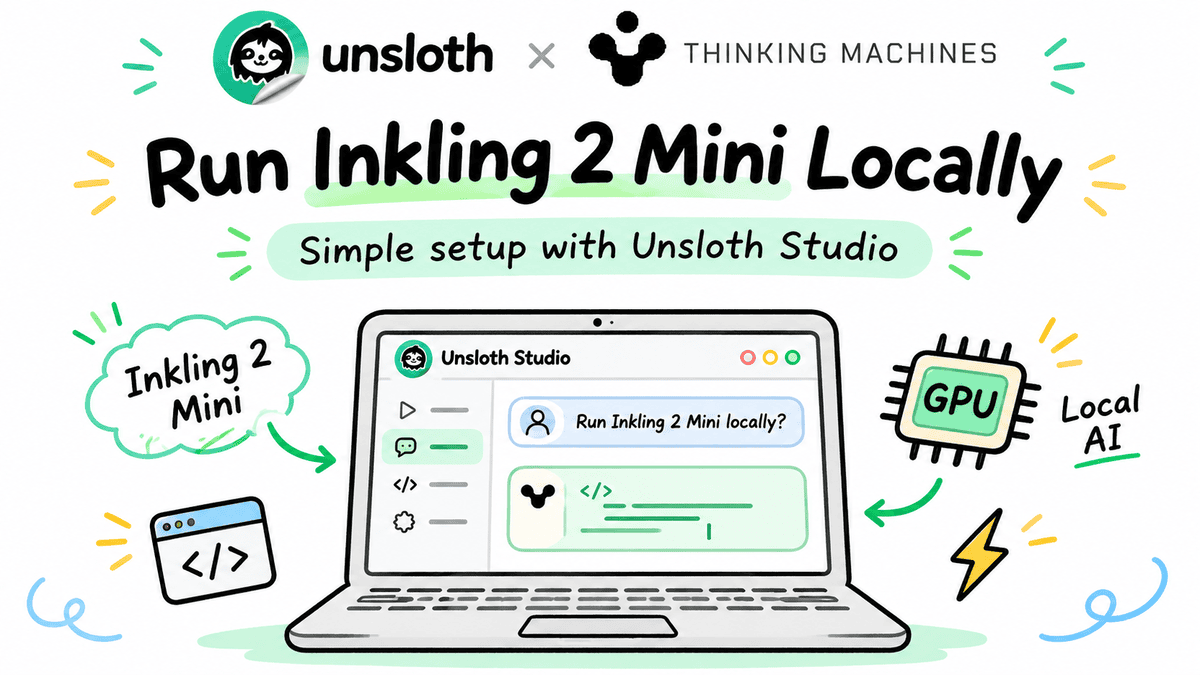
The tutorial demonstrates how to run Inkling 2 Mini via Unsloth Studio, a web-based interface for local AI models. Tests included generating a financial dashboard, building a 2D endless-runner game, and integrating the model with the Pi coding agent for terminal-based development. The author notes that community optimizations—such as custom llama.cpp builds—can push performance to 300 tokens per second or more, depending on hardware and quantization. The model’s open-weight nature allows for further experimentation with tools, inference engines, and custom skills, positioning it as a cost-effective alternative to proprietary APIs for developers and researchers.
The story so far
3 episodes →- Thinking Machines Lab releases Inkling 2 Mini for local use on RTX 3090this story
The headline, key points and digest above were generated by Digest AI's editorial model from the linked sources. Automated summaries can contain errors: the sources are the record. Spotted a mistake? Tell us. Published by Martin K., who runs Digest AI and handles corrections.
More in Research
All →- Benchmark shows models fail on idioms, local knowledge despite Reasoning gains · 2 src
- PrentisAI releases MatHarness for long-term materials science research · 1 src
- ByteDance and HKU open-source Laminar RL framework · 1 src
- Muted Distillation: Sealing Reasoning from Teacher Unlocks Token-Efficient Agents · 1 src
- Neurosymbolic harnesses improve RLM-27B results on long-context benchmarks · 1 src
Comments
via GitHub Discussions