ByteDance and HKU open-source Laminar RL framework
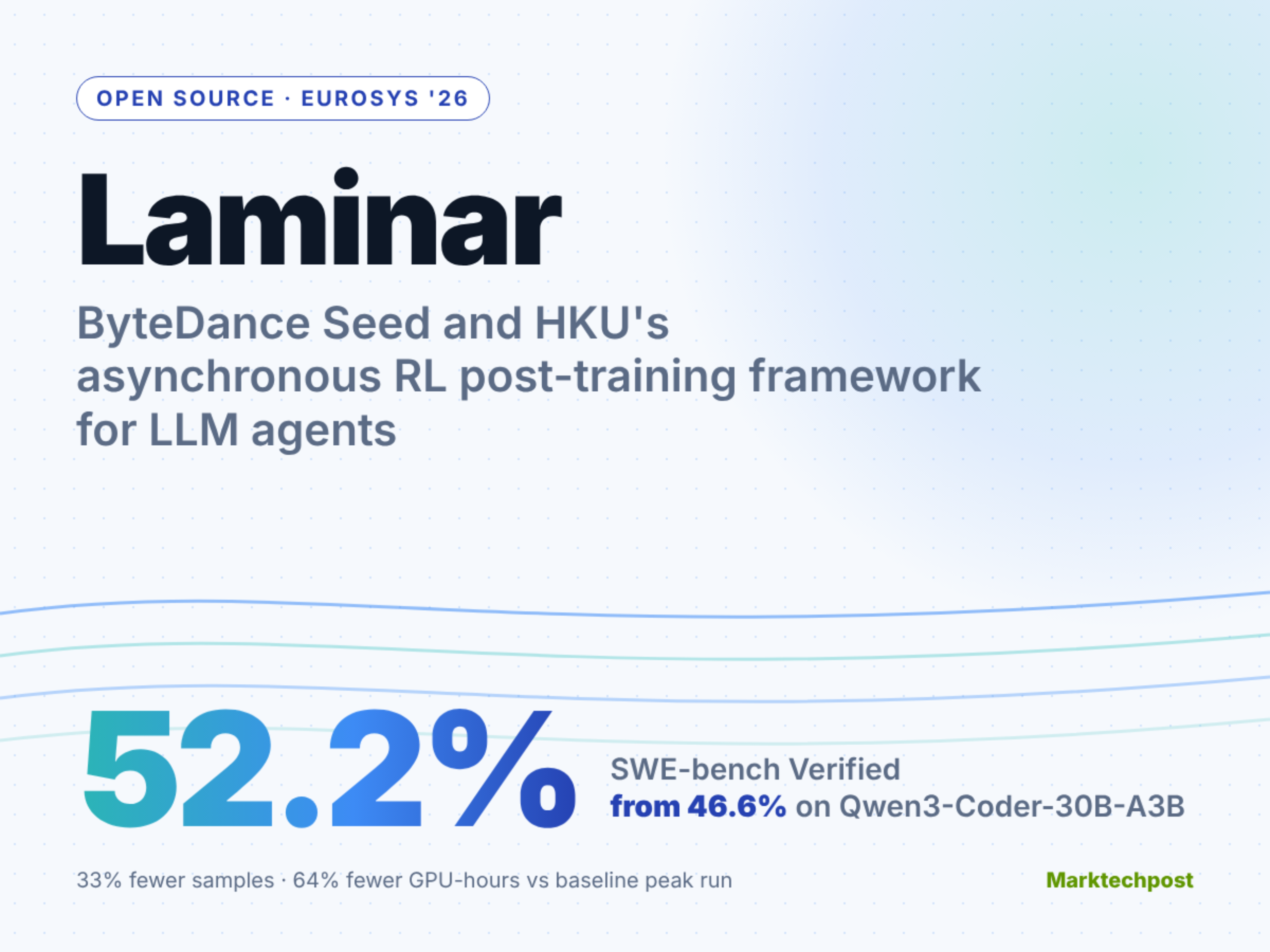
Researchers from The University of Hong Kong and ByteDance Seed have released Laminar, an open-source reinforcement learning post-training framework for large language models and long-horizon agents.
Key points
- Laminar is an open-source RL post-training framework released by ByteDance Seed and HKU researchers.
- It achieved 52.2% on SWE-bench Verified, up from 46.6% for the base Qwen3-Coder-30B model.
- The framework uses 33% fewer samples and 64% fewer GPU-hours than the baseline in reported tests.
The tool is designed to improve GPU efficiency by decoupling rollout, buffering, training, and weight transfer into independent asynchronous loops, preventing slower processes from blocking the entire system. It is built on existing infrastructure like verl and Uni-Agent and released under the Apache-2.0 license.
The team tested Laminar on Qwen3-Coder-30B-A3B-Instruct and Qwen2.5 models across multi-node NVIDIA GPU clusters, including configurations with up to 1,024 H800 GPUs. In their evaluation on SWE-bench Verified, the framework achieved a score of 52.2%, up from the base model's 46.6%. The authors report that reaching this performance required 33% fewer samples and 64% fewer GPU-hours compared to their baseline, though they note the baseline used H100 hardware while Laminar used H800s. The framework also introduces version-consistent rollout to avoid repeated re-prefill costs and includes fault-tolerance mechanisms that allow individual replicas to recover without stopping the trainer.
Despite the performance gains, the project is in early stages. The repository currently has only one commit, vLLM is the sole supported inference backend, and per-step asynchronous checkpointing is still under development. The release aims to reduce the computational cost of training coding agents by optimizing how trajectories and weights are managed across distributed clusters.
The headline, key points and digest above were generated by Digest AI's editorial model from the linked sources. Automated summaries can contain errors: the sources are the record. Spotted a mistake? Tell us. Published by Martin K., who runs Digest AI and handles corrections.
More in Research
All →- Benchmark shows models fail on idioms, local knowledge despite Reasoning gains · 2 src
- PrentisAI releases MatHarness for long-term materials science research · 1 src
- Muted Distillation: Sealing Reasoning from Teacher Unlocks Token-Efficient Agents · 1 src
- Neurosymbolic harnesses improve RLM-27B results on long-context benchmarks · 1 src
- Researchers present SnakeTranslate for simultaneous translation · 1 src
Comments
via GitHub Discussions