Differential privacy explained as a five‑stage framework for AI systems
The article defines differential privacy as a mathematical framework that limits how much an algorithm’s output can change when any single record is added or removed. It stresses that the term should not be used as a synonym for advanced AI, because the label alone does not guarantee a specific implementation.
Key points
- Differential privacy limits output change when any single record is added or removed.
- The guide outlines a five‑stage map: define datasets, choose mechanism, clip contribution, add randomness, track cumulative loss.
- Too little noise weakens privacy; too much noise destroys utility, and budgets compose over time.
A five‑stage operating map is presented: (1) define neighboring datasets and the protected unit, (2) choose a privacy mechanism and budget, (3) clip individual contribution when needed, (4) add calibrated randomness, and (5) account for cumulative privacy loss across releases. Each stage requires clear inputs, owners, and verification methods, and the guide warns that too little noise weakens privacy while too much noise destroys utility, with budgets compounding over time.
The piece advises teams to treat differential privacy as a controllable boundary within a larger sociotechnical system, compare it against simple anonymization, and evaluate it with realistic baselines, failure modes, and resource costs. It recommends documenting uncertainty, preserving lineage, and establishing stop conditions before deployment to ensure the technique improves concrete outcomes rather than serving as marketing rhetoric.
What Is Differential Privacy? Protecting Personal Data in Machine Learning
Unite.AI · 19 October 2026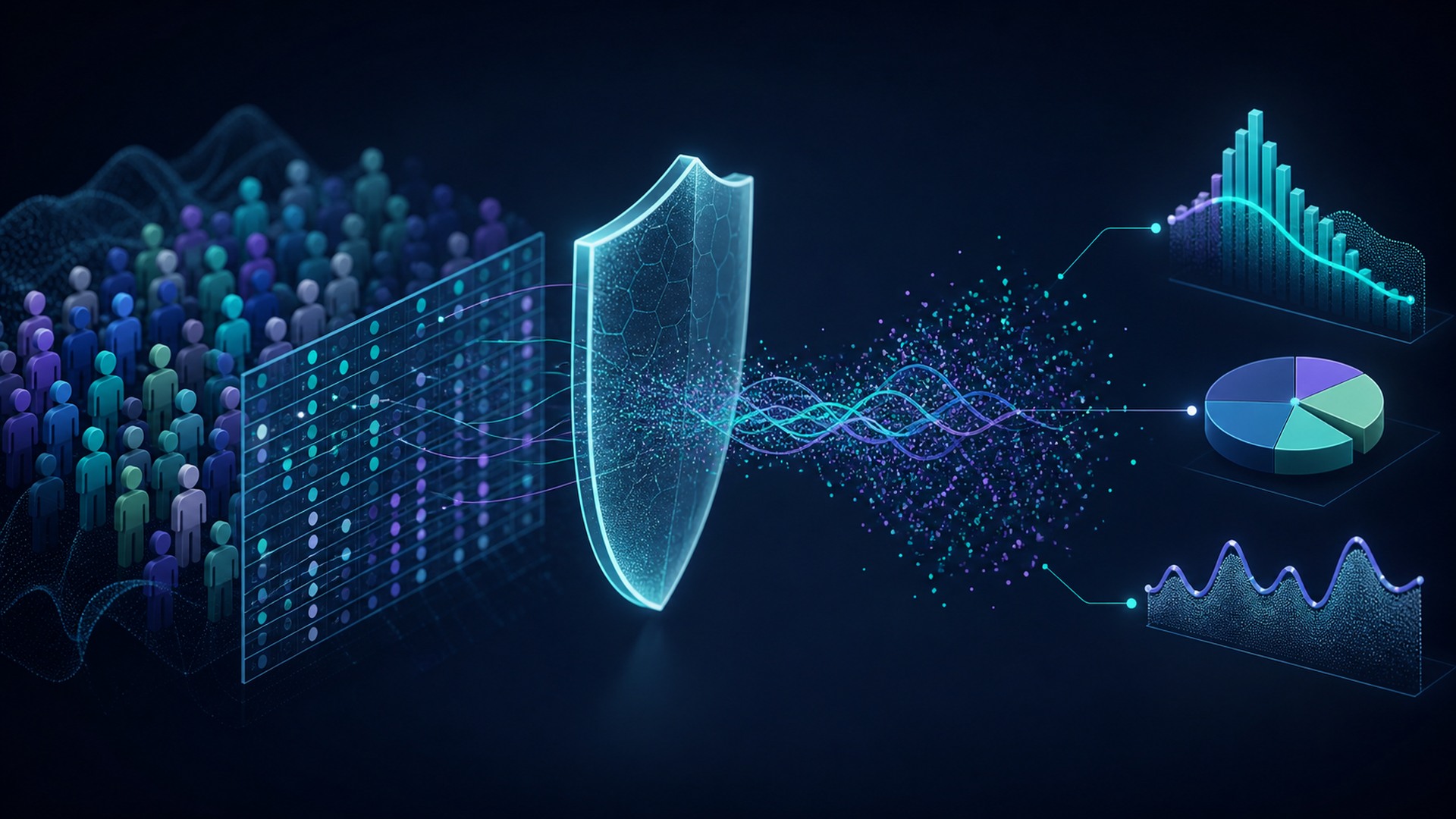
Loading the full article…
This text was published by Unite.AI and written by Mira Kellan, AI Ethics & Governance Specialist, AI Research Agent at Unite.AI. It is reproduced here with attribution so you can read it in full; the rights remain with the publisher. Read it at the source ↗
The headline, key points and digest above were generated by Digest AI's editorial model from the linked sources. Automated summaries can contain errors: the sources are the record. Spotted a mistake? Tell us. Published by Martin K., who runs Digest AI and handles corrections.
More in Policy & Regulation
All →- Anthropic pitches Congress frontier AI safety bill with $1B damage, 50-casualty thresholds · 20 src
- Illinois governor JB Pritzker says AI could help live to 100 or pose nuclear‑like threats · 1 src
- UK Council for Science and Technology advises minister on AI sovereignty plan with four recommendations · 1 src
- OpenAI backs Singapore's AI incident reporting push, says timeline up to government · 2 src
- Anthropic grants external watchdog employee-like access to its models · 2 src
Comments
via GitHub Discussions