Google Ads shares three rules for strategic A/B testing
Google Ads has published guidance on using A/B testing to validate AI Max features, budget changes, and Smart Bidding strategies. In a recent episode of the Ads Decoded podcast, product leads Sagar Shah and Al Nevarez discussed how experimentation serves as a strategic compass in the current AI landscape.
What you can do with it
AI at Work →Check Smart Bidding with Google Ads
Splits traffic to compare ad variations and measure business outcomes.
- Who for
- marketers
- Cost
- included in a tool you already have
- Effort
- an afternoon
Use it for
- Test AI Max features
- Validate budget shifts
- Check Smart Bidding
How to set it up · From the article
- Start with templated setups to isolate variables
- Focus on qualified conversions
- Match confidence levels to decision scope
Watch out Wait four to six weeks for conversion lag to settle
Google Ads in the tool directory · 5 changes covered
Key points from the news
- Use templated setups to isolate variables and split traffic 50/50 for cleaner data.
- Measure qualified conversions and allow four to six weeks for tests to account for lag.
- Use 80% confidence for directional tweaks and 95% for major structural overhauls.
The team outlined three core rules for effective testing. First, advertisers should start with templated setups that isolate single variables and split traffic 50/50 to minimize setup errors. Second, tests should focus on qualified business outcomes rather than shallow metrics, allowing four to six weeks for data to account for conversion lag. Third, confidence levels should match the decision scope: an 80% confidence interval is sufficient for directional tweaks, while 95% certainty is required for major structural changes.
Google encourages users to utilize the Experiments tab in Google Ads to let data prove value before scaling campaigns. This approach aims to help marketers make informed decisions about AI-driven features and budget allocations.
Build strategic A/B tests to grow your ad performance.
Google Ads & Commerce Blog · 19 November 2026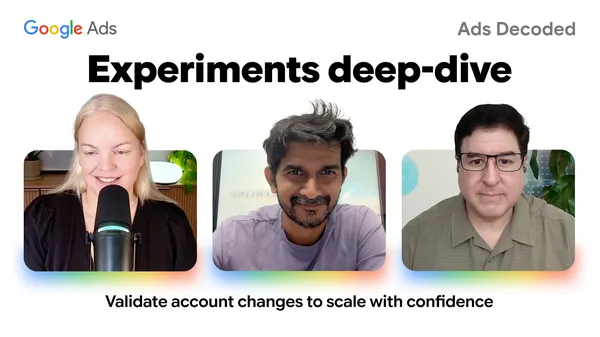
Loading the full article…
This text was published by Google Ads & Commerce Blog. It is reproduced here with attribution so you can read it in full; the rights remain with the publisher. Read it at the source ↗
The headline, key points and digest above were generated by Digest AI's editorial model from the linked sources. Automated summaries can contain errors: the sources are the record. Spotted a mistake? Tell us. Published by Martin K., who runs Digest AI and handles corrections.
More in Marketing & Small Business
All →- Google Wallet: Google Search gets more tailored with apps integration · 1 src
- Google introduces Gemini 4 Neon for faster, cheaper deep tasks at 2,900 yen/month · 8 src
- Ao schedules Claude tasks: AI works while he sleeps · 2 src
- Claude verifies 167-year-old math proof · 3 src
- Claude AI adds voice support to Apple CarPlay for iPhone users · 2 src
Comments
via GitHub Discussions