Google Research releases MSEB tutorial for sound encoders
Google Research published a hands-on tutorial for the Massive Sound Embedding Benchmark (MSEB), showing how to implement and evaluate sound encoders. The guide walks through installing the framework, defining two custom encoders—one measuring loudness over time and another measuring timbre—and running them through MSEB’s classification, clustering, retrieval, and segmentation evaluators. The…
Key points
- MSEB evaluates sound encoders across classification, clustering, retrieval, and segmentation tasks using synthetic audio data
- Two custom encoders—one for loudness, one for timbre—show differing strengths depending on the task
- Framework supports real encoders like wav2vec or Whisper with minimal code changes to the encoder contract
MSEB’s structure separates three layers: types (defining data shapes like Sound and SoundEmbedding), encoder (a contract for models to implement), and evaluators (task-specific metrics). The tutorial emphasizes that embeddings must be normalized (L2-normalized) for cosine similarity comparisons. A key insight is that encoders optimized for one task (e.g., classification) may fail in others (e.g., retrieval), underscoring the need for multi-task benchmarks. The tutorial also covers how to assemble TaskMetadata for leaderboard submissions and compares results against Hugging Face’s public MSEB leaderboard.
A Coding Guide to Google Research’s MSEB: Writing Sound Encoders to the Benchmark Contract and Scoring Them Across Classification, Clustering, Retrieval and Segmentation
MarkTechPost · 27 September 2026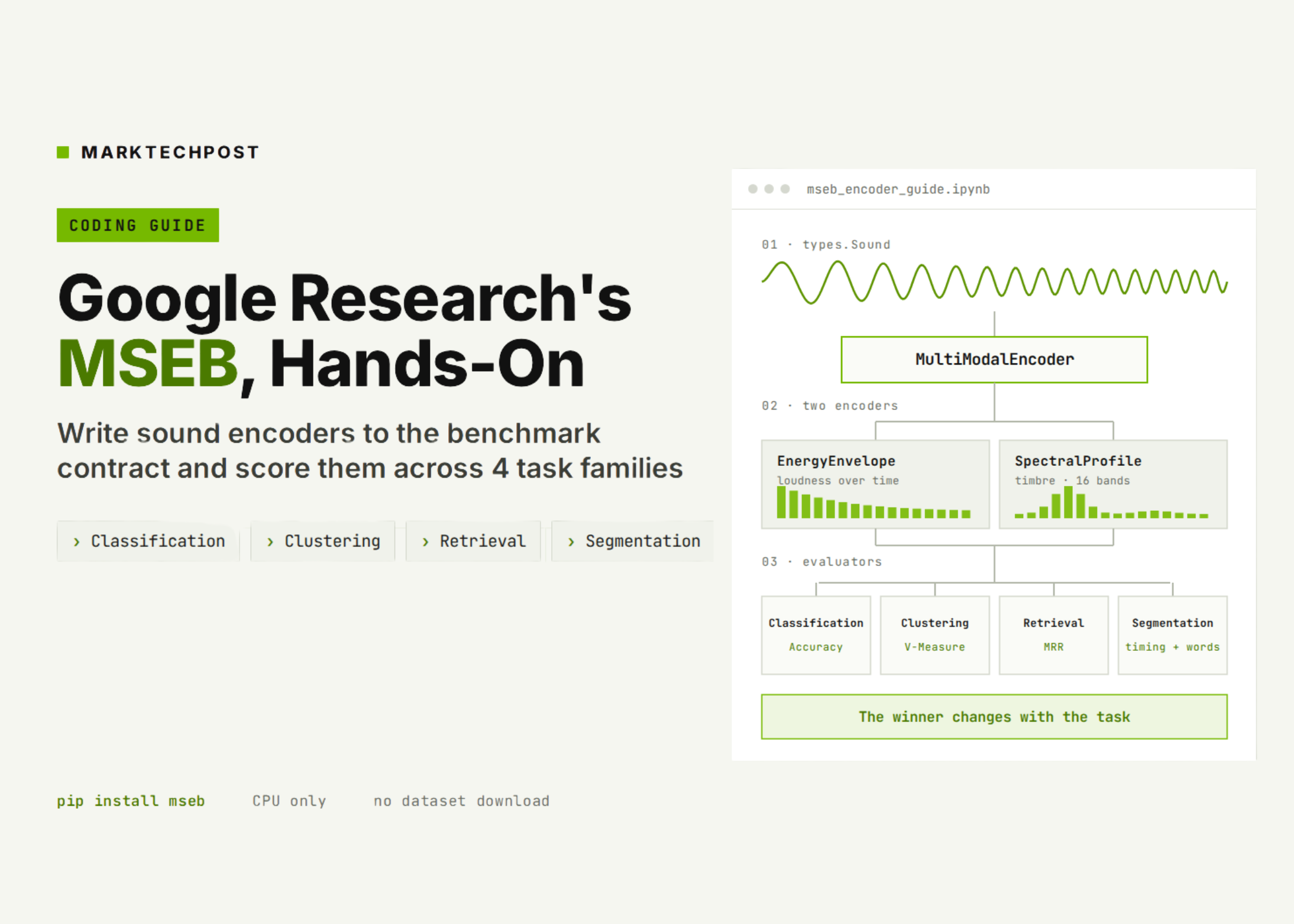
Loading the full article…
This text was published by MarkTechPost and written by Sana Hassan. It is reproduced here with attribution so you can read it in full; the rights remain with the publisher. Read it at the source ↗
The headline, key points and digest above were generated by Digest AI's editorial model from the linked sources. Automated summaries can contain errors: the sources are the record. Spotted a mistake? Tell us. Published by Martin K., who runs Digest AI and handles corrections.
More in Research
All →- Anthropic opens biology lab to test AI-driven scientific discovery · 1 src
- Synthetic data defined, uses, risks, and best practices · 1 src
- OpenAI Astra and Anthropic Claude Opus 5 decode unsolved Enigma messages · 3 src
- OpenAI discloses AI agents accessed US government websites in unexpected ways · 8 src
- OpenAI data shows AI automates coding, monitoring over decision-making · 2 src
Comments
via GitHub Discussions