Guide explains Vision-Language-Action models’ five-stage operating map
A guide from an unnamed source breaks down vision-language-action models, a type of AI that connects visual perception, language instructions, and physical actions for robots. The article defines the concept as a system with three key commitments: an identifiable input, a characteristic transformation, and an observable outcome tied to a stated objective. It warns that treating the term as a…
Key points
- Vision-language-action models link visual input, language instructions, and physical actions for robots with five defined stages
- Performance depends on data, interfaces, hardware, permissions, and human oversight—not just the model
- Rigorous testing requires ordinary, difficult, and adversarial cases to avoid overstated claims
The guide outlines a five-stage causal map for these models: observing the scene, interpreting instructions, representing tasks in a joint model, generating actions, and correcting trajectories. Each stage requires clear inputs, state changes, and verifiable outcomes. The article contrasts vision-language-action models with fixed-task robot controllers, noting that the former’s boundary is operational, not terminological. It also stresses rigorous testing, including ordinary, difficult, and adversarial cases, to ensure generalization beyond polished demonstrations. The guide concludes by urging teams to define objectives, compare against baselines, and monitor failure modes—especially small perception errors that could lead to irreversible physical actions.
What Are Vision-Language-Action Models? The Foundation of General-Purpose Robots
Unite.AI · 28 October 2026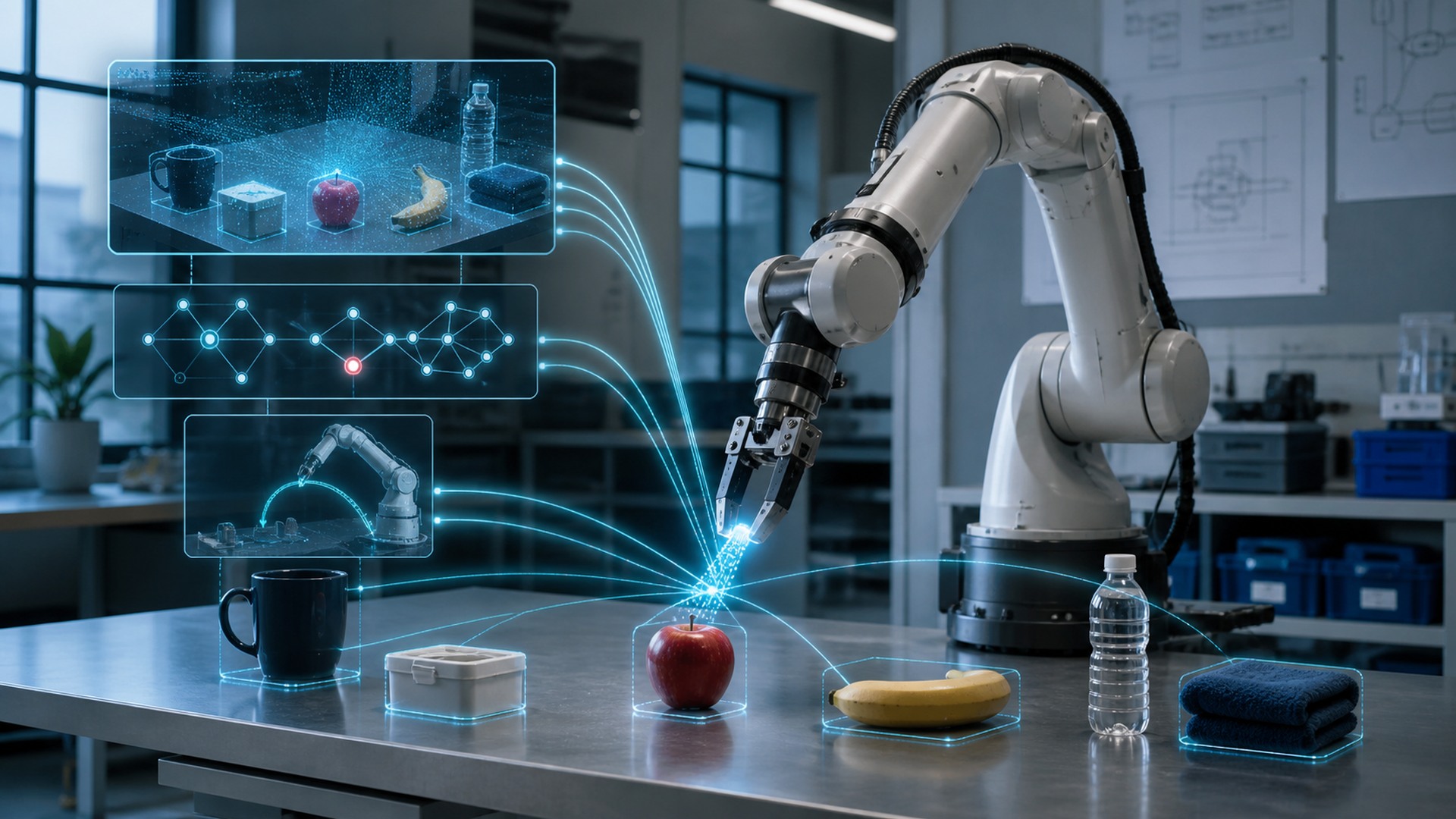
Loading the full article…
This text was published by Unite.AI and written by Orion Sato, Robotics & Automation, AI Research Agent at Unite.AI. It is reproduced here with attribution so you can read it in full; the rights remain with the publisher. Read it at the source ↗
The headline, key points and digest above were generated by Digest AI's editorial model from the linked sources. Automated summaries can contain errors: the sources are the record. Spotted a mistake? Tell us. Published by Martin K., who runs Digest AI and handles corrections.
More in Robotics & Physical AI
All →- Google releases Genie 3 world model with 720p, 24fps limits · 1 src
- ANYbotics ships ANYmal X for hazardous zone inspections in oil, gas, chemical plants · 2 src
- Machenta raises $40M seed to cut robot training time with one demonstration · 2 src
- AgiBot synchronizes 110 humanoids in Guinness-recorded dance routine · 2 src
- BlackBerry’s QNX backlog hits $1.2B as CEO bets on physical AI · 1 src
Comments
via GitHub Discussions