Integrating LLM Translation into Scikit-Learn Pipelines
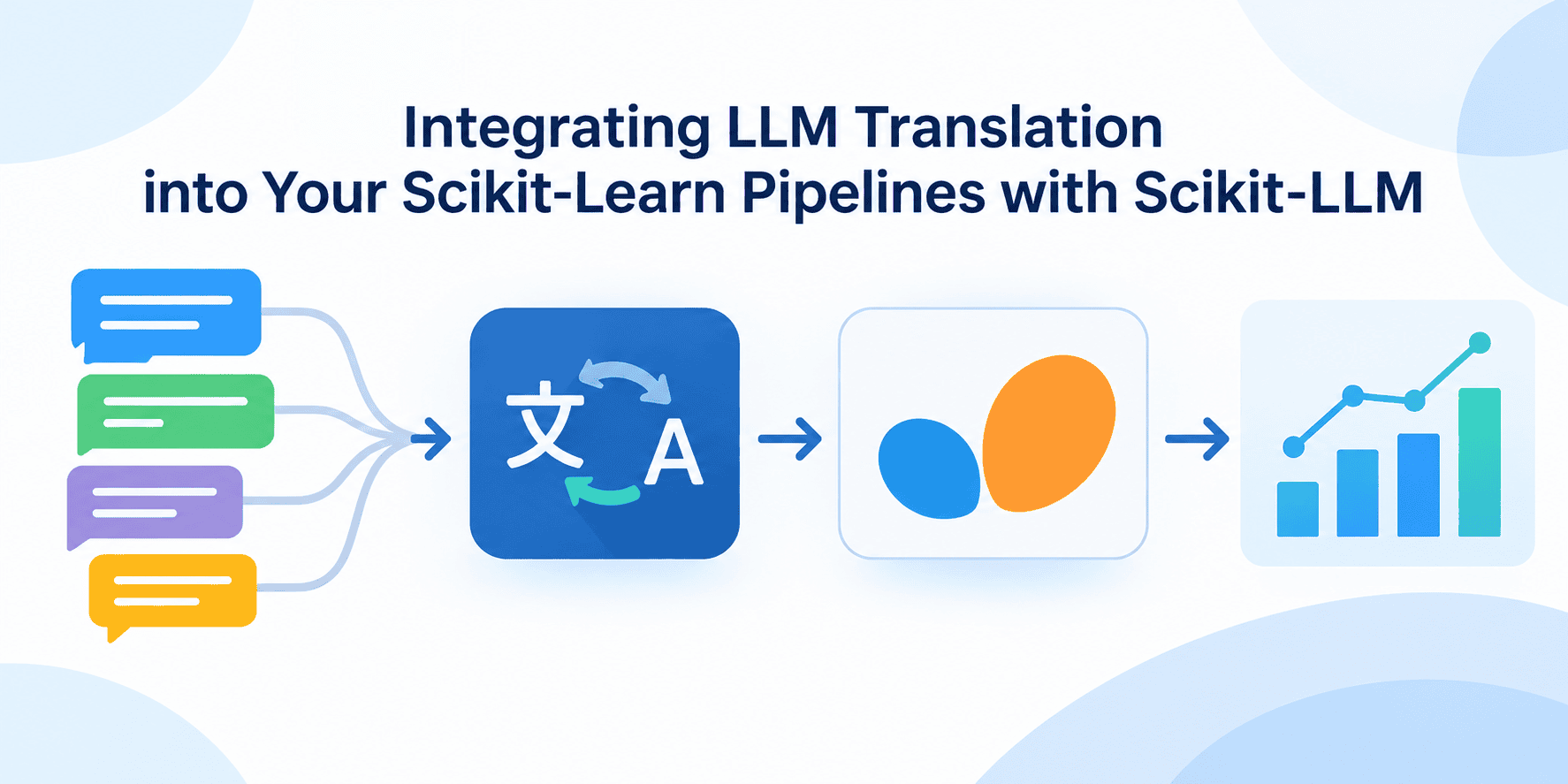
Integrating LLM Translation into Your Scikit-Learn Pipelines with Scikit-LLM Learn how to build a two-stage scikit-learn pipeline for multilingual text classification, guided by pre-trained language models handled by Scikit-LLM.
Key points
- Build a two-stage scikit-learn pipeline for multilingual text classification.
- Use Scikit-LLM to adapt pre-trained language models for translation and zero-shot classification.
- Define unique set of classification labels and placeholder data for minimal training requirements.
This article shows you the steps needed to create an overarching pipeline that includes translation and zero-shot classification.
Building a Multilingual Translation and Zero-Shot Classification Pipeline
This example can be run entirely in a Google Colab notebook. It uses Groq's LLM API for free models, avoiding per-token costs. The code is simple and straightforward, with the advantage of not needing large training sets.
Prerequisites
Install Scikit-LLM: !pip install scikit-llm -q
Configure environment to route requests through Groq's API instead of OpenAI's default.
Define
The story so far
4 episodes →- Integrating LLM Translation into Scikit-Learn Pipelinesthis story
The headline, key points and digest above were generated by Digest AI's editorial model from the linked sources. Automated summaries can contain errors: the sources are the record. Spotted a mistake? Tell us. Published by Martin K., who runs Digest AI and handles corrections.
More in Marketing & Small Business
All →- OpenAI launches OpenWorks, paying up to $8,000 monthly for local AI support · 7 src
- [November 2026] What Am I Actually Using Generative AI For in the End? · 1 src
- Against the Coming Industrial Scale of AI Fraud · 1 src
- Gemini 4: $3 vs Claude 5.5 — $2 · 1 src
- Shopify adds automatic chargeback evidence for AI shopping assistant orders · 2 src
Comments
via GitHub Discussions