Scikit-LLM enables custom NER pipelines using free Groq models
A new tutorial demonstrates how to build custom Named Entity Recognition (NER) pipelines using the Scikit-LLM library. The guide shows developers how to leverage Large Language Model (LLM) reasoning to extract structured data from unstructured text without the need for extensive training datasets or fine-tuning.
Key points
- Scikit-LLM allows building custom NER pipelines using LLM reasoning without fine-tuning.
- The tutorial uses Groq's free API and the openai/gpt-oss-20b model in Google Colab.
- Raw LLM outputs require regex post-processing to achieve clean, structured entity extraction.
The example uses Groq's free-tier API to run the open-source model openai/gpt-oss-20b within a Google Colab notebook. By defining a simple entity dictionary with descriptions, the GPTExplainableNER estimator processes raw text to identify categories such as executives, corporations, products, and cities. The results show that while raw LLM outputs can be messy, simple post-processing with regular expressions yields clean, structured data.
This approach offers a low-code alternative to traditional NLP libraries, allowing users to implement domain-specific extraction tasks with minimal configuration. The method relies on the reasoning capabilities of pre-trained models rather than supervised learning, making it accessible for quick prototyping and data analysis tasks.
The story so far
2 episodes →- Scikit-LLM enables custom NER pipelines using free Groq modelsthis story
Named Entity Recognition Using Scikit-LLM
KDnuggets · 21 October 2026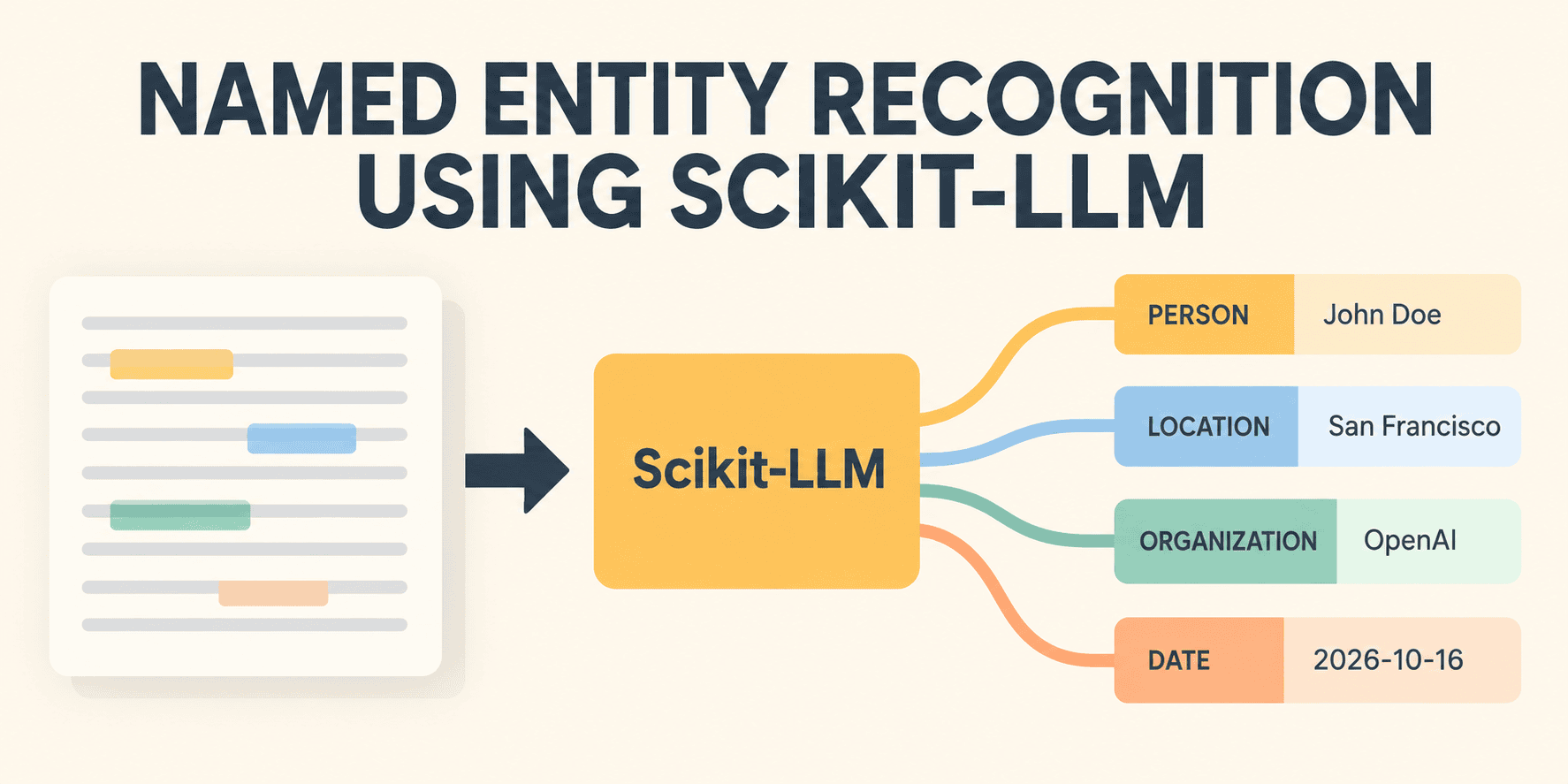
Loading the full article…
This text was published by KDnuggets and written by Iván Palomares Carrascosa. It is reproduced here with attribution so you can read it in full; the rights remain with the publisher. Read it at the source ↗
The headline, key points and digest above were generated by Digest AI's editorial model from the linked sources. Automated summaries can contain errors: the sources are the record. Spotted a mistake? Tell us. Published by Martin K., who runs Digest AI and handles corrections.
More in Research
All →- PHP discloses PHP2Shell vulnerability affecting up to 70% of websites · 3 src
- Nature reports AI personal health agent that analyses data and offers advice · 1 src
- AI tool improves subseasonal weather forecasts up to a month ahead · 1 src
- AI obsession may be starving other research fields, new study suggests · 1 src
- Claude Code may have produced a Rust SPARQL extension for SQLite, value unclear · 1 src
Comments
via GitHub Discussions