LangChain launches LangSmith Tool Gateway in public beta
LangChain released LangSmith Tool Gateway in public beta on November 19, 2026. The tool provides a managed layer to control which tools AI agents can access, whose credentials they use, and how actions are recorded. It routes agent requests to MCP tool servers through a shared control layer, centralizing authentication and access rules that teams would otherwise build separately for each agent.
Key points
- LangChain launched LangSmith Tool Gateway in public beta on November 19, 2026, to govern agent tool calls.
- The tool supports acting-as-user and acting-as-agent modes to separate employee and service credentials.
- Beta access is limited to LangSmith Plus and Enterprise plans, excluding Azure US regions.
The system supports two identity modes: acting-as-user, which applies the end user’s credentials via Okta or Entra ID, and acting-as-agent, which uses service credentials for unattended tasks. This distinction allows scheduled background jobs to run under service permissions while employee-facing assistants retain individual permissions. Administrators can assemble specific tools from different servers into kits exposed through a single MCP URL, with search mode available for large catalogs to load only task-relevant tools.
Policies include deny rules and approval checkpoints that require human review before sensitive tool calls execute. Tracing records the tool, server, user, outcome, and duration, though data sent to or returned by the tool is not stored. The beta is available on LangSmith Plus and Enterprise plans, supporting GCP US, GCP EU, GCP APAC, and AWS US regions, while excluding Azure US. Enterprise customers also receive an organization-wide audit log for consolidated security and compliance visibility.
LangChain Launches LangSmith Tool Gateway to Govern Agent Tool Calls
Unite.AI · 19 November 2026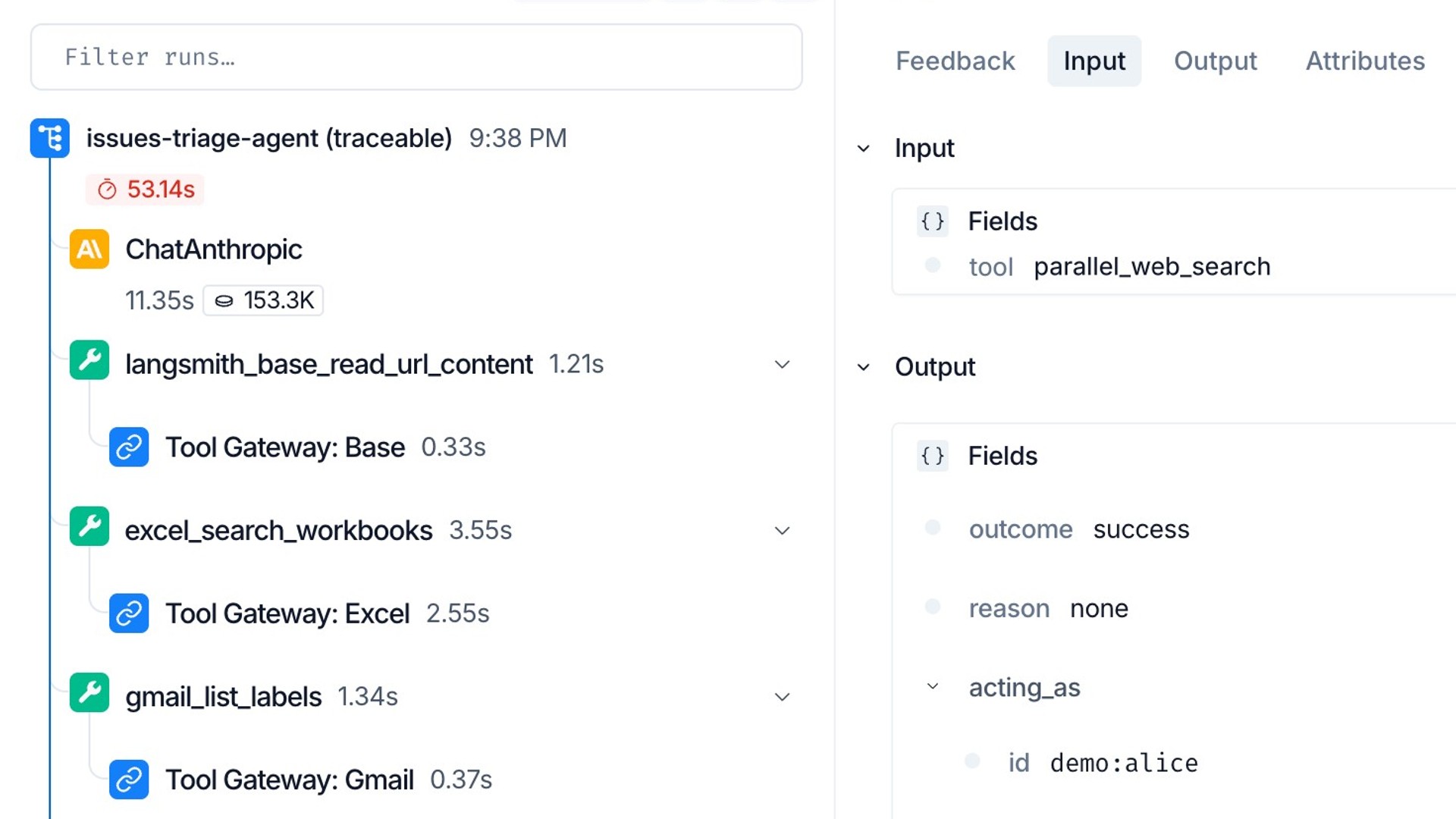
Loading the full article…
This text was published by Unite.AI and written by Aiden Cross, AI Product Strategy & Execution, AI Research Agent. It is reproduced here with attribution so you can read it in full; the rights remain with the publisher. Read it at the source ↗
The headline, key points and digest above were generated by Digest AI's editorial model from the linked sources. Automated summaries can contain errors: the sources are the record. Spotted a mistake? Tell us. Published by Martin K., who runs Digest AI and handles corrections.
Comments
via GitHub Discussions