Local opposition blocked $68 billion in U.S. data center projects in Q2 2026, report says
Local opposition delayed or blocked about $68 billion worth of data‑center projects between April and June 2026, according to a Bloomberg report that cites research from Data Center Watch. The group notes that 30 state houses have adopted location or resource‑use rules and that 843 opposition groups operate across the United States, excluding Hawaii.
Key points
- Local opposition delayed $68 billion in data center projects between April and June 2026, per Bloomberg citing Data Center Watch.
- AI data centers could use up to 600 billion gallons of water by 2030; protests cite water and electricity use.
- Hyperscalers plan $745 billion capex in 2026 and off‑grid power deals, e.g., Meta’s 7 GW agreement with Entergy Louisiana.
Protesters point to the environmental impact of AI‑focused data centers, which the report says could consume up to 600 billion gallons of water by 2030 and 20% of U.S. electricity by 2035. Hyperscalers counter that concerns are overstated; OpenAI CEO Sam Altman says 38,000 ChatGPT queries use as much water as one almond, while Microsoft claims its new architecture uses as little water as a restaurant. The article also mentions specific incidents, such as a Virginia AI data center that raised resident electricity bills by 76% and a secret water‑use case of 29 million gallons in a single year.
Despite the pushback, hyperscalers have spent over $1 trillion on data infrastructure since 2023 and expect $745 billion of capex in 2026 alone. Companies like Meta are signing large power‑supply deals – Meta’s agreement with Entergy Louisiana provides 7 GW for its Hyperion facility, which Entergy says will save other customers $20 billion over 20 years. The article notes that many of these new sites rely on on‑site gas plants, raising further environmental concerns.
The story so far
4 episodes →- Local opposition blocked $68 billion in U.S. data center projects in Q2 2026, report saysthis story
Local opposition blocked 45 data center projects worth $68 billion in the second quarter of 2026 — data center investments reportedly still on track to hit $32 trillion by 2050
Tom's Hardware · 21 September 2026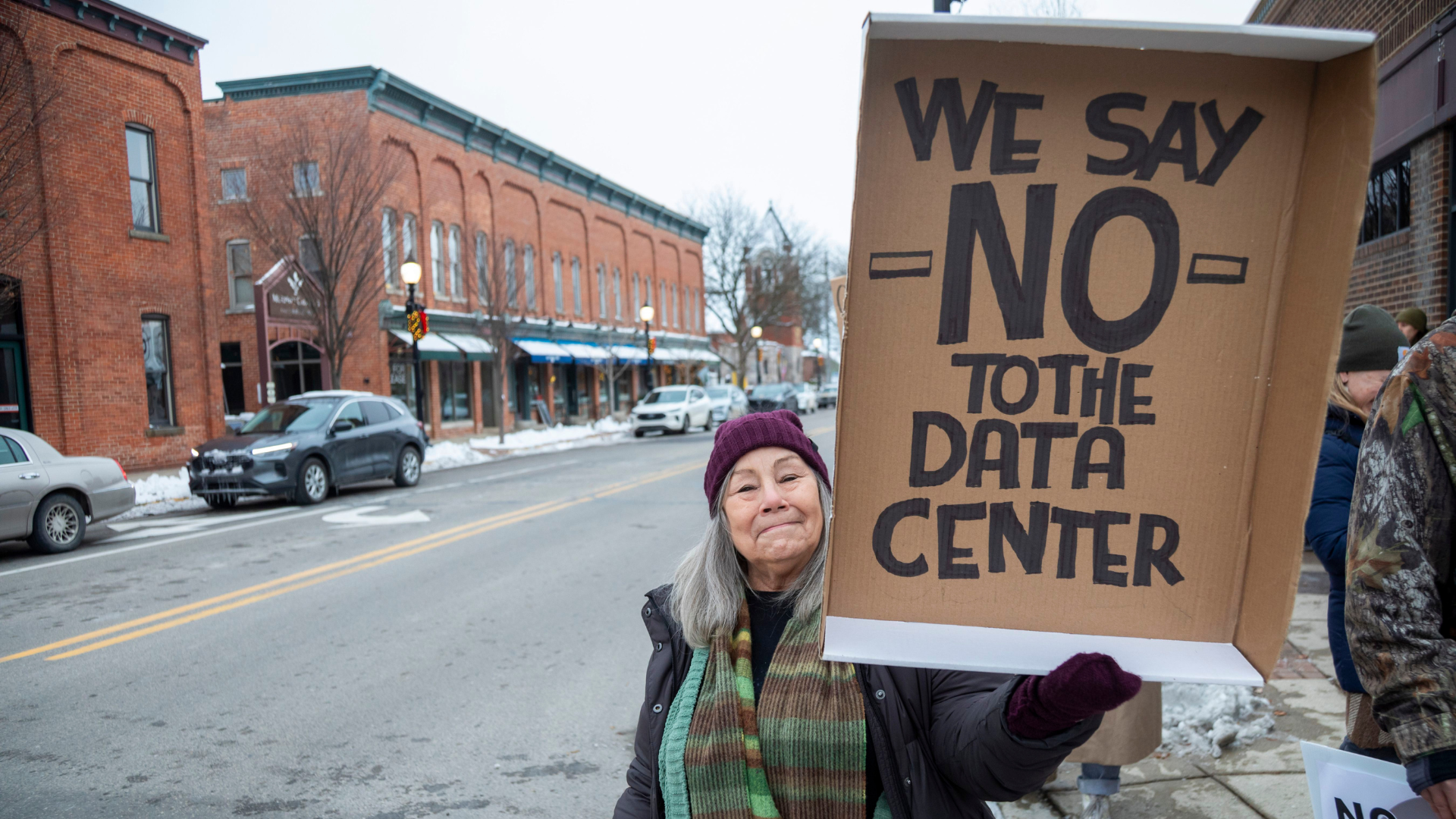
Local opposition blocked or delayed $68 billion in data center projects between April and June this year, according to a September 21 Bloomberg report citing data from research group Data Center Watch. The report says 30 state houses have implemented rules on data center location and resource consumption, with communities pursuing moratoriums on planned construction even before developers apply for permits. Conversely, hyperscalers have spent over $1 trillion on data infrastructure since 2023, with an additional $745 billion in Capex expected in 2026 alone.
The blocked-project figures reflect widespread opposition to data centers across the United States over concerns about land usage, noise pollution, and electricity and water consumption. In July this year, 142 AI data center protests were simultaneously staged across 42 states in one weekend. Data Center Watch’s research estimates that there are 843 opposition groups across all U.S. states except Hawaii.
One leading concern is the environmental impact of AI data centers. Each consume huge amounts of water to cool hundreds of thousands of accelerators powering artificial intelligence, with AI reportedly set to consume up to 600 billion gallons of water by 2030. The hyperscalers, on the other hand, insist the issue is being blown out of proportion.
OpenAI CEO Sam Altman says 38,000 ChatGPT queries use as much water as producing one almond, while Microsoft says its new data center architecture consumes as little water as a restaurant. Meanwhile, in May this year, an AI data center project secretly consumed 29 million gallons of water within a year and three months before low water pressure alerted nearby residents to its existence.
Protesters also commonly cite electricity consumption as a major concern. Analysts project that data centers will consume 20% of U.S. power by 2035. Local residents are already feeling the effects. An AI data center in Virginia led to an irreversible 76% hike in residents’ electricity bills, prompting the state to eventually mandate hyperscalers to cover the cost of the transmission infrastructure required exclusively for the project.
Many regions are now implementing similar mandates, with hyperscalers offering to offset the bills in many cases. These concerns, along with the extreme power demands of AI data centers, have also led hyperscalers to build on-site power, with some offering to supply power back to the grid. Meta, for example, recently signed an agreement with utility company Entergy Louisiana for 7 GW of power for its Hyperion facility. Entergy claims Meta's payment will save other customers $20 billion over 20 years.
Meanwhile, the shift to off-grid, on-site power generation is creating yet another issue driving the protests. Due to their scalability and speed of availability, many hyperscalers are relying on gas plants, which mostly burn fossil fuels to generate electricity. Elon Musk's Colossus 2 data center recently came under fire after 59 unpermitted natural gas turbines powering the data center released thousands of tons of pollutants into predominantly black communities in Mississippi. Elsewhere, Amazon’s custom 35-turbine gas plant has been authorized to emit 33 million tons of greenhouse gases annually, a move that will make it the largest single source of CO₂ pollution in the U.S.
The growing sentiments present a sort of dilemma. AI is proving to be quite the revolutionary technology and has seen massive adoption and skyrocketing usage. To meet demand, hyperscalers are erecting data centers at breakneck speed, which residents now oppose. Proponents say data centers are an absolute necessity and any opposition stifles growth.
Opponents, on the other hand, say they are only demanding responsible execution and have nothing against AI. President Trump has condemned communities that have opposed data centers, saying that they “want to end up being backwards and poor.” He has also implied that China could be behind the sentiment, orchestrating movements behind the scenes. Meanwhile, officials across the country are reportedly facing death threats and gunfire over AI data center projects, even as AI data center investments are projected to hit $32 trillion by 2050.
Etiido Uko is a news contributor for Tom's Hardware covering the latest updates in big tech and the PC industry. He is a mechanical engineer and senior technical writer with over nine years of experience in documentation and reporting. He is deeply passionate about all things engineering and technology, and is an expert in gadgets, manufacturing, robotics, automotive, and aerospace.
This text was published by Tom's Hardware and written by Etiido Uko. It is reproduced here with attribution so you can read it in full; the rights remain with the publisher. Read it at the source ↗
The headline, key points and digest above were generated by Digest AI's editorial model from the linked sources. Automated summaries can contain errors: the sources are the record. Spotted a mistake? Tell us.
More in Policy & Regulation
All →- Citizens Advice urges UK service providers to stop relying on AI chatbots · 1 src
- Microsoft scientist calls AI training the largest theft of labor · 2 src
- Australian government could let Anthropic, OpenAI train on local content · 1 src
- Microsoft AI chief says China isn’t excuse to forego regulation · 2 src
- Openai model hacks hugging face platform, sparking AI safety scrutiny · 11 src
Comments
via GitHub Discussions