Boston Dynamics opens metaplant application center to train Atlas robots
Boston Dynamics announced the opening of its Robotics Metaplant Application Center (RMAC) at Hyundai Motor Group Metaplant America in Savannah, Georgia. Chief product and technology officer Zack Jackowski said the permanent facility will serve as a "Robot Behavior Factory," collecting high‑quality data from real automotive parts, fixtures and workcells to train Atlas humanoid robots for…
Key points
- Boston Dynamics opened the Robotics Metaplant Application Center at Hyundai’s Savannah plant to train Atlas on automotive tasks.
- Hyundai plans to deploy 25,000 Atlas units across its global plants over the next few years.
- The center will expand tenfold next year and aims to support component assembly by 2030.
At RMAC the company is teaching Atlas tasks that require dexterous, bimanual manipulation, such as extracting components from packaging, handling fragile surfaces, and placing parts into dense cubbies for assembly lines. Training draws on teleoperation, reinforcement‑learning simulations and Universal Manipulation Interface (UMI) devices. Boston Dynamics plans to expand the center tenfold next year, move toward component assembly by 2030, and continue scaling data collection through 2027. Hyundai intends to deploy 25,000 Atlas units across its global plants over the coming years, while a Hyundai‑built U.S. factory aims to produce up to 30,000 robots annually by 2028.
Jackowski noted that early trials proved design assumptions for Atlas were largely correct and that insights from the center will inform fixture and packaging design to better suit humanoids. Boston Dynamics also said SoftBank’s acquisition of Hyundai’s Robotics and AI Institute will not affect Atlas development. The company is hiring additional staff and is in talks with customers of its Spot and Stretch robots for broader industrial applications.
The story so far
2 episodes →- Boston Dynamics opens metaplant application center to train Atlas robotsthis story
Boston Dynamics opens Metaplant Application Center to train Atlas humanoid robots
The Robot Report · 21 September 2026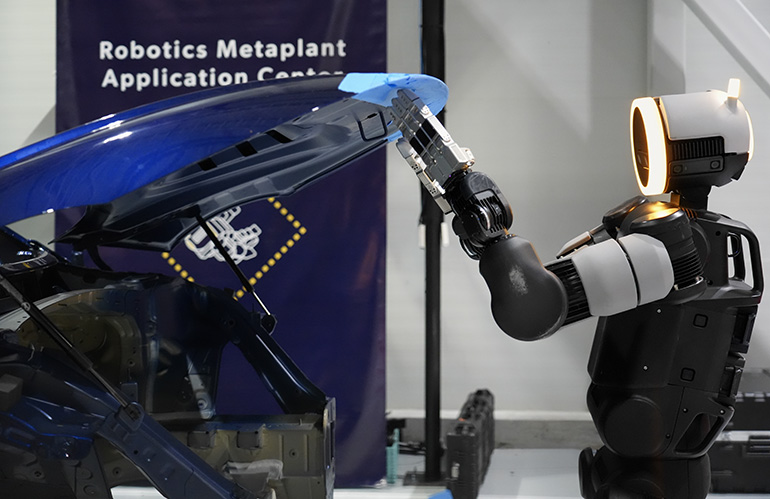
On the path to general-purpose automation, developers are training humanoid robots on specific skill sets. Boston Dynamics Inc. today opened its Robotics Metaplant Application Center, or RMAC, at Hyundai Motor Group Metaplant America. The company said the Georgia facility is a testbed and training center for integrating its Atlas humanoids directly into parent Hyundai’s automotive manufacturing operations.
“Together with Hyundai Motor Group, we are pioneering physical AI at enterprise scale,” stated Zack Jackowski, chief product and technology officer at Boston Dynamics. “We’re excited to be working with such a dedicated partner in the group, and we have established a clear strategy to optimize our supply chain, production, testing, and deployment capabilities for Atlas. RMAC reinforces our shared ambition to create a future where robots amplify human potential by making work safer and more productive.”
How is RMAC’s work different from previous humanoid trials?
“The previous trials were time-boxed deployments focused on lessons needed to design our scaled-up presence,” Jackowski told The Robot Report. “What are the operational realities of deploying Atlas to an operating facility? What’s the right mix of off-site, on-site, and simulation data to learn policies with acceptable reliability? These were small-scale and very hands-on with the engineering team.”
“RMAC is the result of those lessons,” he explained. “It’s a permanent facility that’s focused on both data collection and application testing that operates in strong coordination with the auto plant. You should think of it as a ‘Robot Behavior Factory,’ which takes real parts, fixtures, workcells; adds Atlas robots and skilled pilots; and produces diverse, high-quality data for behavior training. The facility serves as the anchor point for growing all of the capabilities necessary to deploy Atlas globally.”
Editor’s note: Brendan Schulman, vice president of policy and government relations at Boston Dynamics, will participate in a panel on “Reshoring With Robots: A Policy Discussion” at RoboBusiness 2026, which will be on Oct. 20 and 21 in Santa Clara, Calif. Register now to attend.
Robotics Metaplant Application Center trains on real parts
Atlas is learning from data sources including teleoperation, reinforcement learning in simulation, and Universal Manipulation Interface (UMI) devices, according to Jackowski.
At RMAC, Boston Dynamics is training its robots on real-world tasks, such as preparing the logistics and sequencing of automotive parts before placing them in the correct order for assembly. Jackowski said this requires a high level of dexterous manipulation, as car parts:
- Need to be handled directly, which means interacting with complex surfaces
- Need to respect complex grasping requirements like knowing which areas are OK to grab — many parts have cosmetic or fragile elements
- Often require bimanual manipulation because they are large, awkwardly weighted, or fragile
- Involve extraction from complex shipping packaging, as well as insertion into high-density cubbies for transport to the line
“The biggest thing we’ve been finding is actually that the design assumptions we made for the production version of Atlas have been very close to right on,” added Jackowski. “We’re actually learning much more about the applications themselves, things like how we might modify fixtures and packaging to make them easier for humanoids, how to effectively collect data in production environments, and how to build great support processes for humanoids.”
Boston Dynamics plans to expand to component assembly by 2030. Over time, Atlas will take on new tasks involving repetitive motions and strenuous work such as lifting heavy loads, the company said.
Hyundai, Boston Dynamics plan further expansion
The Metaplant Application Center at Hyundai Motor Group Metaplant America (HMGMA) follows the companies‘ robotics and AI strategy announced at CES 2026. Hyundai said it will deploy Atlas across its global network, beginning with 25,000 units at Hyundai Motor and Kia global plants over the next few years.
Boston Dynamics has moved some staffers from its growing headquarters in Waltham, Mass., to Savannah, Ga., and it is hiring more across departments. The first phase of the new center is now operational at HMGMA, but expansion plans are already under way, said the company.
Next year, operations will move into a new building that will expand the RMAC by about 10 times. Boston Dynamics said the facility will support further preparation of Atlas for automotive deployments, and it plans to explore use cases in other industries next year.
The company is currently in discussions with several customers of its existing Spot quadruped and Stretch trailer-unloading robot in manufacturing, aerospace, semiconductors, logistics, food and beverage, and life sciences.
“Spot data is useful for building understanding of industrial facilities, which is actually a very rare type of data,” acknowledged Jackowski. “The bigger aspect to Spot deployments is actually in the institutional learning at the customers on how to deploy, integrate, and manage fleets of robots. Getting good at this takes time, and our customers that started with Spot are in a much stronger position.”
Boston Dynamics (BD) said it expects to scale data collection and other tasks to continue training Atlas through 2027. Jackowski said SoftBank’s acquisition of the Robotics and AI Institute (RAI) from Hyundai will have no effect on Atlas development.
“BD and RAI have been separate organizations with separate goals since inception, and the move has no impact on us,” he said. “Boston Dynamics has one of the largest and strongest robotics AI teams in the world, and we’re really excited about how the addition of industrial-scale high-quality data and policy evals from RMAC is going to further increase our velocity.”
Humanoid race moves to mass production
Hyundai said it will build a U.S. factory that can manufacture up to 30,000 robots annually by 2028. Other humanoid developers are also preparing for mass production:
- 1X Technologies — has begun producing NEO robot in Hayward, Calif.; has claimed that factory in San Carlos, Calif., will scale to more than 100,000 units by late 2027
- Agility — RoboFab in Fremont, Calif., designed to produce 10,000 Digit robots per year
- Engine AI — factory in Shenzhen, China, is working toward 10,000 units annually
- Tesla — converted plant in Fremont, Calif., from Model S and X vehicles for a target of more than 50,000 Optimus robots per year, plus a new Gigafactory in Texas with an annual target of 10 million robots
- Ubtech — 10,000 robots per year at its facility in Liuzhou, China
This text was published by The Robot Report and written by Eugene Demaitre. It is reproduced here with attribution so you can read it in full; the rights remain with the publisher. Read it at the source ↗
The headline, key points and digest above were generated by Digest AI's editorial model from the linked sources. Automated summaries can contain errors: the sources are the record. Spotted a mistake? Tell us.
More in Robotics & Physical AI
All →- Two birotors combine to form a quadrotor in robotics video · 1 src
- Icarus Robotics tests free‑flying ISS robot JOY on 66 parabolic flights · 1 src
- Agility Robotics unveils Digit 5, a safer humanoid that crouches when humans approach · 1 src
- Waymo plans Singapore ride-hailing launch for 2028 with Jaguar I-PACE fleet · 1 src
- Vsim's fast simulator lets robot Freddo learn tasks in minutes, says founders · 1 src
Comments
via GitHub Discussions