Meta FAIR e-means: k-means beat in 1.4-2.6 epochs
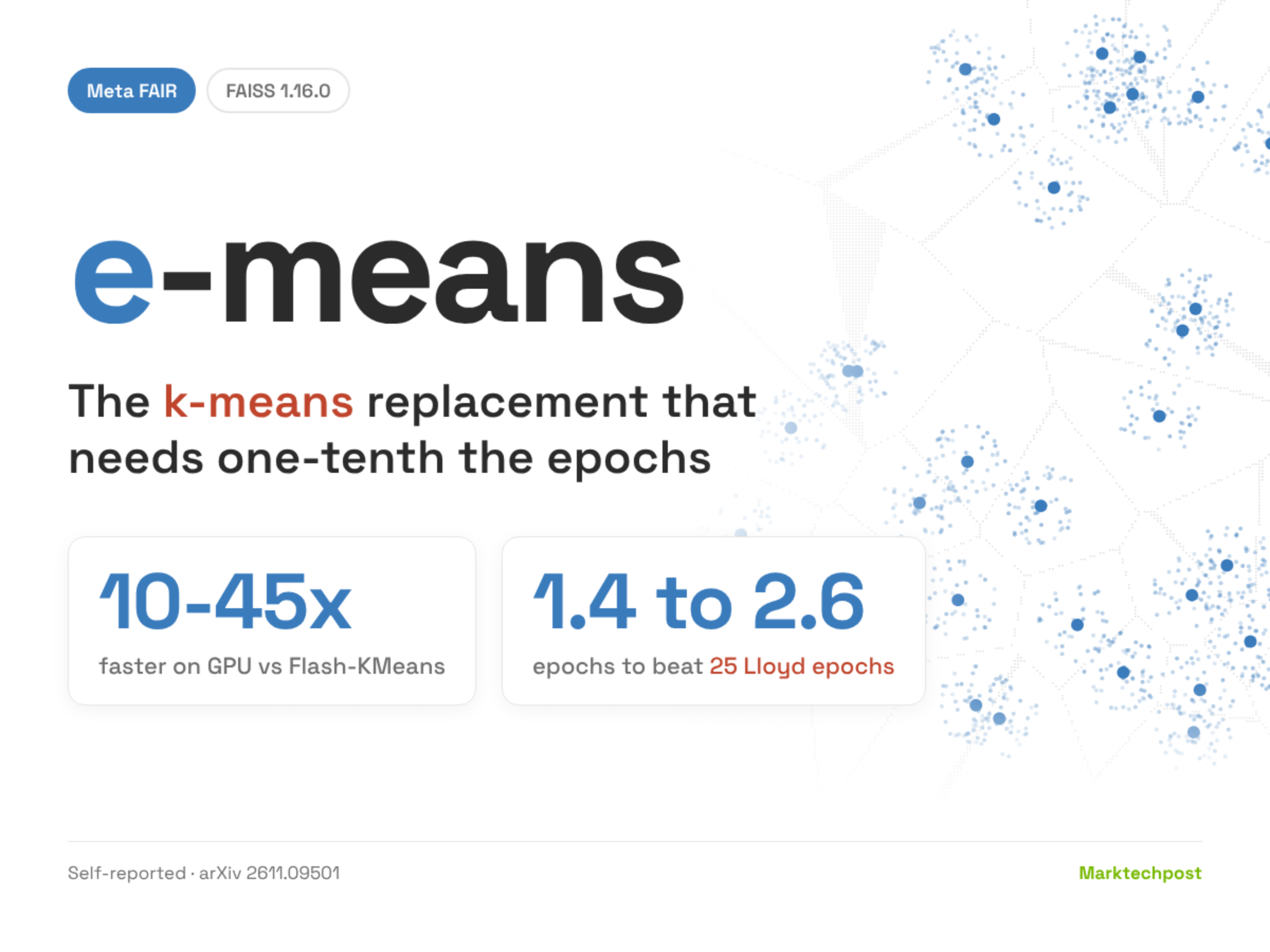
Meta FAIR researchers have released e-means, a new clustering algorithm that outperforms Lloyd's k-means by reaching the same loss in just 1.4 to 2.6 epochs, compared to k-means's 25 epochs. This is significant for anyone building vector indexes or data-curation pipelines where clustering can be a bottleneck.
Key points
- Meta FAIR researchers released e-means, a clustering algorithm
- `e-means` reaches k-means' loss in 1.4 to 2.6 epochs compared to k-means' 25 epochs
- The new algorithm uses exponential moving averages (EMA) for centroid updates
The new algorithm uses exponential moving averages (EMA) and has been tested on datasets ranging from 100K to 10 billion points, with up to 16.7 million clusters. e-means is available in the latest FAISS version 1.16.0 under the name faiss.contrib.emeans. The team behind this algorithm has also released a detailed blog post and code for those interested.
Coverage and discussion
2sources- Meta’s Faiss 1.16.0 Adds E-Means for Faster Large-Scale ClusteringPress · Unite.AI ·
The headline, key points and digest above were generated by Digest AI's editorial model from the linked sources. Automated summaries can contain errors: the sources are the record. Spotted a mistake? Tell us. Published by Martin K., who runs Digest AI and handles corrections.
More in Generative AI & Models
All →- Hill-climbing Inkling 2 Mini inference · 2 src
- Google showcases six Gemini 4 Hydrogen demos, including a reactive moth · 5 src
- OpenAI rolls out GPT-6.2 Sol for ChatGPT Plus, Pro, and Enterprise users · 8 src
- Perplexity users shift from Opus 5.5 and Sol 6.2 to Gemini 4 Neon at 15% daily growth · 2 src
- Google DeepMind releases 544-prompt HFE test to measure LLM consistency · 1 src
Comments
via GitHub Discussions