Meta provides Muse AI for free: strategy
:metaprovidesmuseforfreemetastrategy Recently, what has been attracting attention in the AI world is Meta's personal AI agent 'Muse'. Until now, AI has had the image of a convenient assistant that returns answers when you input questions.
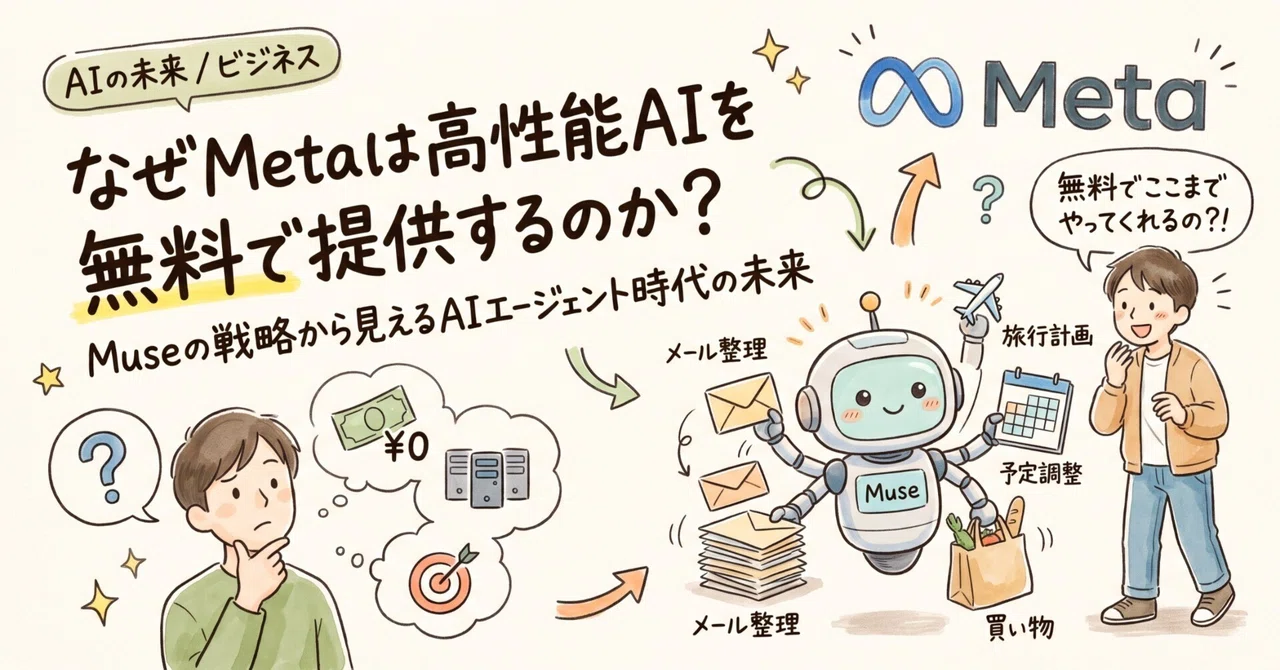
However, AI agents are different; they carry out actual tasks on our behalf, such as organizing emails, planning trips, adjusting schedules, and helping with shopping. Moreover, Meta provides the basic functions of Muse for free. A question arises here: Why can Meta provide such advanced AI for free? In fact, hidden in the background is a new business strategy for giant IT companies that goes beyond just the AI performance race. This article will explain the mechanism of AI agents, the reasons for their free provision, and what kind of changes will occur in our lives in an easy-to-understand way.
First, let's clarify the term 'AI agent'. General AI until now, such as ChatGPT and Gemini, is basically a mechanism that returns answers to questions or instructions from humans. For example: Tell me tomorrow's weather Tell me travel recommendations Draft an email Find me a delicious restaurant
On the other hand, AI agents aim not only to answer but also to carry out tasks. For instance, if you ask it to plan a trip: Research travel destination candidates. Look for hotels. Suggest sightseeing spots. Make reservations yourself.
In the case of conventional AI, these steps are handled by humans. In contrast, an AI agent handles all these tasks autonomously, making it a more advanced and versatile form of AI. This is not just about AI becoming smarter; it means AI is changing from a 'consultant' to a 'partner that helps with work'.
Secondly, let's understand the terms related to AI agents: 'models' and 'harnesses'. These might sound a bit difficult, but they can be explained simply. A model is the AI's brain - it has the ability to understand text, analyze information, and think of answers. For example: The ability to provide accurate answers to difficult questions The ability to organize complex conditions
A harness is the mechanism that manages the AI's limbs and actions. For instance: Searching for information on the internet Checking emails in Gmail Registering appointments in a calendar Operating a hotel reservation page Entering necessary information into another app
The true capability of an AI agent is determined by both the intelligence of its brain (model) and the mechanism that allows it to actually take action (harness).
Thirdly, why does Meta provide Muse for free? One conceivable reason is a strategy to capture a massive future market early. For example: Increasing the number of users: By having as many people use Muse in the same way as they do with Facebook and Instagram, Meta aims to build a user base for AI agents. Earning revenue from shopping and booking mechanisms: As these systems become more widespread, there is a possibility that product purchases and service bookings through AI will increase. For Meta, supporting these transactions opens up opportunities to generate future revenue related to payments or partnerships with businesses.
The headline, key points and digest above were generated by Digest AI's editorial model from the linked sources. Automated summaries can contain errors: the sources are the record. Spotted a mistake? Tell us. Published by Martin K., who runs Digest AI and handles corrections.
More in Generative AI & Models
All →- Hill-climbing Inkling 2 Mini inference · 2 src
- Google showcases six Gemini 4 Hydrogen demos, including a reactive moth · 5 src
- OpenAI rolls out GPT-6.2 Sol for ChatGPT Plus, Pro, and Enterprise users · 8 src
- Perplexity users shift from Opus 5.5 and Sol 6.2 to Gemini 4 Neon at 15% daily growth · 2 src
- Google DeepMind releases 544-prompt HFE test to measure LLM consistency · 1 src
Comments
via GitHub Discussions