MIT and NYU researchers introduce FLEX to help robots reason beyond literal commands
MIT engineers, in collaboration with New York University, have developed FLEX, a flexible feature-editing pipeline that enables robots to interpret natural language commands beyond literal meaning.
Key points
- FLEX enables robots to generalize from natural language commands using an LLM to avoid implied risks
- The system uses GPT-4o in its Generalize step to detect patterns and make safety inferences
- Full FLEX cycle takes about five seconds and was tested in simulated coffee, candle, and bowling ball tasks
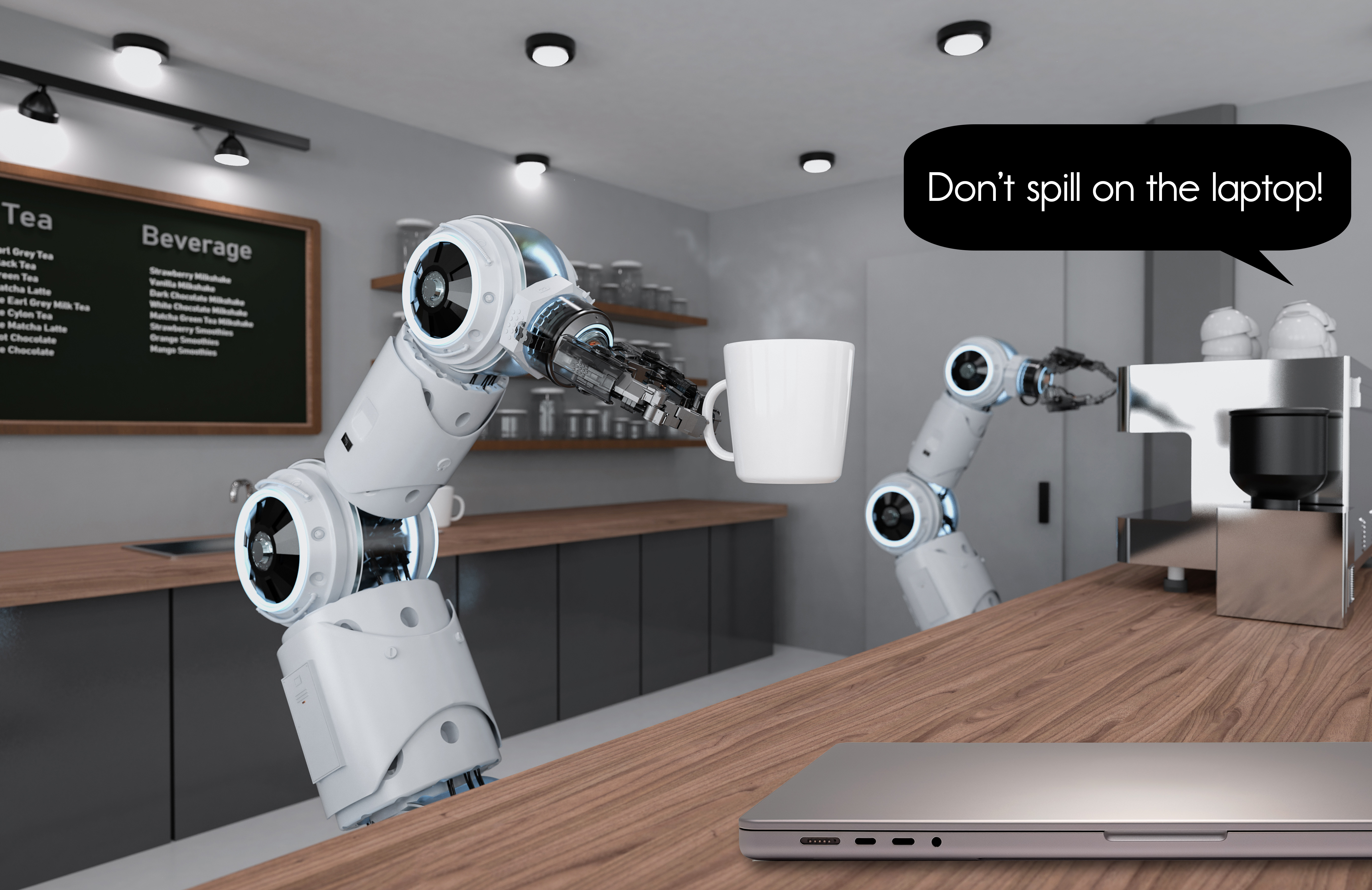
The platform uses a large language model, specifically GPT-4o, to generalize from user instructions—such as “Don’t spill on the laptop!”—to avoid related risks like bumping into other electronics. The system operates in three steps: Add, Generalize, and Mask, with the full process taking about five seconds in simulation. The research was led by Andreea Bobu of MIT’s CLEAR Lab and includes co-authors Audrey Lee and Ilia Sucholutsky. The study will be presented at the Conference on Robot Learning this month and was supported by the MIT Generative AI Impact Consortium and the MIT Schwarzman College of Computing’s Social and Ethical Responsibilities of Computing program.
Coverage and discussion
2sources- FLEX Teaches Robots to Generalize From Human CorrectionsPress · Unite.AI ·
The headline, key points and digest above were generated by Digest AI's editorial model from the linked sources. Automated summaries can contain errors: the sources are the record. Spotted a mistake? Tell us. Published by Martin K., who runs Digest AI and handles corrections.
More in Robotics & Physical AI
All →- XPeng unveils IRON humanoid robot for autonomous work tasks · 1 src
- Genesis AI raises $500M Series A to test robot reliability in manufacturing · 1 src
- BrightAI raises $97M Series A led by Smith Point Capital · 2 src
- Opinion: simulation may not replace Real-World data for warehouse robots · 1 src
- Roscosmos launches Teledroid humanoid robot to ISS on Progress MS-36 · 1 src
Comments
via GitHub Discussions