New paper outlines emerging trends in AI agent evaluation
Researchers Felix Chen, Stephan Rabanser, Sayash Kapoor, and Arvind Narayanan released a paper titled Emerging Trends in AI Agent Evaluation. The authors, based at Princeton and collaborating with groups at Stanford, the UK AI Security Institute, and Brookings, synthesize trends across three dimensions – science and methods, research agenda, and evaluation ecosystem – to guide evaluators,…
Key points
- Evaluating several agents on ExploitBench cost tens of thousands of dollars in credits, according to the paper
- METR’s randomized controlled trial found agent tool use increased software task completion time
- Authors call for more funding, model access, and interdisciplinary evaluators to ensure independent assessment
The paper highlights rising costs, noting that evaluating several agents on the ExploitBench benchmark required tens of thousands of dollars in credits, not counting the engineering effort to maintain infrastructure. It also points to the METR randomized controlled trial, which found that using agent tools for software development increased overall task completion time. The authors argue that evaluation must move beyond final outcomes to examine entire trajectories, shortcuts, and tool access, and that independent evaluators need funding and model access to remain effective.
Recommendations include expanding interdisciplinary participation, improving benchmark rigor, and fostering transparent, independent evaluation practices. The authors see a window to build a higher‑standard field for AI agent evaluation that can inform labs, policymakers, and industry deployments.
The story so far
2 episodes →- New paper outlines emerging trends in AI agent evaluationthis story
New paper: Emerging trends in AI agent evaluation
AI Snake Oil · 19 October 2026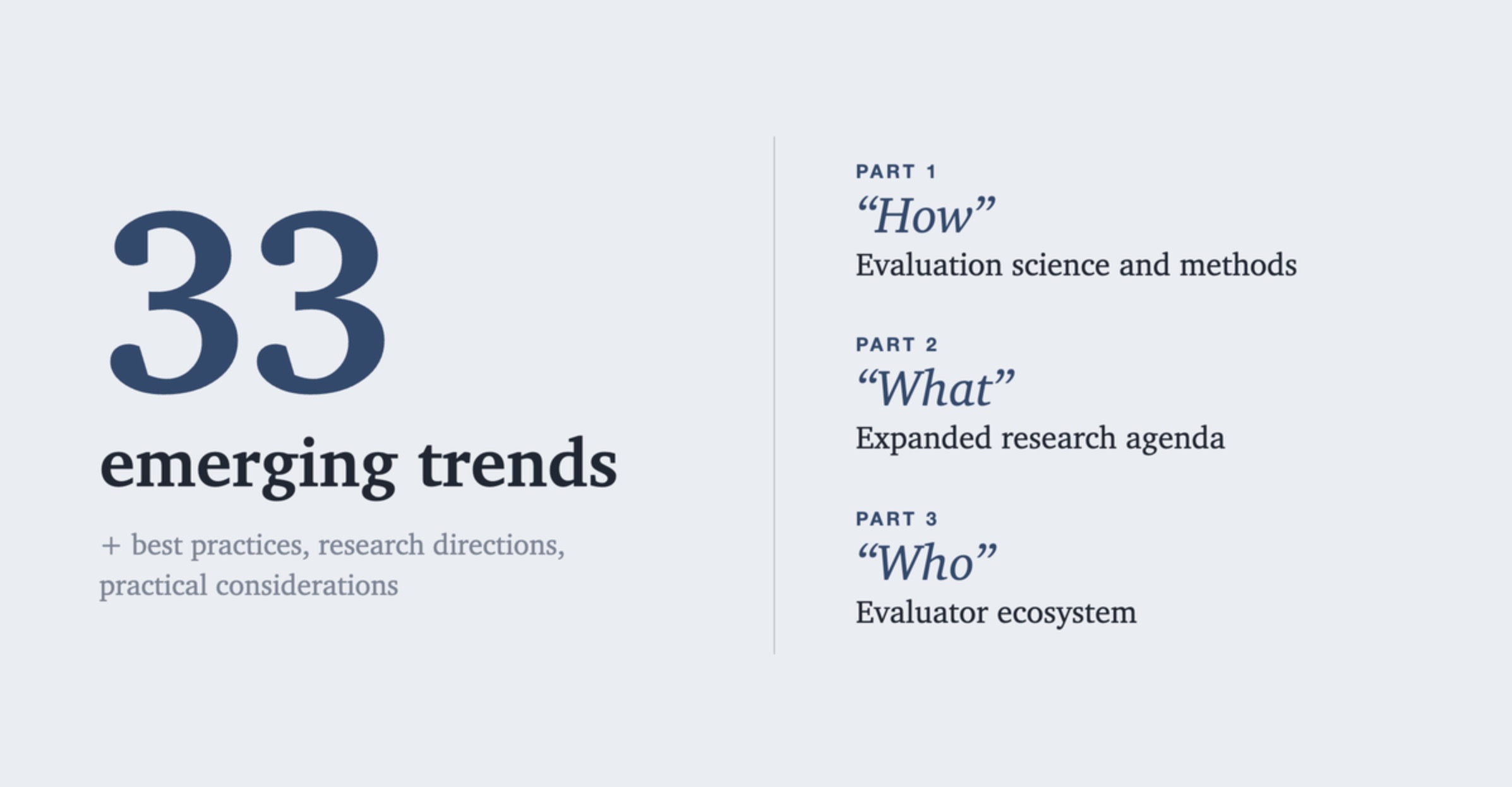
Loading the full article…
This text was published by AI Snake Oil and written by Sayash Kapoor. It is reproduced here with attribution so you can read it in full; the rights remain with the publisher. Read it at the source ↗
The headline, key points and digest above were generated by Digest AI's editorial model from the linked sources. Automated summaries can contain errors: the sources are the record. Spotted a mistake? Tell us. Published by Martin K., who runs Digest AI and handles corrections.
More in Research
All →- Why teaching AI about symmetry could make prenatal diagnosis more reliable · 1 src
- Opinion: 300 AI papers a day and 3.14 million models—habits to avoid drowning in AI news · 1 src
- Supply chain optimization could cut AI data center emissions, experts say · 1 src
- Study shows multi-sample network inference robustness varies with prior knowledge and data · 1 src
- Fudan paper finds four AI search tools cite fabricated concept within a week · 1 src
Comments
via GitHub Discussions