NVIDIA releases 14 open checkpoints of its continuous diffusion language model
NVIDIA released Nemotron-Labs-Sigma, a family of 14 open checkpoints for continuous diffusion language models. The models range from 3 billion to 8 billion parameters and include base, instruct, distilled, and self-speculative variants. Sigma operates in a 16-dimensional embedding space, enabling smoother text generation and faster distillation compared to discrete token-based diffusion models…
Key points
- 14 open checkpoints released: 3B/8B base, instruct, distilled, and self-speculative variants with 4,096-token context (8,192 for instruct)
- Sigma-8B scores 71.16 on NVIDIA’s 6-task suite, excelling in math (GSM8K: 91.96) but weak on advanced problems (AIME25: 17.00)
- Self-speculative decoding achieves 3.46x faster inference than autoregressive models on average, requiring CUDA GPUs only
Sigma-8B achieves an average score of 71.16 on NVIDIA’s 6-task benchmark suite, outperforming NLD-8B (70.22). Its strongest performance is on GSM8K (91.96), but it struggles with advanced math problems like AIME25 (17.00). Distilled and self-speculative variants improve speed—Sigma-distill-8B decodes 8 tokens per forward on math tasks, while self-speculative decoding offers up to 3.46x faster inference than autoregressive decoding. All models require a CUDA GPU (Ampere or newer) and are available on Hugging Face under NVIDIA’s open license.
NVIDIA AI Releases Nemotron-Labs-Sigma, a Continuous Diffusion Language Model with 14 checkpoints at 3B/8B
MarkTechPost · 20 November 2026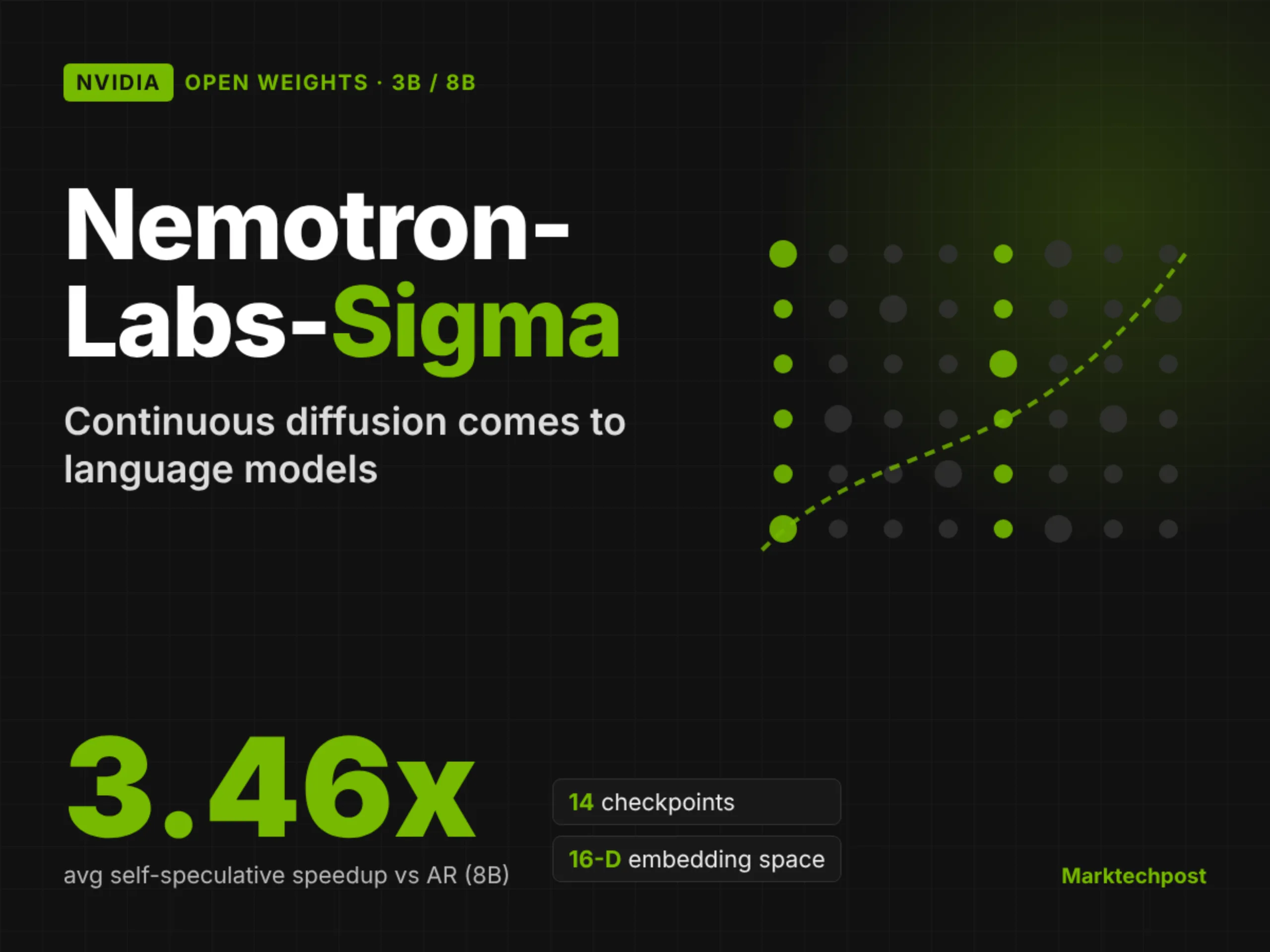
Loading the full article…
This text was published by MarkTechPost and written by Asif Razzaq. It is reproduced here with attribution so you can read it in full; the rights remain with the publisher. Read it at the source ↗
The headline, key points and digest above were generated by Digest AI's editorial model from the linked sources. Automated summaries can contain errors: the sources are the record. Spotted a mistake? Tell us. Published by Martin K., who runs Digest AI and handles corrections.
More in Research
All →- Google DeepMind cuts quantum circuit costs with Gemini 4 agents · 1 src
- Hi-TPH dataset improves T cell receptor binding predictions · 1 src
- OpenAI releases 'yardstick for intelligence': Let's pause here · 1 src
- Hugging Face outlines steps for building and maintaining agentic evaluations · 1 src
- Apple launches 200,000-person study on health AI trust with OpenEvidence · 1 src
Comments
via GitHub Discussions