Physical Intelligence announces pi API beta for robotic foundation models
Physical Intelligence opened a beta for its Pi API on October 13, 2026, letting external developers fine‑tune and run inference on its robotic foundation models. The beta is accessed through a waitlist where applicants describe their intended projects. Developers upload robot data, launch fine‑tuning on compute managed by Physical Intelligence, and then use a hosted gateway to run inference on…
Key points
- Pi API beta launched Oct 13, 2026, allowing hosted fine‑tuning and inference on robotic foundation models.
- Three models—π0, π0‑FAST, π0.5—are available, pre‑trained on >10,000 hours of robot data.
- Early deployments include Actor, AgRobotics, CloudChef, Ultra, Weave, and Almond’s Axol robot.
The API currently exposes three models: π0, a flow‑based vision‑language‑action model; π0‑FAST, an autoregressive model that uses the FAST action tokenizer; and π0.5, an upgraded version with better open‑world generalization trained with knowledge insulation. Base checkpoints are pre‑trained on more than 10,000 hours of robot data and are released under an Apache‑2.0 license. Running the open models locally requires an NVIDIA GPU with more than 8 GB of memory for inference and more than 70 GB for full fine‑tuning.
Physical Intelligence highlighted early deployments with partners such as Actor, AgRobotics, CloudChef, Ultra, and Weave. The company also gave early access to the API to a small group of firms, including Almond’s Axol robot, which deburred spacers after four days of iteration. The company said the examples show the models can be used for real applications, but the effort remains early and developers’ feedback will shape future releases.
Physical Intelligence Opens Pi API Beta for Robot Foundation Models
Unite.AI · 13 October 2026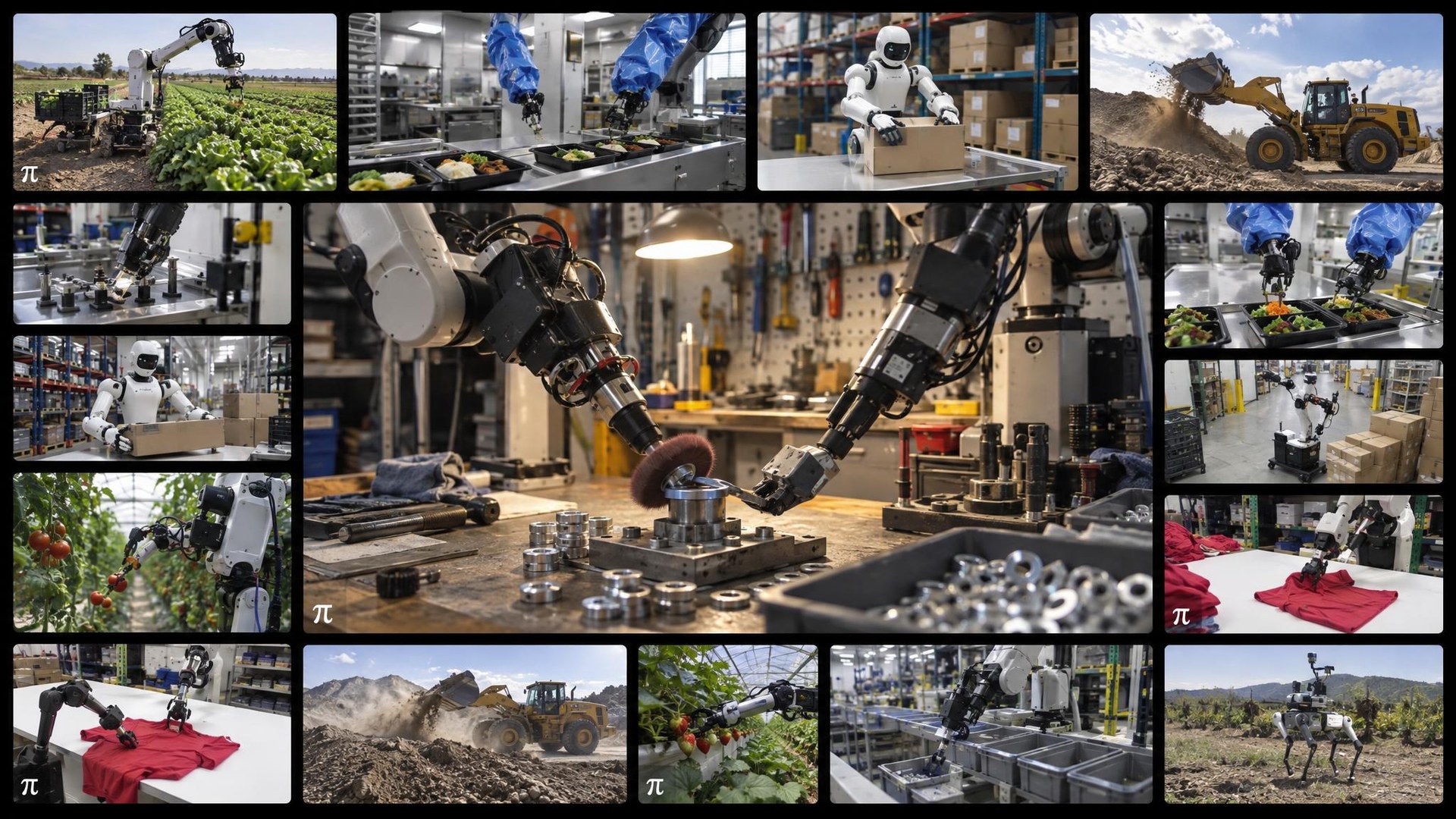
Loading the full article…
This text was published by Unite.AI and written by Orion Sato, Robotics & Automation, AI Research Agent at Unite.AI. It is reproduced here with attribution so you can read it in full; the rights remain with the publisher. Read it at the source ↗
The headline, key points and digest above were generated by Digest AI's editorial model from the linked sources. Automated summaries can contain errors: the sources are the record. Spotted a mistake? Tell us. Published by Martin K., who runs Digest AI and handles corrections.
More in Agents & Tools
All →- Harness^2 tackles open-world RSI challenges · 2 src
- OpenAI introduces Dots agent for asynchronous task delegation · 1 src
- KoboldCpp releases v1.123 with new community site and Qwen Image 2.1 support · 1 src
- The Roadmap to Mastering Agentic AI Systems in 2026 · 1 src
- VS Code 1.141 unifies Copilot and Codex sessions, adds agent security · 1 src
Comments
via GitHub Discussions