OpenAI introduces Dots agent for asynchronous task delegation
OpenAI’s Dots is an always-on AI agent designed to handle long-term tasks without constant human oversight, shifting from synchronous chat interactions to what the company calls asynchronous delegation. Unlike traditional chatbots—where users must monitor responses in real time—Dots operates in a dedicated cloud environment, browsing, researching, and organizing data independently. Early user…
Key points
- Dots runs in a dedicated cloud environment, enabling autonomous tasks like web searches and data organization without user presence
- Approvals required for irreversible actions (e.g., sending messages) but frequent notifications may cause user fatigue or missed risks
- Early adopters report success with overnight tasks (e.g., market research reports) but warn of ‘spinning wheels’ from ambiguous instructions
Three key challenges emerge in real-world use. First, vague instructions can lead to wasted effort—e.g., an agent spending hours on misaligned research. Second, defining clear completion criteria (e.g., ‘a table comparing five companies’) is critical to avoid aimless work. Third, securing access to internal tools demands careful permission management to prevent data leaks or prompt injection risks from external websites. OpenAI plans phased rollout, prioritizing higher-tier plans like ChatGPT Pro or Business, with features subject to organizational policies.
The story so far
7 episodes →- OpenAI introduces Dots agent for asynchronous task delegationthis story
What is OpenAI's Always-On Agent 'Dots'? — Asynchronous Delegation from 'Waiting in Front of the Screen' to 'Leaving it to AI While You Sleep,' and the Three Walls Faced in
note.com · 13 October 2026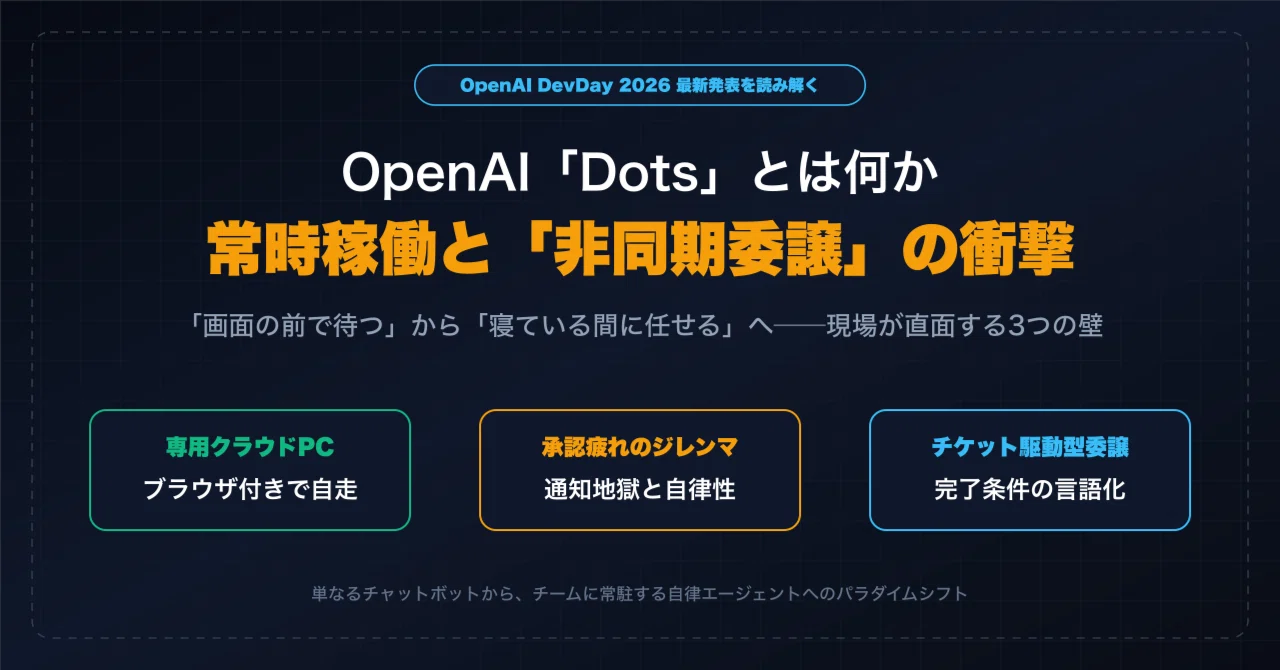
Loading the full article…
This text was published by note.com and written by えこーず@AI環境育成中. It is reproduced here with attribution so you can read it in full; the rights remain with the publisher. Read it at the source ↗
The headline, key points and digest above were generated by Digest AI's editorial model from the linked sources. Automated summaries can contain errors: the sources are the record. Spotted a mistake? Tell us. Published by Martin K., who runs Digest AI and handles corrections.
More in Agents & Tools
All →- Author compares GPT-6.1 Sol and Claude Opus 5.5 for AI coding roles · 1 src
- Harness^2 tackles open-world RSI challenges · 2 src
- KoboldCpp releases v1.123 with new community site and Qwen Image 2.1 support · 1 src
- Claude Code shifts from instructions to goals for tasks · 2 src
- Physical Intelligence announces pi API beta for robotic foundation models · 1 src
Comments
via GitHub Discussions