Tencent releases WeVisOne-VL, a 2B/4B open vision model for detection, OCR and matting
Tencent’s WeChat Vision team has open-sourced WeVisOne-VL, a vision-language model in 2B and 4B parameter sizes. It combines detection, object counting, referring, OCR, segmentation, and alpha matting into one model, eliminating the need for separate tools like SAM for pixel-level tasks. The model uses a 9.6M-parameter decoder for outputs and can return “None” when an object is absent, reducing…
Key points
- Combines detection, OCR, segmentation, and matting into one 2B/4B model, replacing multiple tools
- Outperforms LocateAnything-3B on Dense200 (71.3 F1 vs. 58.7) and PixMo-Count (89.6% exact match)
- Open-sourced under Apache 2.0 with hosted demos and Hugging Face weights
Trained on a knowledge-graph-driven dataset of 100M+ images with 3.6B annotated boxes, WeVisOne-VL outperforms baselines like LocateAnything-3B on benchmarks such as Dense200 (71.3 F1 vs. 58.7) and PixMo-Count (89.6% exact match). The 4B model leads on most tasks, while the 2B version still excels in box-prompted matting. Weights are available under Apache 2.0 on Hugging Face, with hosted demos and a Python wrapper for inference. Fine-tuning code is pending.
The story so far
2 episodes →- Tencent releases WeVisOne-VL, a 2B/4B open vision model for detection, OCR and mattingthis story
Tencent WeVisOne-VL Unifies Detection, OCR, Segmentation and Matting
MarkTechPost · 4 November 2026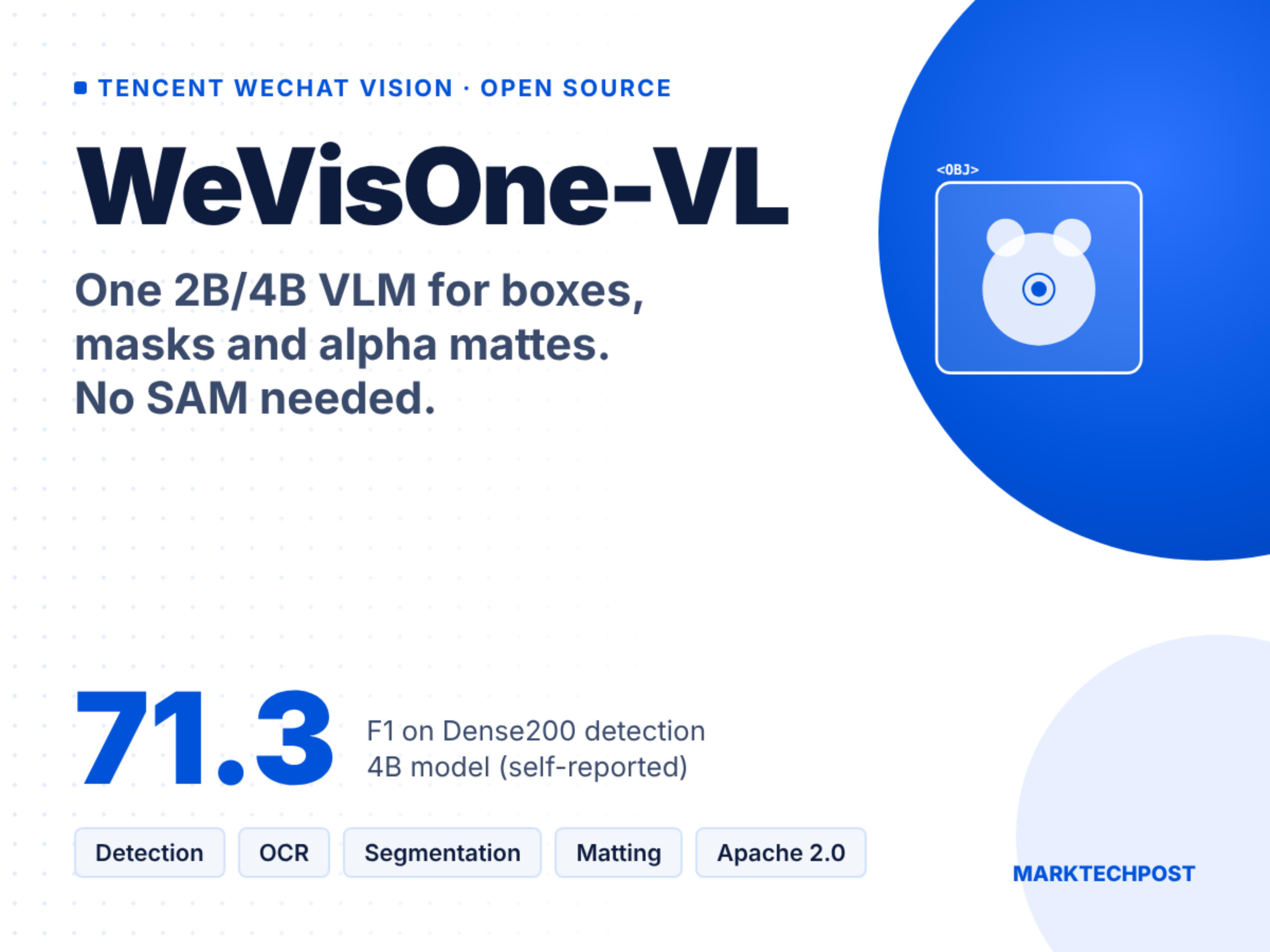
Loading the full article…
This text was published by MarkTechPost and written by Michal Sutter. It is reproduced here with attribution so you can read it in full; the rights remain with the publisher. Read it at the source ↗
The headline, key points and digest above were generated by Digest AI's editorial model from the linked sources. Automated summaries can contain errors: the sources are the record. Spotted a mistake? Tell us. Published by Martin K., who runs Digest AI and handles corrections.
More in Research
All →- Anthropic releases FlashProve open-source system for provable AI inference · 6 src
- Lama-dt outperforms baselines on meta-world and mujoco · 1 src
- Researchers release Dory1.0-4B, a 4B-parameter looped model with 256K-token context · 1 src
- SLATE benchmark tests long-horizon API selection in e-commerce automation · 1 src
- Researchers compare two fine-tuning methods for small medical AI models · 1 src
Comments
via GitHub Discussions