Two AI API Designs Clarified: Upload, Use, Delete vs Send, Compute, Return
In a recent article for MarkTechPost, Lin Qiao of Fireworks AI explained two standard designs in AI data retention. There are two common API designs: Customer-managed retention (upload, use, delete) and Ephemeral processing (send, compute, return). In the first design, customers manage their own data lifecycle by uploading files or datasets and then deleting them when they're done. This is…
Key points
- Fireworks AI introduced two standard API designs for AI data retention: upload, use, delete (customer-managed) and send, compute, return (ephemeral processing).
- In upload, use, delete design, customers manage their own data lifecycle by uploading files or datasets and then deleting them when done.
- Ephemeral processing involves sending data to an inference API for computation, with no application state being kept at rest. This is exemplified by OpenAI Chat Completions and Google Gemini text generation.
Clearing Up the Confusion on AI Data Retention: Two Standard Designs Explained
MarkTechPost · 17 November 2026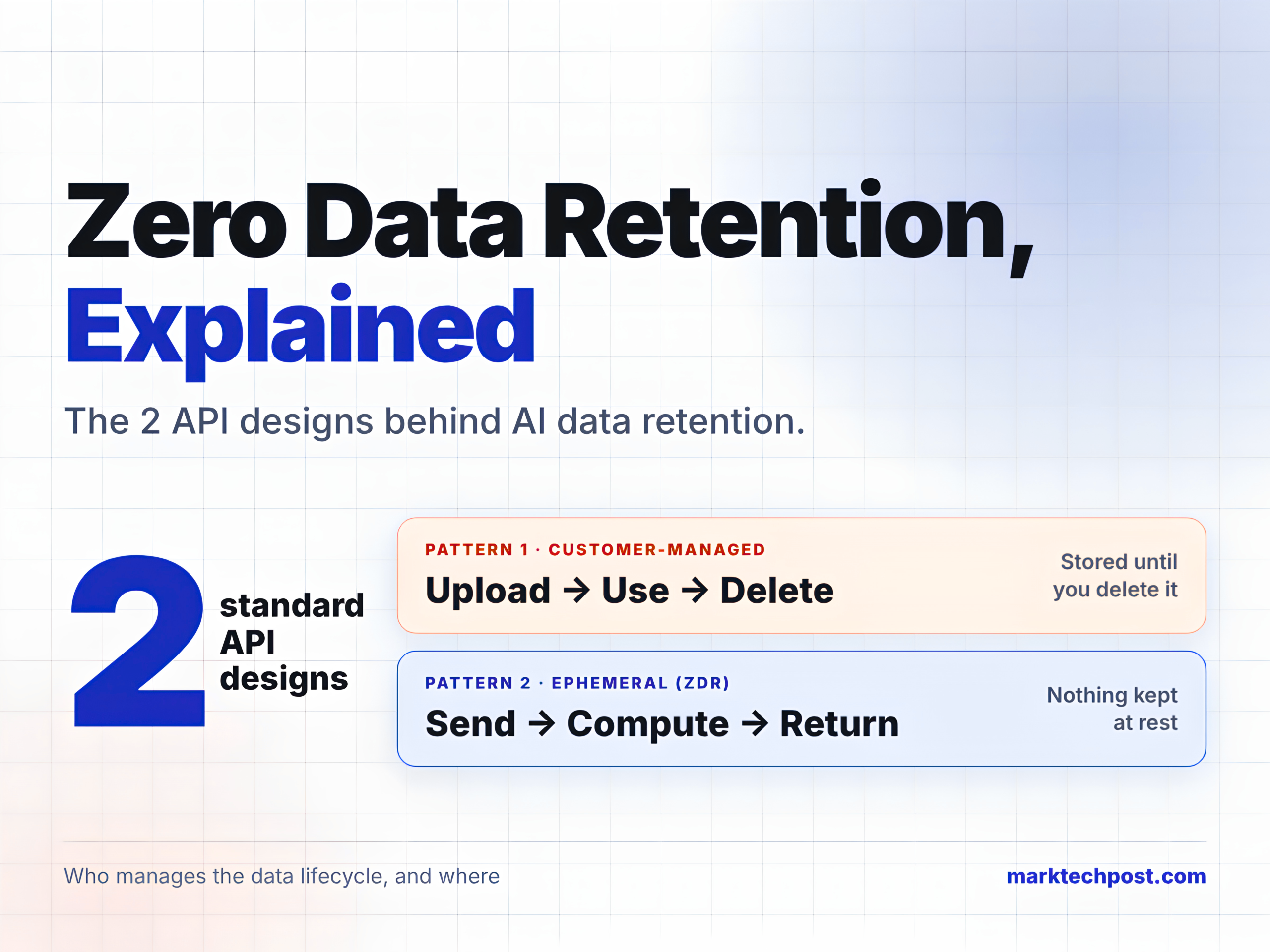
Loading the full article…
This text was published by MarkTechPost and written by Asif Razzaq. It is reproduced here with attribution so you can read it in full; the rights remain with the publisher. Read it at the source ↗
The headline, key points and digest above were generated by Digest AI's editorial model from the linked sources. Automated summaries can contain errors: the sources are the record. Spotted a mistake? Tell us. Published by Martin K., who runs Digest AI and handles corrections.
More in Marketing & Small Business
All →- Google Wallet: Google Search gets more tailored with apps integration · 1 src
- Google introduces Gemini 4 Neon for faster, cheaper deep tasks at 2,900 yen/month · 8 src
- Ao schedules Claude tasks: AI works while he sleeps · 2 src
- Claude verifies 167-year-old math proof · 3 src
- Claude AI adds voice support to Apple CarPlay for iPhone users · 2 src
Comments
via GitHub Discussions