UT Arlington finds CXL memory locks add 3–5µs delays per access
Researchers at the University of Texas at Arlington and Intel tested shared CXL memory pools on four 86-core Intel Xeon 6787P servers, each with 256GB DRAM, connected via PCIe 5.0 to a single CXL memory box.
Key points
- UT Arlington’s test on four servers found CXL memory locks add 3–5 microseconds per access, canceling shared-memory speedups
- BFS benchmarks showed no benefit from shared CXL memory, while hash tables and triangle counting scaled linearly with hosts
- SK hynix and Micron claim CXL KV cache designs offer 2.6x–30x AI performance gains, but software overhead remains unproven
They found that software-managed locks—necessary to prevent data overwrites across servers—introduce a 3–5 microsecond delay per lock acquisition, negating performance gains. The setup lacks cross-host cache coherence and atomic operations, forcing software to handle synchronization, which adds overhead compared to local hardware locks (100 nanoseconds vs. 3.7–132 microseconds median/95th percentile). Breadth-first search (BFS) benchmarks showed no speedup with shared memory, while hash tables and triangle counting scaled linearly or improved by over 50% when adding hosts.
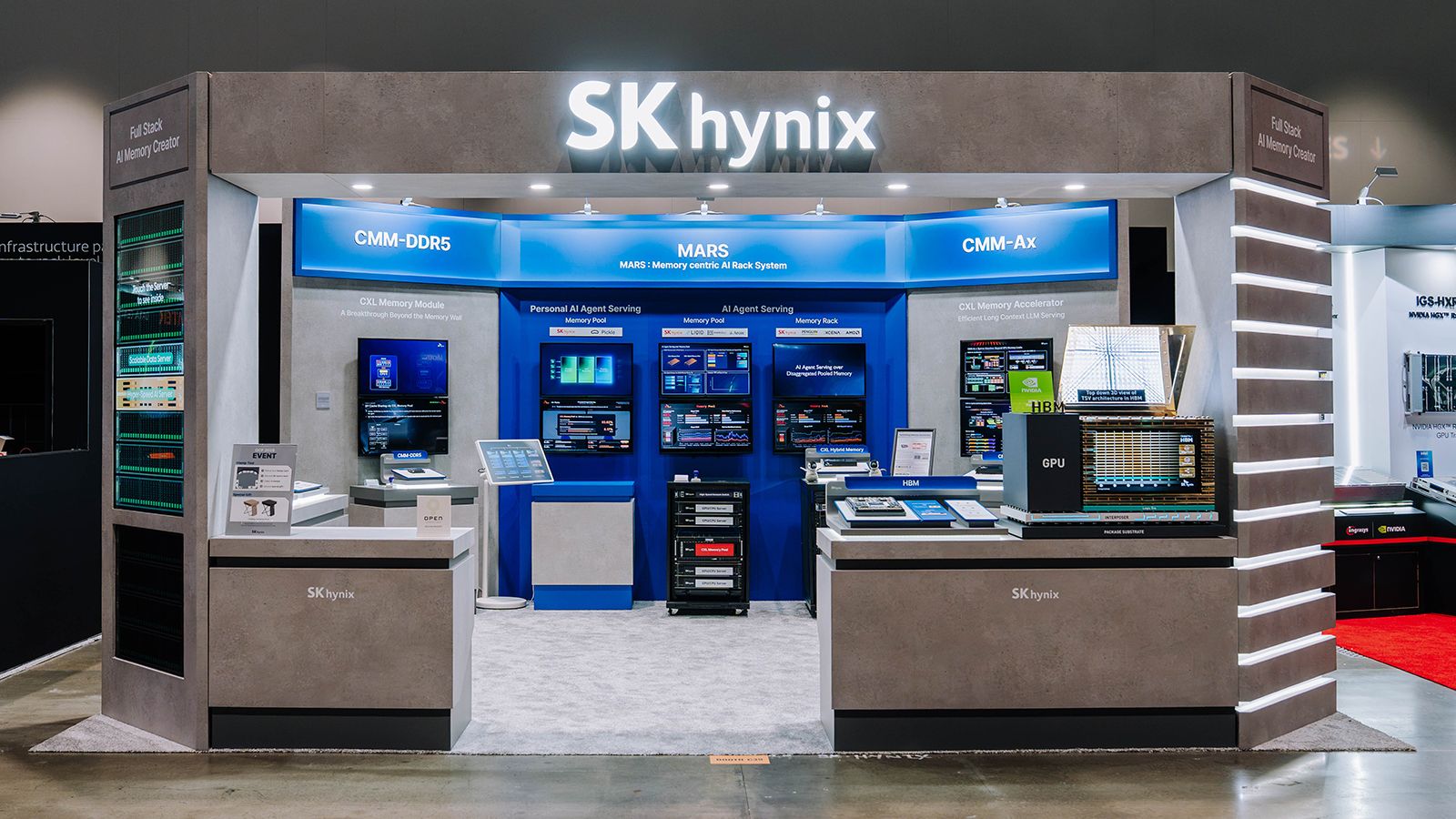
The findings complicate CXL’s potential as a scalable KV cache solution for AI, as cloud providers and GPU makers like SK hynix and Micron have proposed it for handling large context windows. SK hynix claims its design offers 2.6x faster time-to-first-token and 3x lower latency, while Micron’s Abaco reference design promises 10x–30x agentic AI gains. However, UT Arlington’s results highlight software coherence costs, even as hardware fixes like CXL 3.0’s Back-Invalidate remain unconfirmed. Nvidia Research’s Vikram Sharma noted KV cache demand is growing despite efficiency improvements, with context lengths now exceeding millions of tokens. Vendors like Intel and Marvell are exploring optical links for broader pooling, but current CXL implementations face limitations in cross-rack scalability and subtle data corruption risks.
The headline, key points and digest above were generated by Digest AI's editorial model from the linked sources. Automated summaries can contain errors: the sources are the record. Spotted a mistake? Tell us. Published by Martin K., who runs Digest AI and handles corrections.
More in Hardware & Compute
All →- Applied Optoelectronics signs $2.2B AI optics supply deal · 1 src
- OpenAI says its models cut AMD chip design time by a year · 2 src
- OpenAI and Cisco release Shirudo runtime to block AI-driven Linux exploits without reboots · 4 src
- Nothing unveils Ear Note AI earbuds with transcription and agent support · 2 src
- Marlowe raises $277M seed to build AI inference factories with AMD, Etched · 3 src
Comments
via GitHub Discussions