AMD Radeon RX 10800 XT could outperform RTX 5090, insider leaks suggest
Insider leaks attribute massive specifications to AMD's upcoming flagship graphics card, the Radeon RX 10800 XT, which is based on the RDNA 5 microarchitecture. Leaked details suggest the chip could feature up to 200 Compute Units, a 512-bit bus, up to 48 GB of fast GDDR7 memory, and operating frequencies between 3.1 and 3.4 GHz on a 3 nm process. These specifications could allow the card to…
Key points
- Leaked AMD Radeon RX 10800 XT specs include up to 200 Compute Units and 48 GB of GDDR7 memory.
- The card could outperform the NVIDIA RTX 5090 by 15-25% in 4K raster rendering.
- The 48 GB VRAM would enable running Llama 3 70B locally on a single GPU.
For local AI tasks, the rumored 48 GB of video memory would allow users to run large language models like Llama 3 70B directly on a single GPU. This memory capacity would surpass the RTX 5090's reported 32 GB, giving AMD an advantage in processing larger batch sizes and loading complex scenes. However, NVIDIA's upcoming Rubin-based RTX 6090 is expected to retain the lead in absolute graphics power, path tracing, and CUDA-based professional rendering.
Radeon RX 10800 XT can outperform the RTX 5090 by 15-25% in 4K gaming and local AI
en.gamegpu.com · 19 September 2026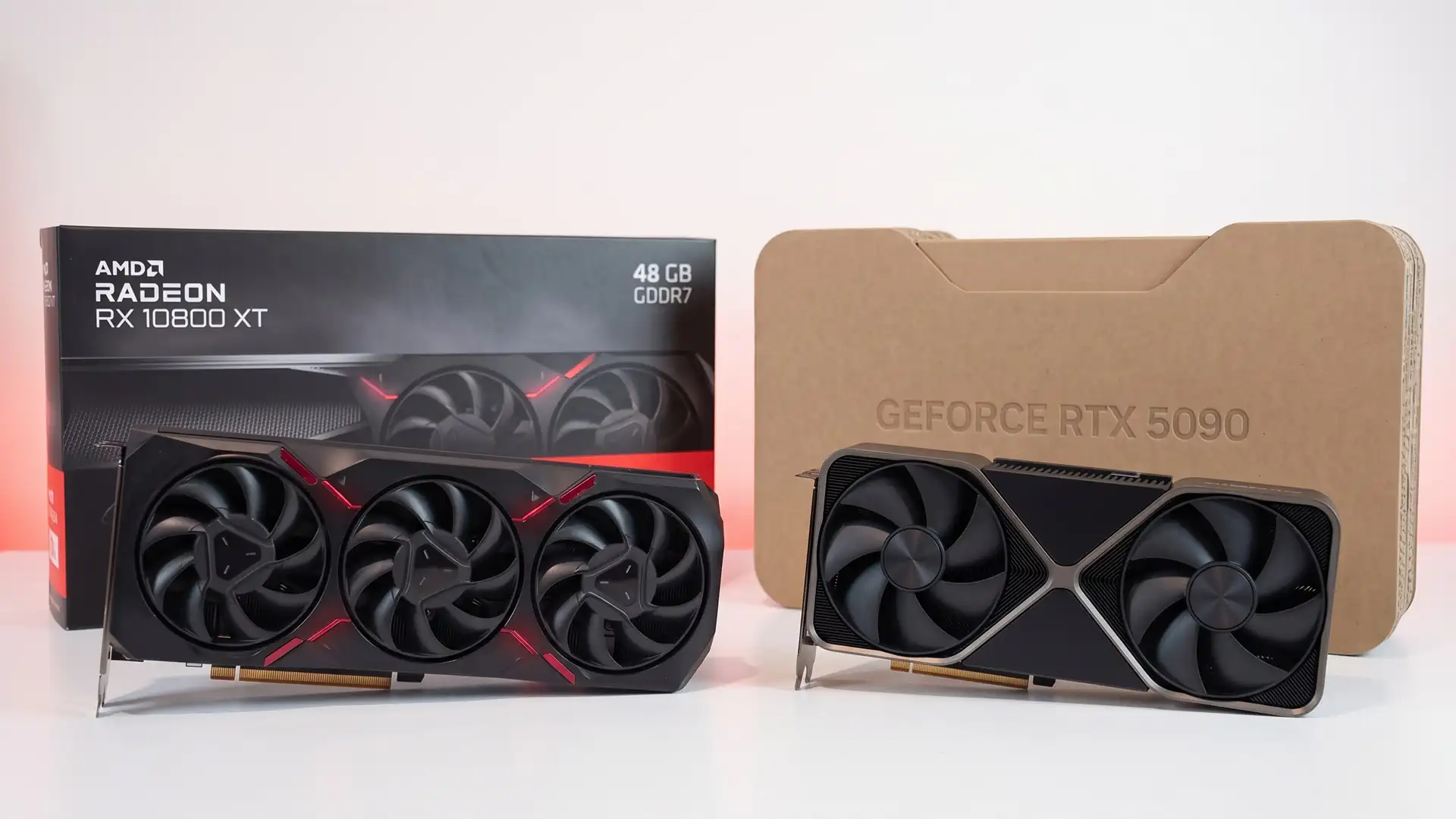
Potential flagship AMD Radeon RX 10800 XT based on microarchitecture RDNA 5 already looks like the company's most ambitious project in the entire history of its graphics division. Insider leaks (from Moore's Law is Dead to Kepler_L2) attribute gigantic specifications to the chip: up to 200 Compute Units (CU), a massive 512-bit bus, up to 48 GB of fast GDDR7 memory, and operating frequencies in the range of 3.1–3.4 GHz on the fresh 3 nm process technology.
Our assessment of the scaling of compute units in the upcoming flagship graphics card AMD Radeon RX 10800 XT architecture RDNA 5 This demonstrates a fundamental difference in the quantitative approach compared to the NVIDIA GeForce RTX 5090 Blackwell-based and RTX 6090 Rubin-based chips. A comprehensive comparison requires considering not only the number of units, but also the internal density of the shader processors and the presence of specialized coprocessors.
The flagship NVIDIA GeForce RTX 5090 graphics card is equipped with the GB202 GPU, configured with 170 active streaming multiprocessors (SMs) out of the 192 physically present on the die. With a standard architecture of 128 CUDA cores per SM, this yields a total of 21,760 FP32 compute cores, supplemented by 170 hardware RT Cores and 680 Tensor Cores. The release of the next-generation NVIDIA GeForce RTX 6090 flagship, based on the Rubin architecture, will raise the bar to 192 active SMs, equivalent to 24,576 CUDA cores.
On the AMD side, it's the flagship chip Radeon RX 10800 XT on the base RDNA 5 The RTX 2090 is targeting 200 Compute Units. With a typical 64 stream processors per unit, this yields a total of 12,800 ALUs. Despite the smaller physical number of base shader cores compared to the RTX 5090's 21,760, AMD's chiplet architecture allows for extremely high operating frequencies of 3.1–3.4 GHz and the deployment of massive Infinity Cache, compensating for the difference in raw FP32 computations.
In traditional raster rendering without ray tracing, 200 CUs running at ultra-high frequencies will give the RX 10800 XT a clear advantage. The enormous fill rate and the bandwidth of the 512-bit GDDR7 memory bus with up to 48 GB will allow AMD's new card to outperform the NVIDIA GeForce RTX 5090 by 15-25% at 4K resolution. However, when compared to the upcoming RTX 6090, the raster performance advantage will be negated, and the Rubin chip with its 192 CUs will outperform the RTX 6090. Radeon RX 10800 XT by 15–20%, although AMD will retain a colossal advantage in energy efficiency.
In ray-traced scenarios, the situation is different. Reworking Ray Accelerators in the architecture RDNA 5 and a two-fold increase in BVH tree processing speed per CU will allow the RX 10800 XT to overcome its weaknesses in games with hybrid Ray Tracing, delivering frame rates on par with the RTX 5090. However, in intensive panoramic path tracing, the flagship RTX 6090 will remain untouchable, as NVIDIA's dedicated fifth-generation RT cores will provide a 35-50% advantage over AMD. Regarding AI scaling, the integration of Wave Matrix units within 200 CUs will enable full-fledged neural network-based FSR frame generation, bringing image quality closer to DLSS, although the isolated Tensor Cores in the RTX 6090 will still retain lower latency.
In professional 3D rendering software with CUDA and OptiX support, NVIDIA cards will maintain their lead in final rendering speed. However, when working with ROCm or HIP, the massive 48 GB of GDDR7 memory gives the RX 10800 XT a huge advantage, allowing it to load heavy 8K textures and complex geometric scenes into local memory, which would otherwise crash due to the RTX 5090's 32 GB of memory. When processing video and working in Unreal Engine 5 The 512-bit bus and dual VCN media engine will ensure smooth editing of high-definition RAW sources without creating proxies and will speed up Nanite geometry compilation. For local AI tasks, 48 GB of video memory will allow running large language models like Llama 3 70B directly on a single GPU. GPU, leaving the RTX 5090 behind in terms of the size of the batches processed.
With a massive 200 CU array, high frequency efficiency and 48GB of VRAM, the flagship graphics card AMD Radeon The RX 10800 XT will confidently outperform the NVIDIA GeForce RTX 5090 with its 170 SMs in classic games, video editing, and heavy local neural network workloads. AMD's new product won't be able to catch the NVIDIA GeForce RTX 6090, as its Rubin architecture will maintain its lead thanks to a combination of 192 dedicated SMs and significantly greater performance from dedicated RT and Tensor cores in the most complex tasks. Path Tracing and CUDA computing. Ultimately, the RX 10800 XT will directly compete with the RTX 5090 in terms of raster speed and memory capacity, but the RTX 6090 will continue to occupy the top spot in absolute graphics power.
This text was published by en.gamegpu.com and written by Maxim Boldson. It is reproduced here with attribution so you can read it in full; the rights remain with the publisher. Read it at the source ↗
Coverage and discussion
1source- Reddit discussionreddit.com
The headline, key points and digest above were generated by Digest AI's editorial model from the linked sources. Automated summaries can contain errors: the sources are the record. Spotted a mistake? Tell us.
More in Hardware & Compute
All →- Petlibro launches Granary 2 AI feeder series for multi‑cat homes · 1 src
- Valve releases Steam Frame VR headset that works as standalone and PC device · 1 src
- Meta develops camera-free 'Luna' smart glasses to address privacy concerns · 4 src
- Apple launches iPhone 18 Pro and Pro Max worldwide as CEO John Ternus greets fans · 2 src
- Apple intelligence in iOS 27 needs up to 14 GB on iPhone 17 Pro models · 1 src
Comments
via GitHub Discussions