Analog Devices outlines challenges for physical AI in new report
Analog Devices Inc. (ADI) published a whitepaper titled “The Race to Make AI Physical,” describing the shift from purely digital AI to systems that must sense, decide, and act in the real world. The company says physical AI faces imperfect measurements, timing constraints, changing conditions, and the consequences of action, requiring advances not just in model performance but also in sensing,…
Key points
- ADI released a whitepaper called “The Race to Make AI Physical”.
- Physical AI demands advances in sensing, simulation, computing, connectivity, and control beyond model performance.
- ADI says its semiconductors support automation, robotics, mobility, healthcare, energy, and data centers.
ADI argues that the technologies enabling success often sit beneath the application layer, such as rules that shut down a machine when vibration exceeds a limit versus judgment‑level systems that detect bearing wear and adjust proactively. The report positions physical AI as a key focus for manufacturing, automation, robotics, mobility, healthcare, energy, and data centers, and notes ADI’s participation in RoboBusiness 2026 and its Robotics Startup Boot Camp.
The story so far
2 episodes →- Analog Devices outlines challenges for physical AI in new reportthis story
ADI explains the race to make AI physical
The Robot Report · 17 October 2026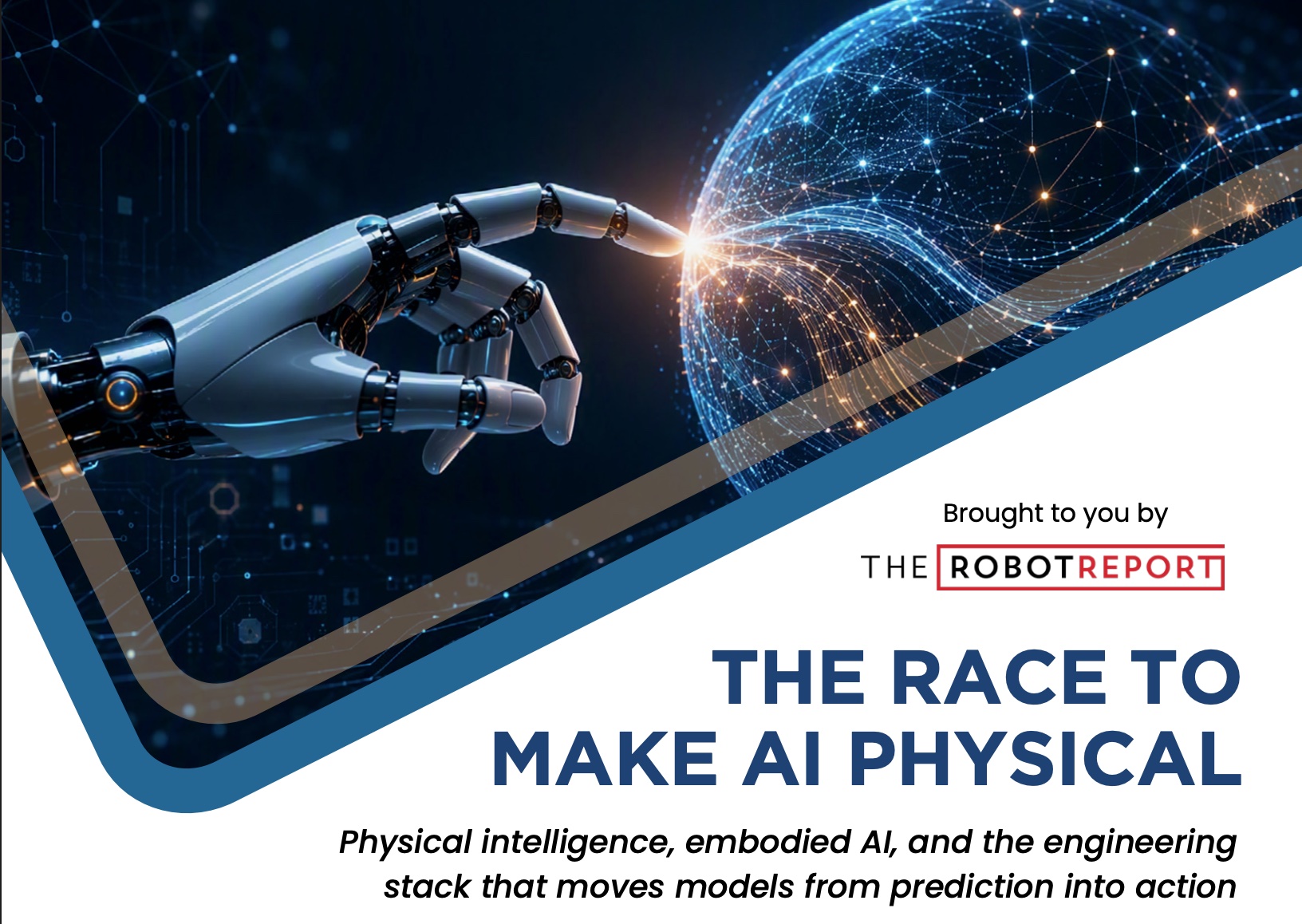
Loading the full article…
This text was published by The Robot Report and written by The Robot Report Staff. It is reproduced here with attribution so you can read it in full; the rights remain with the publisher. Read it at the source ↗
The headline, key points and digest above were generated by Digest AI's editorial model from the linked sources. Automated summaries can contain errors: the sources are the record. Spotted a mistake? Tell us. Published by Martin K., who runs Digest AI and handles corrections.
More in Research
All →- Decomp.dev shuts public index and leaderboard amid AI misuse · 2 src
- Gen-Verse releases DiscoveryRSI-27B for scientific hypothesis generation · 1 src
- New study finds AI struggles to correct false claims clearly across languages · 2 src
- Shanghai AI Lab’s Shusheng‑S2 aids reported proof of three‑dimensional Ghys conjecture · 1 src
- OpenAI fails to prove Navier-Stokes, mathematicians claim · 1 src
Comments
via GitHub Discussions