Article outlines five practices for building robust Python AI libraries
The article from KDnuggets details five best practices for creating production-ready Python AI libraries. It highlights common pitfalls like unhandled API errors, bloated dependencies, and unreliable model outputs. The author emphasizes schema-first design, testing at the model boundary, optional dependencies, resilience for external calls, and automated quality gates as key solutions. Each…
Key points
- Schema-first design prevents raw model outputs from reaching callers, using Pydantic for validation and structured responses
- Testing focuses on prompt construction and parsing, not model outputs, to avoid flaky tests tied to provider behavior
- Optional dependencies via `pyproject.toml` extras isolate heavy frameworks like `torch` or `transformers` for specific use cases
5 Best Practices for Building Robust Python AI Libraries
KDnuggets · 6 October 2026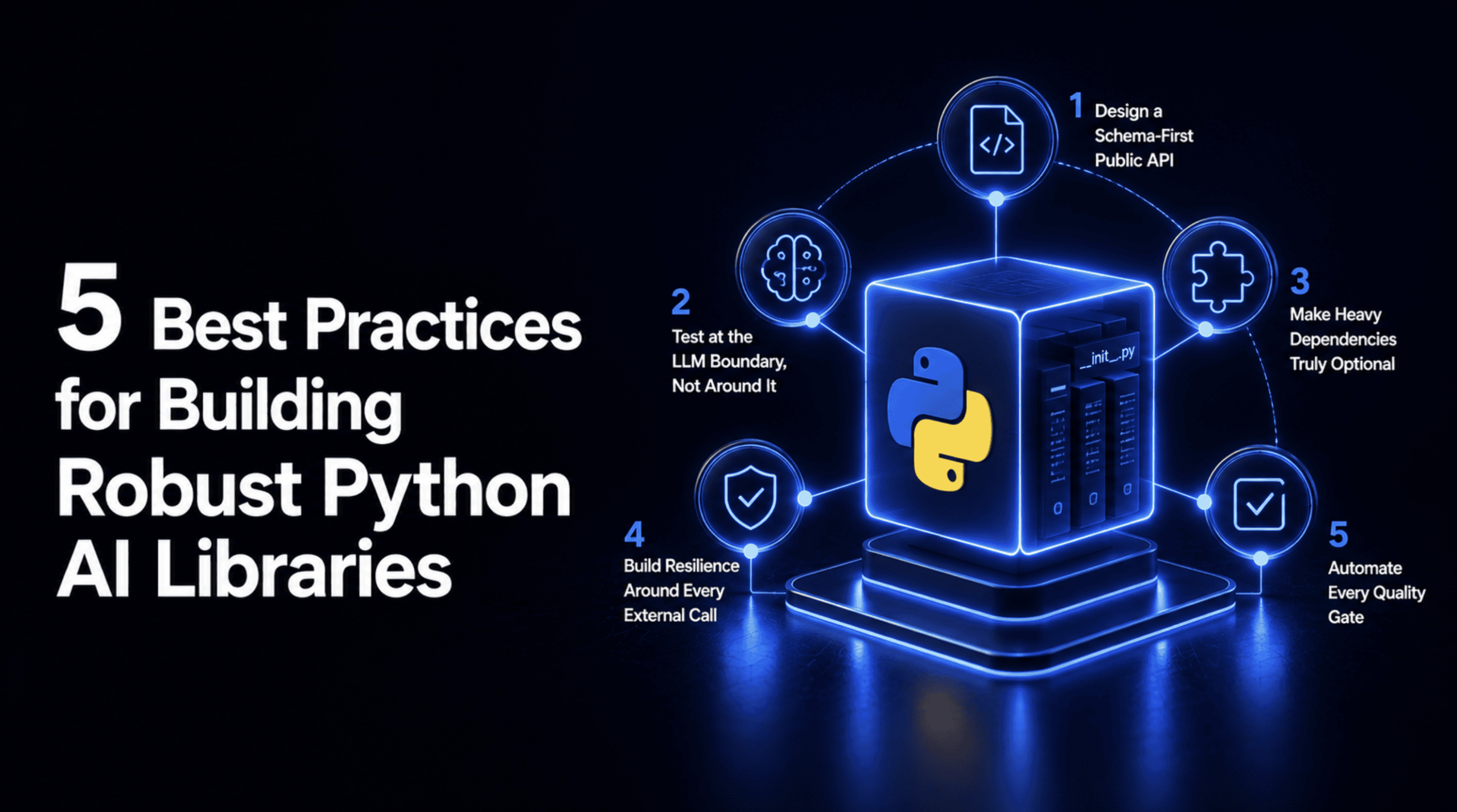
Loading the full article…
This text was published by KDnuggets and written by Shittu Olumide. It is reproduced here with attribution so you can read it in full; the rights remain with the publisher. Read it at the source ↗
The headline, key points and digest above were generated by Digest AI's editorial model from the linked sources. Automated summaries can contain errors: the sources are the record. Spotted a mistake? Tell us. Published by Martin K., who runs Digest AI and handles corrections.
More in Research
All →- PyTorch tutorial shows how to cut drone data usage by 94% · 1 src
- Vector databases explain how AI retrieves similar data at scale · 1 src
- PhAI Labs introduces JEPA-Anything framework for cross-domain world models · 2 src
- Researchers introduce VIMA for finding disease patterns in tissue data · 2 src
- AI may create scientific monocultures, researchers warn · 1 src
Comments
via GitHub Discussions